
WASHINGTON — The marathon negotiations between the United States and Iran in Pakistan didn’t lead to a peace deal, but American leadership came away with one major conclusion: Iran is delusional about its standing in negotiations.
Vice President JD Vance will soon arrive back in Washington, and President Donald Trump has upped the ante declaring a complete blockade of the Strait of Hormuz.
The negotiations helped the United States understand just how little Iran understood their situation, U.S. officials told The Daily Wire. Iran failed to recognize the reality of the situation on the ground, the officials say, and has not come to terms with the fact that its inability to ever have a nuclear weapon is a primary American objective.
A U.S. official said that Vance entered the negotiations well-aware that the United States and Iran had hardly interacted with one another for half a century. Vance went into the 21 hours of negotiations with plans to test the counterparties and assess what they believed their situation was.
Vance probed their vulnerabilities, and Trump is now testing those vulnerabilities, the official said, and the world will see whether the Iranians recognize reality.
After Vance’s departure, Trump announced that the United States would blockade the Strait because Iran had refused to commit to abandoning its nuclear program. The president shared that he had been fully briefed by the vice president, and said that the U.S. Navy would begin its blockade of the Strait of Hormuz and targeting vessels that attempt to enter or exit, as well as identify vessels that have paid what he described as “illegal” tolls to Iran.
“The meeting with Iran began early in the morning, and lasted throughout the night — Close to 20 hours. I could go into great detail, and talk about much that has been gotten but, there is only one thing that matters — IRAN IS UNWILLING TO GIVE UP ITS NUCLEAR AMBITIONS,” the president said.
“In many ways, the points that were agreed to are better than us continuing our Military Operations to conclusion, but all of those points don’t matter compared to allowing Nuclear Power to be in the hands of such volatile, difficult, unpredictable people.”
One of the vice president’s main goals, heading into the talks, was for both the United States and Iran to get to a mutual understanding on each country’s objectives and their “negotiating space,” the first U.S. official explained. Though the conversations were tough, the official said, by the end, the negotiators had completed a productive exchange of proposals.
It became clear from the outset that the Iranians weren’t grasping the core objective of the United States: any deal would have to center on the fact that Iran can not ever obtain a nuclear weapon. Vance corrected this misunderstanding during the deliberations, the official shared, and when the vice president left Islamabad, he had offered Iran the best and final offer that worked for both parties.
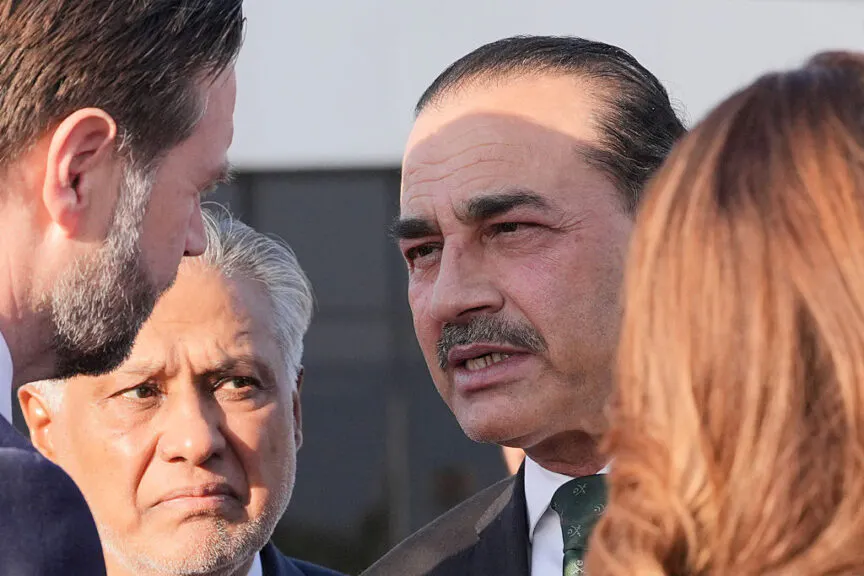
US Vice President JD Vance (L) talks to Pakistan’s Chief of Defence Forces and Chief of Army Staff Field Marshall Asim Munir (R) and Pakistan’s Deputy Prime Minister and Foreign Minister Mohammad Ishaq Dar (C) before boarding Air Force Two after attending talks on Iran in Islamabad on April 12, 2026. (Photo by Jacquelyn MARTIN / POOL / AFP via Getty Images)
Vance also believed that deal should be acceptable to the Iranians and said publicly that he hopes they will accept it.
Another key point of the weekend negotiations: Vance probed the Iranian assessment of their own position and discovered that they fundamentally misunderstood their own position walking into the negotiations. That was why the vice president left Islamabad after he gave that final offer: if the Iranians believe they have leverage that they do not have, the official said, no deal is achievable.
And before they are ready to entertain a serious offer, the Iranians need to recognize that the realities on the ground in Iran do not match their assumptions heading into the negotiations.
“The simple fact is that we need to see an affirmative commitment that they will not seek a nuclear weapon, and they will not seek the tools that would enable them to quickly achieve a nuclear weapon,” Vance told reporters as he departed Pakistan. “That is the core goal of the president of the United States. And that’s what we’ve tried to achieve through these negotiations.”
“We leave here, and we leave here with a very simple proposal, a method of understanding that is our final and best offer. We’ll see if the Iranians accept it.”
The White House national security team has come up with a plan, in consultation with the president, intended to break the Iranian closure of the Strait of Hormuz and, at the same time, challenge the idea that the Strait of Hormuz can distract from the main issue: Iran’s nuclear program. The vice president is hopeful that Iran recognizes that the deal they have been presented is in both parties’ interest, the official said.
A separate U.S. official outlined the United States red lines to The Daily Wire: Iran must end all uranium enrichment, dismantle all major nuclear enrichment facilities, retrieve highly enriched uranium, accept a broader peace, security and de-escalation framework that includes regional allies, end funding for the terrorist proxies Hamas, Hezbollah, and the Houthis, and fully open the Strait of Hormuz, charging no tolls for passage.
There is a deal still on the table, the U.S. official noted, and the vice president’s statement emphasized that. It now remains up to the Iranians whether or not they accept it.
.png)
.png)

