 Brad Schaeffer
Editor’s note: This is the first in a four-part weekend series on the hunt for the Bismarck, coming up on its 85th anniversary this month.
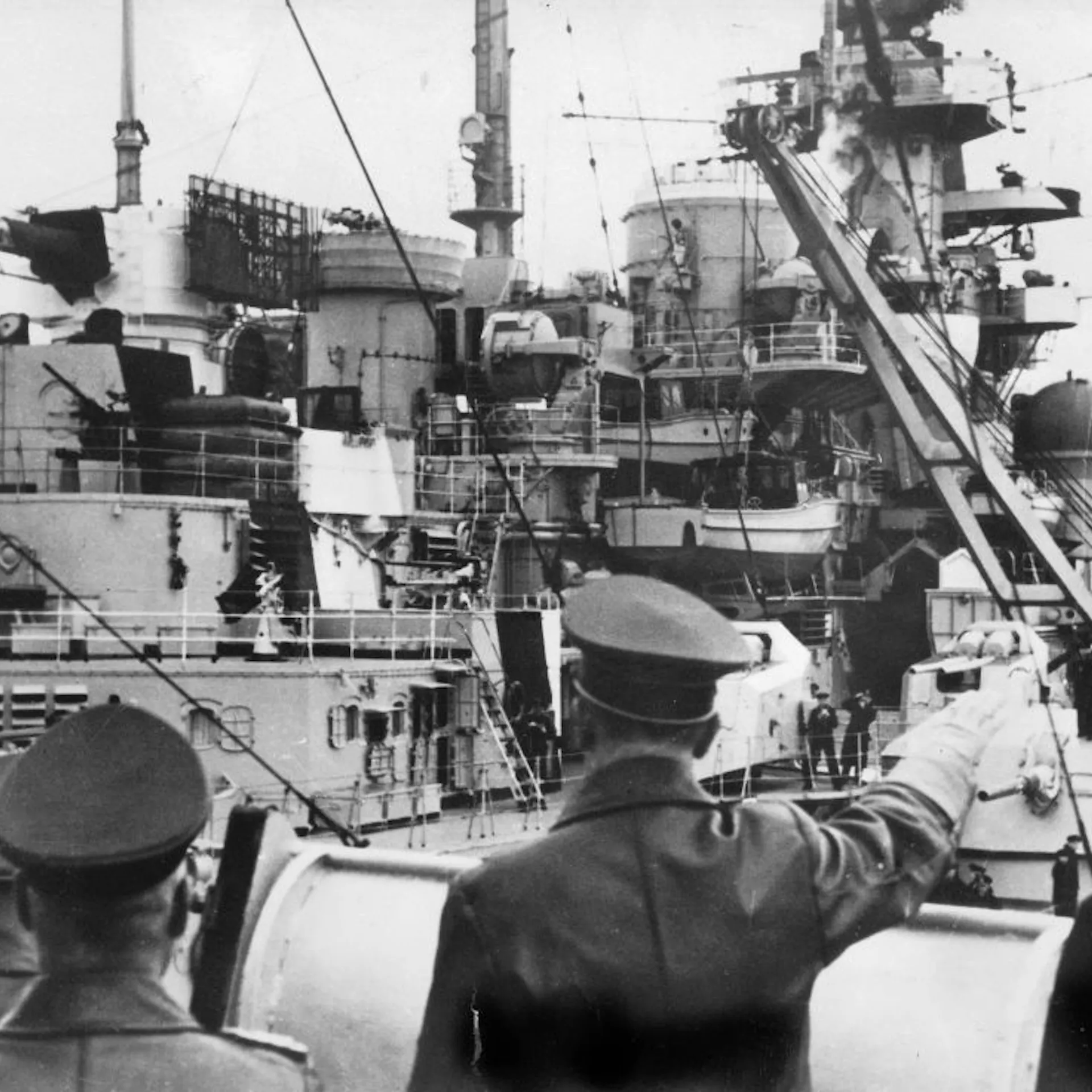
On Valentine’s Day 1939, Adolf Hitler visited Hamburg’s Blohm & Voss shipyard. He was there to preside over the christening of Germany’s newest battleship. Dorothee von Löwenfeld, granddaughter of Otto von Bismarck, the father of the modern German superstate, broke a champagne bottle over the bow while movie cameras rolled and flashbulbs popped. To the cheers of 60,000 spectators, the hull of the mighty vessel, named in honor of her illustrious grandfather, slid into the launch basin while bands played martial hymns. After a speech exhorting Bismarck’s crew to prove themselves worthy to serve on the namesake of the “Iron Chancellor,” Hitler departed, confident that Germany’s resurgence as a sea power had moved another step closer to addressing the imbalance between the Kriegsmarine and its future adversary, Great Britain’s Royal Navy.
Bismarck was a leviathan. 823 feet long and 118 feet wide at the beam, she had truly gorgeous lines. The newsreels announced that Germany’s newest battleship displaced 35,000 tons, which was the treaty limit. But with war clouds rumbling, Hitler had no interest in honoring mere parchment. When fully loaded, Bismarck would actually displace just shy of 51,000 tons. And she bristled with awesome firepower. Four turrets, two fore and two aft, housed eight 15-inch main guns in twin batteries that could hurl a 1,800-pound shell over 20 miles. These monster weapons were complemented by 12 5.9-inch secondary guns and an array of small-caliber anti-aircraft batteries.
It was still a time when battleships were considered the apex predators of any fleet. And Bismarck was the very embodiment of naval power. Yet as impressive as she was, Bismarck was among only a handful of warships Germany had produced since ignominiously surrendering the High Seas Fleet in 1918 as a condition of the Armistice that ended the First World War. Before then, Germany and Great Britain had been at rough naval parity — their largest sea battle, Jutland in 1916, was a tactical draw. But now, for every ship Hitler could send out to sea, the British could counter with 10. The Führer had assured his navy that he would not go to war before 1945, giving them ample time to close the tonnage gap. The Kriegsmarine head, Grand Admiral Erich Raeder, believed that to fight sooner would spell disaster for the fleet, stating, “The best they could hope to demonstrate was their ability to die gallantly.”
And yet, when in May 1941 a commissioned, manned, and loaded Bismarck set out on her first sortie, war had already been raging for almost two years. Raeder understood the Kriegsmarine could not fight the much larger Royal Navy head-to-head. Rather, they would engage in commerce warfare — attack the cargo convoys steaming from North America to Britain, upon which the latter depended for its very survival. Bismarck’s mission, called Operation Rheinübung (“Exercise Rhine”), was to break out into the Atlantic where she could disappear into the vastness of the open ocean.
Once on the prowl, such a dangerous weapon could wreak havoc on merchant shipping and sever Britain’s supply lifeline, starving the island nation into submission. Indeed, four smaller surface raiders — Scharnhorst, Gneisenau, Hipper, and Scheer — had already sent 50 merchant ships to the bottom. The British Admiralty, and especially Winston Churchill, who always feared strangulation before invasion, understood the danger. Bismarck had to be stopped.
On May 18, 1941, Bismarck, along with the heavy cruiser Prinz Eugen, set sail from then-Gotenhafen and made her way to a Norwegian fjord near Bergen. Bismarck was under the command of Captain Ernst Lindemann, a capable seaman respected by his 2,283-man crew. But he shared the bridge with the overall operation commander, Admiral Günther Lütjens, and was compelled to defer to his authority. Unlike Lindemann, Lütjens was unpopular with the men, who found him dour, fatalistic, even something of a Jonah. Nevertheless, the admiral would do his best to slip into the North Sea and head for the hunting grounds of the Atlantic.
Aware that if word got to the British that he was aiming for the open ocean they would try to intercept him, Lütjens had hoped to make the passage through the narrow Scandinavian waters in secret. But Norwegian resistance, as well as a Swedish vessel, alerted British intelligence that the mightiest battleship in service was on the move. On May 21, an overflying Spitfire reconnaissance fighter photographed the two warships while briefly at anchor in the fjord. During the pause, Prinz Eugen took the opportunity to top off her fuel, but Lütjens failed to do the same with Bismarck. Unaware they’d been spotted, the warships weighed anchor on May 22 and made for the Atlantic.
It was only after the ships were underway that the German naval high command informed the Führer of the operation. Raeder feared he might get cold feet at the prospect of risking such an expensive and prestigious weapon. Hitler was already wary of the Kriegsmarine. Not only did the former infantryman have little interest in naval warfare, but it was also the least Nazified of the armed services — they eschewed the Nazi salute and even kept on Jewish officers. After a contentious discussion, Hitler grudgingly approved the mission post facto, adding, “I have a bad feeling about this.”
At the same time, Bismarck entered the Norwegian Sea, Admiral John Tovey aboard the battleship HMS King George V at Scapa Flow — the Royal Navy’s Home Fleet base in northern Scotland — was working to coordinate an intercept once reconnaissance revealed Bismarck’s movements. But what passage into the ocean would she choose? Lütjens had several paths available to him to break into the open sea. The route he chose was the Denmark Strait, between Iceland and Greenland. Though narrow, it offered a direct route to the shipping lanes and was often covered in heavy fog. For nearly two days, Bismarck and Prinz Eugen steamed towards the strait, cloaked in a thick haze. But by late Friday afternoon, May 23, the skies cleared, revealing the stunning iron-green expanse of the Arctic waters.
The cruiser HMS Suffolk was patrolling the Denmark Strait searching for the Germans. Due to ice flows and mines, the navigable section she crisscrossed was just 40 miles wide. At 7:22 p.m. on May 23, the two German vessels appeared on Suffolk’s radar and then suddenly emerged out of the mist on a horizon still under sunlight at these latitudes. Suffolk’s lookouts reported: ONE BATTLESHIP ONE CRUISER IN SIGHT. The British warship slipped into a fog bank before Bismarck could fire.
Fifteen miles away, another cruiser, Norfolk, raced in to help track her. But Norfolk charged out of the mist just six miles from Bismarck, dangerously close. As the cruiser turned hard over to get away, the German battleship rotated her turrets, the barrels fingered skyward, and for the first time she fired her main guns in anger. The shells screamed overhead until huge geysers erupted around the fleeing British warship. Norfolk took splinters from a near-miss, but she survived. Both cruisers then maneuvered out of gun range to get behind and track the two German ships, doggedly staying with them through heavy seas and frigid spray despite their targets’ attempts to shake them.
The cruisers’ job was not to engage the larger enemy vessels but to stay with the Germans like terriers and track them by radar until the larger capital ships arrived. Two powerful British warships with escorting destroyers were, in fact, racing towards the Denmark Strait to plug the gap while Tovey gathered his scattered assets. One was the newest battleship in the fleet, Prince of Wales. The other was the pride of the Royal Navy, the battlecruiser Hood. After steaming through the night, the British warships were approaching Bismarck from the southeast. It was 5:25 a.m. on May 24 when they spotted the ominous silhouettes of the German vessels as dots making smoke on the horizon.
On board the trailing destroyer Electra, confidence abounded. Contemplating Hood’s enormous yet graceful lines off the quarter, one sailor predicted: “Jerry’s going to have a bit of a shock when he sees her ahead of him!”
He wasn’t wrong. At the same time, on Bismarck, Lieutenant Commander Conrad von Müllenheim-Rechberg recalled the nervous anxiety throughout the crew when at 5:30 a.m. an enemy ship appeared: “At first, we didn’t know who’d come out. Was it a cruiser? Then it got bigger and bigger coming over the horizon. And the second gunnery officer with his powerful binoculars said, ‘Oh no! It’s the Hood! The Hood!’ The terror of our wargames.” Down in Bismarck’s boiler room teenaged Fireman 3rd Class Johannes Zimmerman was told to prepare to engage the Hood, and he thought, “What, are they crazy? They’re going to hold a wargame now?”
But this was no game. As the two flotillas closed the range, one of the most dramatic and tragic naval engagements in history was about to begin.
***
Brad Schaeffer is a commodities fund manager, author, and columnist whose articles have appeared on the pages of The Wall Street Journal, NY Post, NY Daily News, The Daily Wire, National Review, The Hill, The Federalist, Zerohedge, and other outlets. He is the author of three books. You can also follow him on Substack and X. His latest book, “A War For Half The World: Why the Real Battle for the Future was Fought in the Pacific,” will be released in February 2027.
.png)
.png)