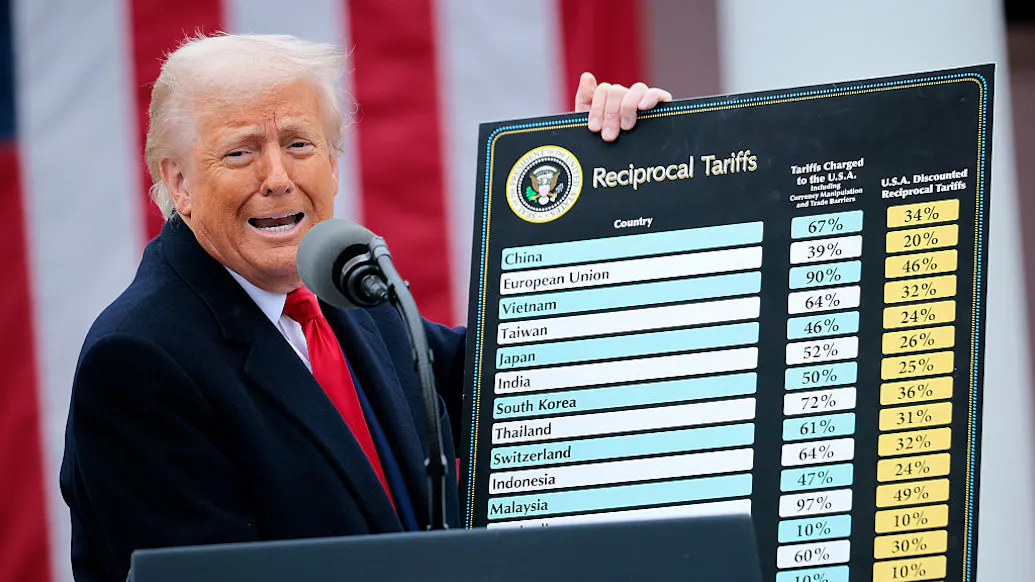
The Supreme Court delivered a long-awaited decision on Friday, striking down President Trump’s sweeping International Emergency Economic Powers Act (IEEPA) tariffs. But while the court ruled on the legality of the tariffs themselves, it did not address whether the United States must refund more than $200 billion in revenue already collected.
“The court’s decision is likely to generate other serious practical consequences in the near term. One issue will be refunds,” dissenting Supreme Court Justice Brett Kavanaugh wrote. “Refunds of billions of dollars would have significant consequences for the U.S. Treasury.”
Ruling only on the narrow legal question before them, the court did not establish a framework for refunds. Such a framework will likely be established by lower courts, particularly the United States Court of International Trade, which ruled against Trump’s tariff decision.
In response to the Supreme Court decision, President Trump said, “They take months and months to write an opinion, and they don’t even discuss that point. We’ve taken in hundreds of billions of dollars … wouldn’t you think they’d put one sentence in there saying keep the money or don’t keep the money?”
If refunds are ultimately required, the United States Treasury would be tasked with reimbursing importers for the levies they incurred — a process Kavanaugh deemed a “mess,” as refunds could be required to be issued to foreign nations, consumers, and manufacturers depending on court outcomes.
The president of the Committee for a Responsible Federal Budget, Maya MacGuineas, said that with the federal deficit in mind, the ruling was very bad news: “With today’s Supreme Court ruling affirming the illegality of President Trump’s emergency tariffs, the country will now be about $2 trillion deeper in the hole. With the national debt already the size of the entire U.S. economy and interest on the debt costing more than $1 trillion this year, this is very bad news. Congress should work quickly to fill that hole.”
She added, “We are in a dismal fiscal situation, and it just got worse.”
Treasury Secretary Scott Bessent said the $200 billion in tariff revenue could be used to shrink the $2 trillion deficit and pay down the $36 trillion debt.
Beyond budgetary concerns, the ruling could impact Trump’s broader use of tariffs as a foreign policy tool during negotiations. In February, he threatened to impose tariffs on countries that do business with Iran, citing the country’s repression of protesters, support for proxy terrorist groups, and continued pursuit of nuclear capabilities. In May, the president warned China that tariffs would increase if the country continued not to ship rare earth minerals to the United States — materials used in products ranging from household appliances and automobiles to semiconductors for artificial intelligence chips.
In addition to bringing back jobs and supply chains to the United States, Trump argues he needs tariffs to address a national security concern: the hollowing out of the manufacturing base. In an executive order signed on Liberation Day, Trump explained that the inability to scale advanced manufacturing undermines “critical supply chains; and rendered our defense-industrial base dependent on foreign adversaries.”
At a White House press conference on Friday, the president confirmed he will continue issuing tariffs under authorities granted to him through Section 232, rather than relying on the broader emergency powers provided under the International Emergency Economic Powers Act (IEEPA).
.png)
.png)