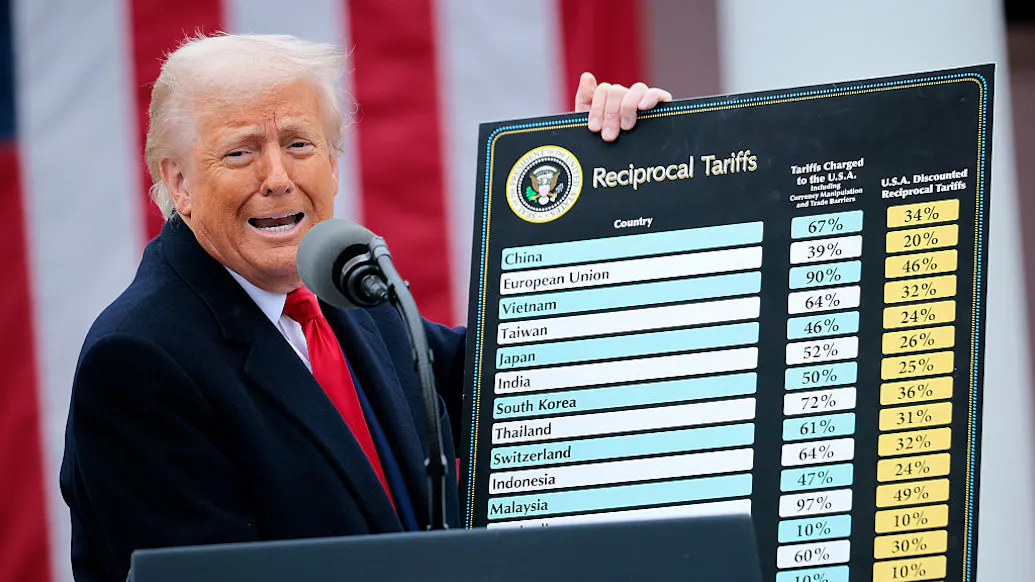
The Supreme Court ruled on Friday that President Donald Trump exceeded his constitutional authority when he used the International Economic Emergency Powers Act to impose sweeping tariffs on most of the world.
In a long-anticipated decision, the court ruled 6-3 that Trump’s justification for the tariffs under the Emergency Powers Act went “beyond the President’s legitimate reach.” Chief Justice John Roberts was joined in the majority opinion by the three liberal justices, along with Trump-appointed Justices Amy Coney Barrett and Neil Gorsuch. Conservative Justices Clarence Thomas, Samuel Alito, and Brett Kavanaugh dissented.
The court rebuked Trump’s use of the International Economic Emergency Powers Act, or IEEPA, stating that the act passed by Congress in 1977 makes no mention of “tariffs” or “duties” in the “lengthy list of powers” given to the president.
“That omission is notable in light of the significant but specific powers Congress did go to the trouble of naming. It stands to reason that had Congress intended to convey the distinct and extraordinary power to impose tariffs, it would have done so expressly—as it consistently has in other tariff statutes,” the Supreme Court stated.
“We hold that IEEPA does not authorize the president to impose tariffs,” the majority added in the opinion written by Roberts.
Not all of Trump’s tariffs were struck down in the decision, as the president did not invoke the International Emergency Economic Powers Act to impose certain tariffs on aluminum and steel. Trump’s so-called reciprocal tariffs on most of the world, including massive duties on China, are affected by the high court’s decision. Trump’s 25% tariffs on Canada and Mexico over their failure to prevent fentanyl trafficking are also affected.
While the ruling is a loss for Trump, the White House believes there are other avenues for Trump to keep his tariffs in place. Treasury Secretary Scott Bessent said in December that the president has three other avenues to impose the wide-ranging tariffs, pointing to provisions in the 1962 Trade Act that the administration could use to “recreate the exact tariff structure.”
Still, the International Emergency Economic Powers Act was the most effective way to impose global tariffs, according to Bessent.
“There are lots of other authorities that can be used, but IEEPA is by far the cleanest, and it gives the US and the president the most negotiating authority,” he said. “The others are more cumbersome, but they can be effective.”
Leading up to the decision, Trump warned of significant damage to the United States if the Supreme Court ruled against him. In a Truth Social post earlier this week, the president wrote, “Because of Tariffs, our Country is financially, AND FROM A NATIONAL SECURITY STANDPOINT, FAR STRONGER AND MORE RESPECTED THAN EVER BEFORE.”
The president has used the tariffs as leverage to urge companies to invest in U.S. manufacturing and to pressure foreign governments to negotiate with the United States on foreign policy and peace proposals.
A key question at the center of Friday’s decision was whether Trump’s tariffs should be considered a tax, pitting Trump’s foreign policy and economic agenda against Congress’ authority over taxation.
Trump’s “reciprocal tariffs” were challenged by multiple companies, including Costco, which filed lawsuits in federal courts, arguing that the tariffs would force them to significantly raise prices to continue importing the goods they offer their customers. The case made its way to the Supreme Court after the United States Court of Appeals for the Federal Circuit ruled in August that Trump’s use of the International Emergency Economic Powers Act to impose tariffs violated the Constitution.
Trump was the first president to use the International Emergency Economic Powers Act to impose tariffs. Since its enactment in 1977, the law has been used by presidents to sanction foreign adversaries and terrorist regimes.
Trump’s Solicitor General, John Sauer, argued before the court in November that national emergencies related to the fentanyl crisis and America’s declining industrial base justify Trump’s use of the International Emergency Economic Powers Act to impose tariffs.
“President Trump has declared that these emergencies are country killing and not sustainable, that they threaten the bedrock of our national and economic security, and that fixing them will make America a strong, financially viable, and respected country again,” he said in his opening argument. “Due to IEEPA tariffs, President Trump has negotiated agreements worth trillions of dollars with major trading partners, including most recently China.”
.png)
.png)