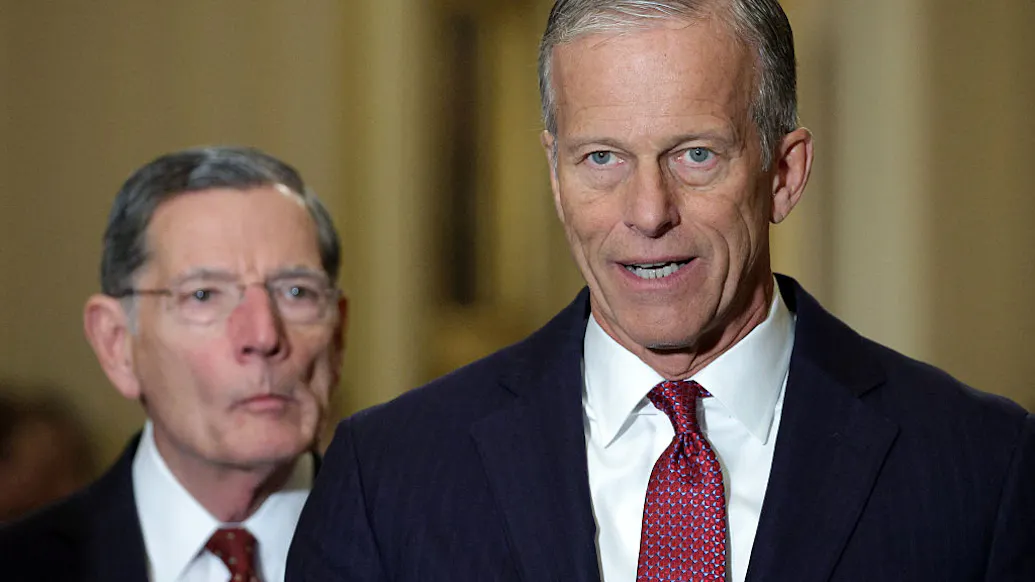
Senate Majority Leader John Thune (R-SD) announced Wednesday that Republicans intend to overhaul the Safeguard American Voter Eligibility (SAVE) Act to include a mandatory photo identification requirement for federal elections. GOP leadership says the change is intended to close what they view as a significant gap in existing election integrity laws.
While the original version of the SAVE Act, which passed the House in April 2025, focused primarily on requiring documentary proof of citizenship (DPOC) at the point of voter registration, Thune noted that it lacked a specific requirement for photo identification at the polling place.
“I cosponsored the SAFE Act in the past; my understanding is that they are still modifying the bill,” Thune told reporters. “It includes, right now, a requirement that you be a citizen to register to vote but it doesn’t include a requirement that to vote you be a resident. So, in other words, if you’re going to have what we call voter ID, photo ID, when somebody goes into the ballot box to vote, that’s not currently covered in the bill. So that’s being fixed and addressed, and I think the new bill that comes out will deal with that. … I’m for it; I think most of our colleagues in the Senate are.”
The SAVE Act, originally introduced by Senator Mike Lee (R-UT), would amend the National Voter Registration Act of 1993. Its core provisions currently include:
- Mandatory Proof of Citizenship: Requiring passports, birth certificates, or military records to register.
- Roll Maintenance: Compelling states to remove non-citizens from existing voter rolls.
- Criminal Penalties: Establishing federal charges for officials who register ineligible individuals.
The proposed amendment would establish a uniform photo ID requirement nationwide. Currently, voter ID laws vary by state, with 36 states requiring some form of identification and 14 states relying on signature matching or verbal attestation instead.
Proponents of the measure cite high public confidence in ID requirements. Recent data suggests that 80% of Americans favor photo ID laws, including 97% of Republicans, 84% of Independents, and 53% of Democrats. Furthermore, 77% of minority voters reportedly support such measures.
Critics, however, argue that strict ID requirements and the elimination of mail-in registration could disproportionately burden voters without easy access to government-issued documents. Despite these concerns, supporters cite a National Bureau of Economic Research study that found such laws have no statistically significant negative effect on overall voter turnout.
The bill now awaits further action in the Senate, where it is expected to face a difficult path along party lines, despite Thune’s confidence that “most” of his colleagues support the revision.
.png)
.png)

