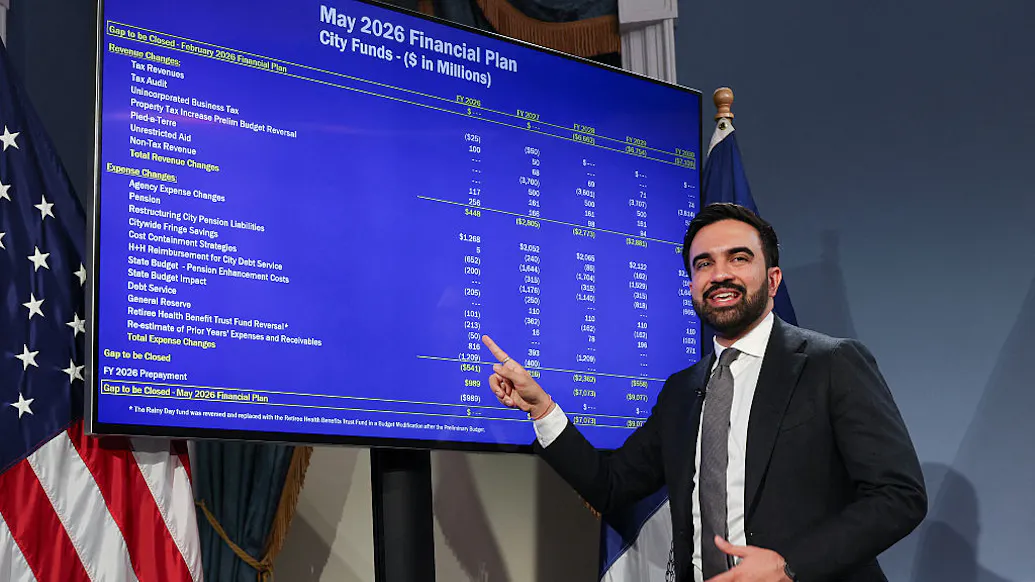
This week, U.S. Senator Bernie Sanders, America’s perennial socialism-salesman, lauded New York City’s Zohran Mamdani, saying the new mayor had “inherited a huge budget deficit” and “brought it down to zero,” while still boosting spending.
Sanders and others have been quick to cheer Mamdani’s plan to balance the $125 billion city budget, which still must be approved by the City Council. But these boosters, quite conveniently, avoid getting into the details. That’s by necessity. Closer inspection reveals how much New York City’s problems were of its politicians’ own making — and the extremes to which they’re going to avoid making hard choices.
Mamdani, with great alarm, announced in January that the city faced a budget crisis. The city’s looming fiscal crunch was hardly news; state officials had been warning about it for many months.
There was a kernel of truth to the mayor’s worries, though: the city was in its fourth year of spending more than it took in. The trouble, though, was exclusively on the expenditure side. There was no single culprit, but rather a systemwide expansion of costs, including newer programs — such as a housing-voucher system whose cost quadrupled to almost $2 billion in just four years.
One particular, and avoidable, trouble spot was a state-imposed “class-size” mandate set to cost the city close to $1 billion annually by requiring the city to hire more teachers. Then-Assemblyman Mamdani, along with most lawmakers, had supported the rule in 2022, which was a thinly veiled effort to shield the NYC teachers’ union from the pain of school consolidation driven by collapsing student enrollment. Part of the mayor’s budget triumph came from Albany simply postponing the law’s implementation.
Mamdani will eventually have to confront the gap between his vision for democratic socialism and the extent to which New York’s public employee unions, and their stranglehold over city operations (and the state Legislature), prevent agencies from delivering, in his terms, “public excellence.”
But that fight for greater efficiency is not happening today.
The mayor, always quick to bemoan spending restraint as “austerity,” instead seems to have squeezed more aid from the state government, though Albany hasn’t yet approved a budget for the state’s current fiscal year (which began six weeks ago).
That extra cash is only available because of the combination of Albany’s steep personal and business income taxes and the recent strong performance of the NYC-based financial sector. When markets do well, cash rains in. But when capital gains dry up, so do tax receipts.
The Global Financial Crisis, and the resulting collapse in capital gains, flooded the New York state government in a sea of red ink, which washed thousands of state workers out of their jobs, and forced the state to close its aid spigot for local governments and school districts.
New York pols treat that as ancient history instead of a cautionary tale about the imprudence of counting on tax receipts that might not exist a year from now.
The mayor’s antagonism toward the city’s high earners, and recent expansions by financial heavyweights into Texas and South Florida, have put NYC at greater risk of tax-base erosion.
The biggest chunk of Mamdani’s budget-balancing strategy is arguably the least responsible: he’s simply punting costs into the future.
New York City pays into five public pension systems on behalf of current workers, expecting that the payments, plus investment returns, will be sufficient to fund each worker’s pension in retirement.
But that often hasn’t been the case. The City right now is about two-thirds of the way through paying off an extra pension debt that hit its balance sheet around 2010 as the pension systems acknowledged that retirees were living (and collecting pensions) longer and that investments couldn’t be counted on to generate such high average returns (8% per year) over the long run.
Instead of paying off the last of that decades-old pension debt in 2032, Mamdani wants to “restructure” the city’s pension payments in each of the next few years and instead stretch the costs out to 2037. That means deferring $1.6 billion in pension costs in the next fiscal year alone and forcing city taxpayers to pay it back, with interest.
New York’s state constitution guarantees public pensions, meaning they can never be reduced, so if the pension systems’ still-generous assumptions about future investment performances don’t materialize, taxpayers will be hit up for even more to make up the difference.
Mamdani should be looking more seriously at the decisions that put New York City in the red, and use the time-tested methods of previous mayors (like “programs to eliminate the gap”) to get costs back under control.
In the meantime, for the people eager to tout the weekly triumphs of socialism in Gotham, these inconvenient details about the city’s long-term standing are a problem for another day.
***
Ken Girardin is a fellow at the Manhattan Institute.
.png)
.png)

