
WASHINGTON — Secretary of War Pete Hegseth, Chairwoman Jennifer Hegseth, and Executive Director Desiree Thompson Sayle held the first Military Spouse Commission meeting on Monday, setting the stage for a new level of communication between military spouses, the War Department, and President Donald Trump’s White House.
During Monday’s inaugural meeting, the commission announced a number of policies related to healthcare, housing, employment, education and childcare, and deployment-related support. Hegseth encouraged the military spouses on the commission to think outside the box, and to “think big,” but also to look closely at changes that can be made immediately to help military families thrive.
“Where we can change things immediately, to see immediate relief or immediate directional change, we’re prepared to execute, but as we’ve also discovered, there are a lot of things that have been moving and are maybe stuck, or initiatives that were launched and maybe they’ve stalled, or they’ve become a little stale, or they need to be revitalized, new leadership,” he explained.
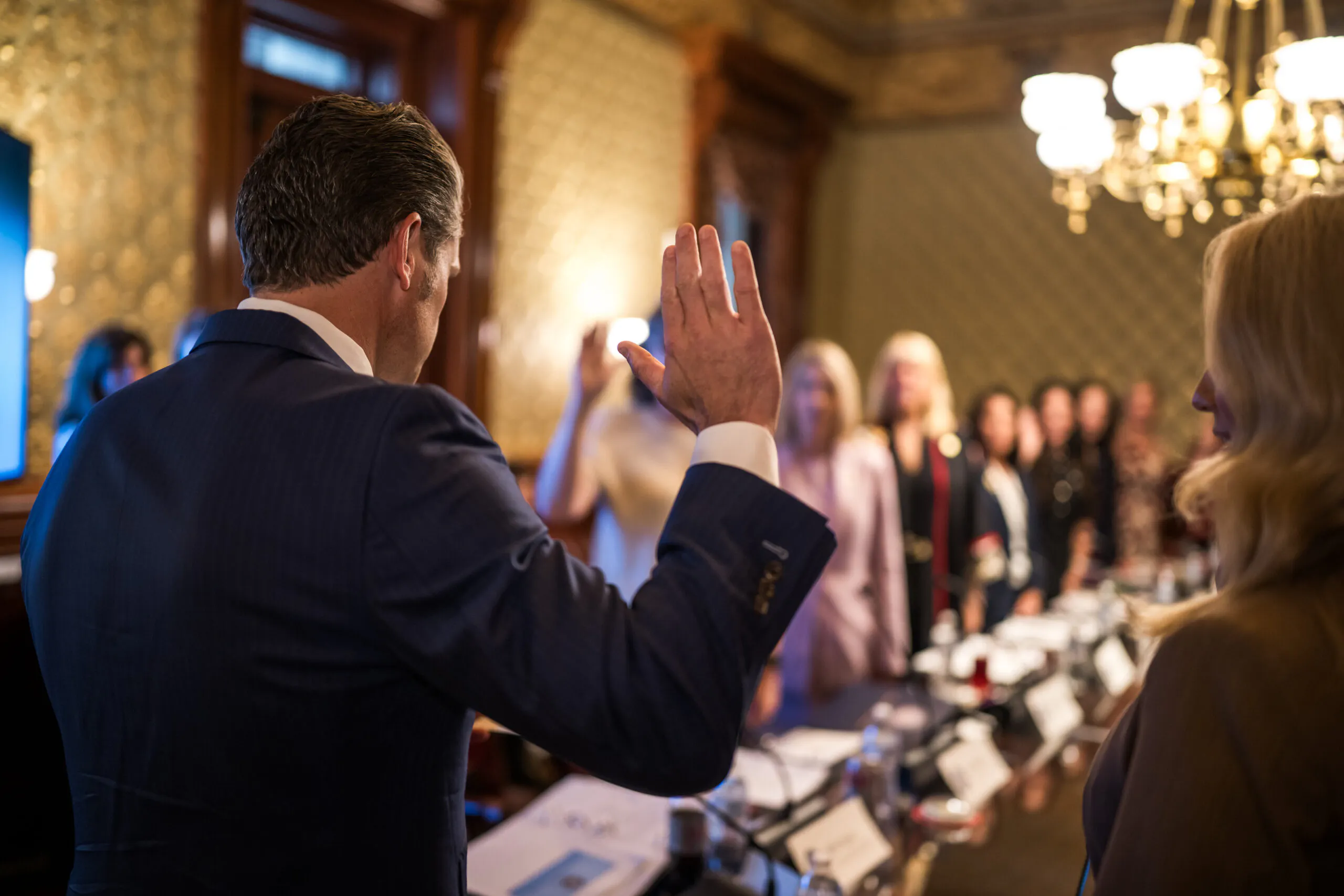
Photo courtesy of the White House.
“Because there have been a lot of great Americans for generations before us, like all of you, who wanted to fix those things and tried really hard to do it and made a lot of progress,” Hegseth added. “My hope for this commission is that a lot of it isn’t reinventing the wheel. It’s recognizing problems that have been persistent, that maybe have been siloed in certain regions or certain departments: a Navy thing, or Air Force thing, or Marine Corps thing, or Army thing, and now that we can look at it in totality, discretely in that service or in that region, but also across the imperative margin, that chance to think even bigger.”
While military spouses formerly could not attend each other’s medical appointments, the Defense Health Agency has changed the policy at the Military Spouse Commission’s request, making it so that military treatment facility visitation policies no longer block spouses from attending each other’s military appointments. Now military treatment facilities must accommodate patient requests for a spouse to be present, “consistent with the patient’s preferences, privacy requirements, and clinical operations,” The Daily Wire has learned.
Additionally, the commission convinced the Defense Health Agency to issue guidance directing that military treatment facilities allow parents to accompany a minor to medical appointments “unless doing so is prohibited or limited by applicable law, patient privacy rights, clinical necessity, or safety requirements.”
To address military family housing needs, the commission discussed the War Department’s budget request for $62.2 million in new family housing construction projects, as well as $53.4 million for operation and maintenance costs. The Barracks Task Force also announced its plan for $1.2 billion in new housing projects as well as $400 million in immediate renovations to housing.

Photo courtesy of the White House.
President Donald Trump signed an executive order in September focused on accelerating access to veterans’ benefits and employment opportunities. The commission dwelt on the executive order and the importance of improving the “hand-off” between the War Department and Veterans Affairs, ensuring that families get the benefits and services when their service member leaves active duty.
The commission is working with the War Department to make sure that military families in the 19 states that opted out of the Tax Credit program for military children get access to the schools of their choice through a voucher initiative “to provide equivalent education access and funding directly to those families.”
The Military Spouse Commission also successfully asked the War Department to launch a pilot program at five locations that extends fee assistance funds to faith-based and license-exempt childcare providers. Three of those five programs will be in Virginia, with one in Arlington, one in Norfolk, and another in Virginia Beach. The other two programs will be at the Naval Base Kitsap in Bremerton, Washington, and the Naval Base Point Loma in San Diego.
And finally, on the deployment support front, the commission is urging its congressional partners to pass the “Love Lives on Act,” legislation that would end the “unjust and anti-family policy of stripping Gold Star spouses of their benefits if they remarry before the age of 55.”
“Military spouses are the backbone of our incredible armed forces and our great country,” White House Cabinet Secretary Meghan Bauer told the commission. “You support your spouses and family every day as they accomplish their mission to defend our great nation. Strong military families help build a strong, stronger military, a more resilient fighting force, and a safer and more secure America.”
“That is why this commission is so important,” she said. “By addressing the challenges facing these families, this commission will help strengthen military families, improve retention, and ensure America’s armed forces remain ready to meet any challenge.”
.png)
.png)

