 Brent Scher
Everyone knows that Social Security is the “third rail” of American politics: touch it, and you die.
This may as well be etched in stone. There’s no debate over whether or not the federal retirement program is headed towards insolvency — that’s inevitable. In fact, there’s no debate over the program at all. The fear of proposing a change to a program that pulls money out of every American paycheck has paralyzed politicians. Neither party seems willing to take the blame when it falls apart, so Washington plans to watch as the train flies off the tracks.
But what if everybody is wrong? Not wrong about Social Security’s insolvency — that truly is inevitable — but about the fact that proposing a plan to fix it is political suicide.
This thought came from our very own Matt Walsh, who prefaced his take on Social Security with the consensus point that reforming the program is “political poison.” His take, however, is impossible to argue with.
“Taking huge chunks out of the paychecks of young working Americans in order to pay for the retirements of older Americans who have a net worth several times higher,” Walsh wrote, “all to prop up a system that everyone knows likely won’t be there when those younger people are retirement age themselves, is morally abhorrent and economically insane.”
There is bipartisan political consensus that more needs to be done to boost young Americans’ economic outlook. Yet there is also political consensus that reforming a program that steals wealth from young people to feed into a broken system is out of bounds.
I’d like to challenge that political consensus. Because it’s complete garbage.
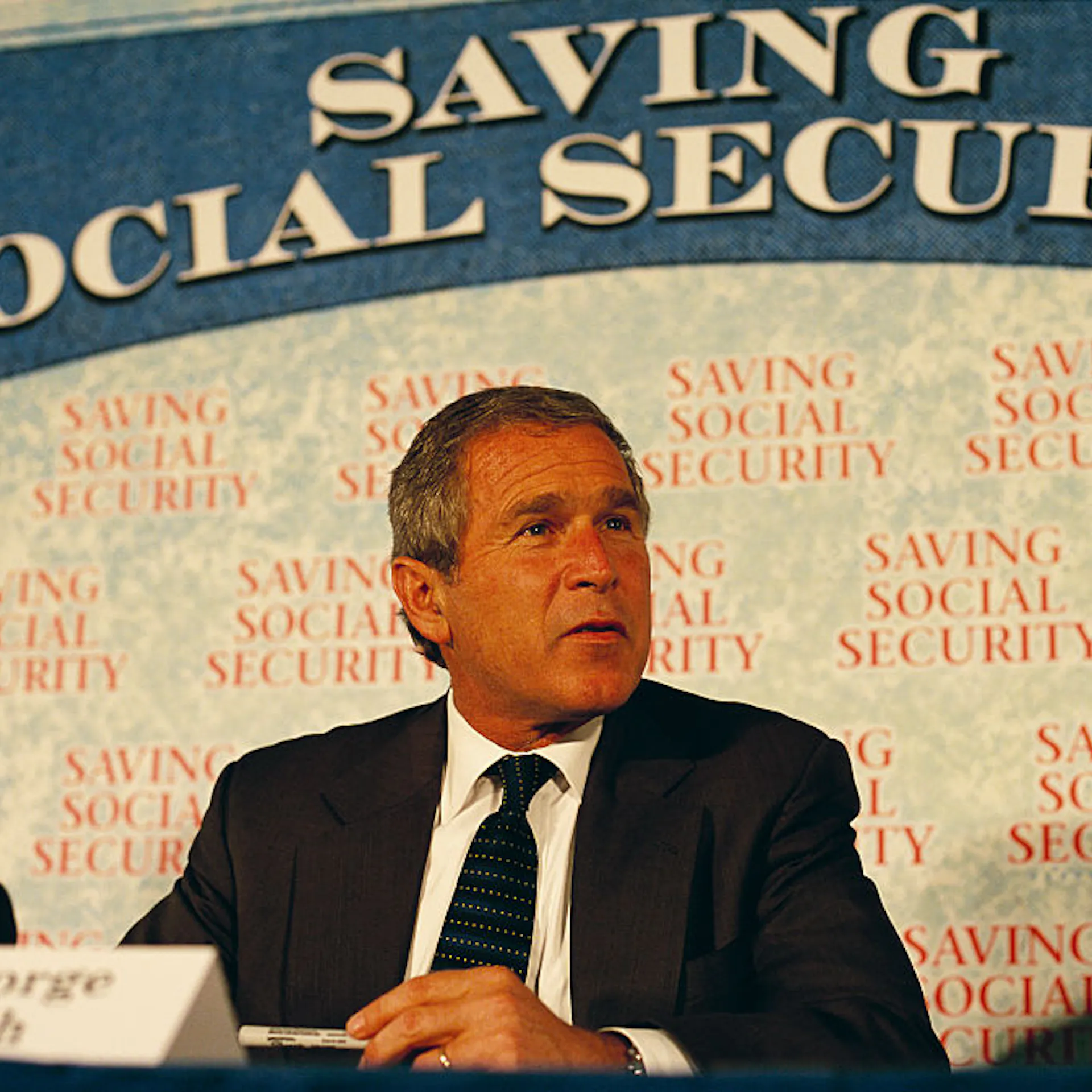
The last politician to champion Social Security reform was George W. Bush, our greatest living former president. It was a longtime obsession for Bush, but he used his 2004 State of the Union address to introduce his plan to privatize the retirement benefit.
“Younger workers should have the opportunity to build a nest egg by saving part of their Social Security taxes in a personal retirement account,” he said on January 20, 2004. “We should make the Social Security system a source of ownership for the American people.”
The proposal became a regular part of Bush’s stump speech during his reelection campaign against John Kerry. Bush called it the “ownership society,” saying people should have ownership over the money they put into Social Security.
Yes, the proposal drove leftists like Kerry and writers at The Atlantic mad. But no, it wasn’t political suicide. Lest we forget, Bush won, and he entered his second term determined to spend his political capital saving Social Security.
“As we fix Social Security, we also have the responsibility to make the system a better deal for younger workers,” Bush said to cheers in his 2005 State of the Union. “And the best way to reach that goal is through voluntary personal retirement accounts.”
Americans were united in the belief that Social Security was a problem. According to a March 2005 Gallup poll, 92% of Americans said they were worried about the Social Security system — 48% a great deal worried, 21% worried a fair amount, and 20% a little worried.
It wasn’t enough. Bush tried to win support from Democrats, who were in the minority in both houses of Congress. But in that political era, overriding the filibuster wasn’t even on the secret menu. Democrats were led in the U.S. Senate by Harry Reid, who was famously effective at keeping his minority coalition together, and Bush needed at least five Democrats to break from him. Buoyed by a massive AARP-fueled public campaign against Bush’s plan, Democrats never felt the heat.
Public support for Bush’s plan started to fall. It wasn’t because his plan was bad. It was because his plan had no chance in Congress. By the end of the first summer of his second term, Hurricane Katrina had ravaged New Orleans, the wars in the Middle East were becoming increasingly unpopular, and Bush suddenly needed all that political capital. He waved the white flag.
But concerns about Social Security never waned. By March 2006, they had risen. The same Gallup poll found that 94% of Americans were worried — 51% a great deal worried, 29% worried a fair amount, and 14% a little worried.
Gallup kept polling, and the numbers never really changed. This March, 90% of Americans said they were worried — 43% a great deal worried, 29% worried a fair amount, and 18% a little worried.
Good for Americans. If you’re not worried, you’re not paying attention. We’ve done nothing to fix Social Security, even though it’s just as inevitable now as it was in 2004 that the program is headed towards insolvency. Even by conservative estimates, that day is less than a decade away.
I’ve always declared Franklin Delano Roosevelt our worst president, dead or living, for strapping our nation with Social Security in 1935 as part of his New Deal. The deal sucked, and now we’re a country that measures its debt in the trillions.
Harry Reid, one of our worst-ever senators, defeated Social Security reform through legislative procedure and interest-group cash, not politics. The last time someone ran a political campaign promising Social Security reform, Bush won.
Of course, it’s not easy to reform the program that every American expects to cut them checks one day. But it’s going to be just as hard to tell them the checks aren’t coming because we were too cowardly to try to fix it.
.png)
.png)