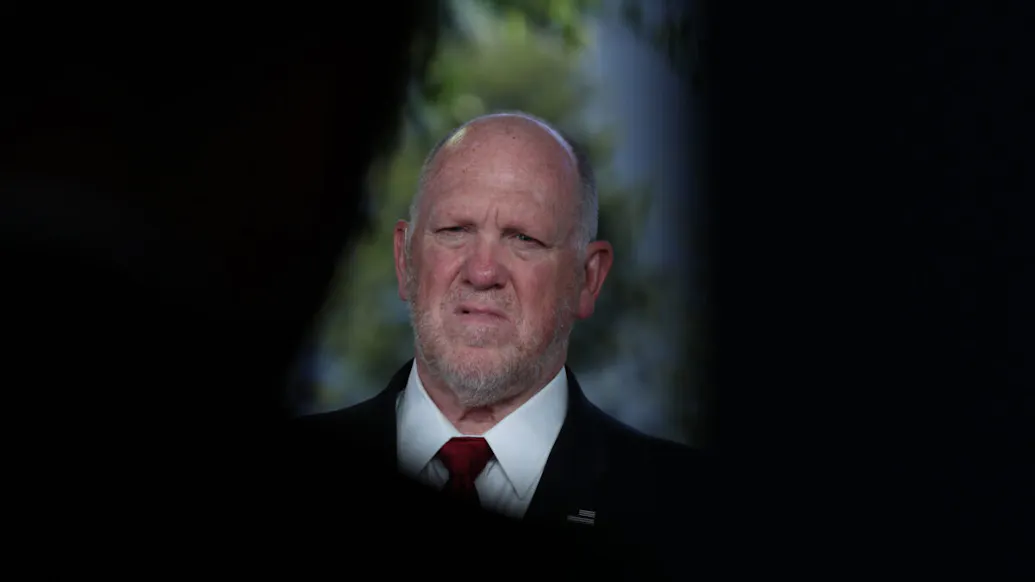
Former acting ICE Director and current White House Border Czar Tom Homan blasted congressional Democrats over the ongoing Department of Homeland Security funding standoff, accusing lawmakers of trying to strong-arm policy changes by withholding funding.
Speaking on CNN’s “State of the Union,” Homan said the dispute is not about budgetary constraints, but about efforts to curb immigration enforcement.
WATCH:
“President Trump wants the entire @DHSgov funded,” says @RealTomHoman.
“They’re holding the department hostage because they don’t like what ICE is doing — and ICE is enforcing laws they enacted.” pic.twitter.com/bMDcSIJ7IB
— Rapid Response 47 (@RapidResponse47) March 29, 2026
“President Donald Trump wants the entire Department of Homeland Security funded. He wants the government open and funded,” Homan said. “But the bottom line is they want changes in ICE tactics. They want changes in policy.” Homan argued that Immigration and Customs Enforcement is simply carrying out laws that have remained consistent across multiple administrations.
“The same laws ICE follows today have been in place during the Clinton, Obama [administrations], and now,” he said. “The law hasn’t changed.” According to Homan, lawmakers are privately pushing to limit arrests rather than openly advocating for abolishing ICE.
“They can say they don’t want to abolish ICE — I’m in the room,” he said. “They want to change operations so we arrest fewer people.” The remarks come as Congress remains locked in a dispute over DHS funding, with negotiations increasingly tied to immigration enforcement demands. Some lawmakers have pushed for additional oversight measures and operational restrictions, including expanded use of body cameras and clearer guidelines around enforcement locations.
Homan noted that ICE has already engaged in discussions on some of those issues, including funding for body cameras, which he said has been allocated at roughly $120 million. But he rejected claims that agents are routinely targeting sensitive locations such as churches or hospitals.
“They can’t point to a single instance—not one—where we’ve arrested anybody in a church or inside of a hospital,” Homan said. “We already practice discretion. We don’t do operations there unless there’s a significant national security threat.”
He added that while discussions over enforcement practices could continue, they should not come at the expense of funding the department. “Why can’t these discussions continue while we keep the Department of Homeland Security open?” Homan said. “They’re holding the department hostage because they don’t like what ICE is doing.”
At the center of the dispute is a fundamental divide between the House and Senate over whether immigration enforcement agencies should be fully funded. The Senate passed a bipartisan measure to reopen most of DHS but excluded funding for ICE and parts of Customs and Border Protection, an approach backed by Democrats but rejected by House Republicans.
House Republicans instead pushed a short-term funding bill that includes full funding for ICE, arguing that enforcement agencies should not be carved out of appropriations. That measure passed narrowly but faces strong opposition in the Senate, prolonging the stalemate.
The deadlock has had tangible consequences across the country. Tens of thousands of DHS employees, particularly Transportation Security Administration workers, have gone without pay for weeks, leading to staffing shortages, airport delays, and mounting pressure on the administration to act.
President Trump has attempted to mitigate the fallout by signing an emergency order to ensure TSA agents receive pay, which Homan later said during the interview “There is a plan to get these TSA agents paid, hopefully by tomorrow or Tuesday,” but many other DHS functions remain affected as lawmakers continue to clash over immigration policy and enforcement reforms.
Democrats have insisted that any long-term funding deal must include new restrictions or oversight on ICE operations, while Republicans argue that such demands amount to undermining existing law enforcement authority, mirroring the criticism Homan leveled in his interview.
Homan framed the dispute as a fundamental separation-of-powers issue, arguing that Congress should change the law if it disagrees with enforcement outcomes.
“If they don’t like what ICE is doing, then change the law,” he said. “That’s their job.”
As negotiations continue, the standoff underscores a broader clash in Washington over immigration enforcement, one that is increasingly spilling into funding battles with real consequences for federal agencies and the everyday Americans they employ.
.png)
.png)