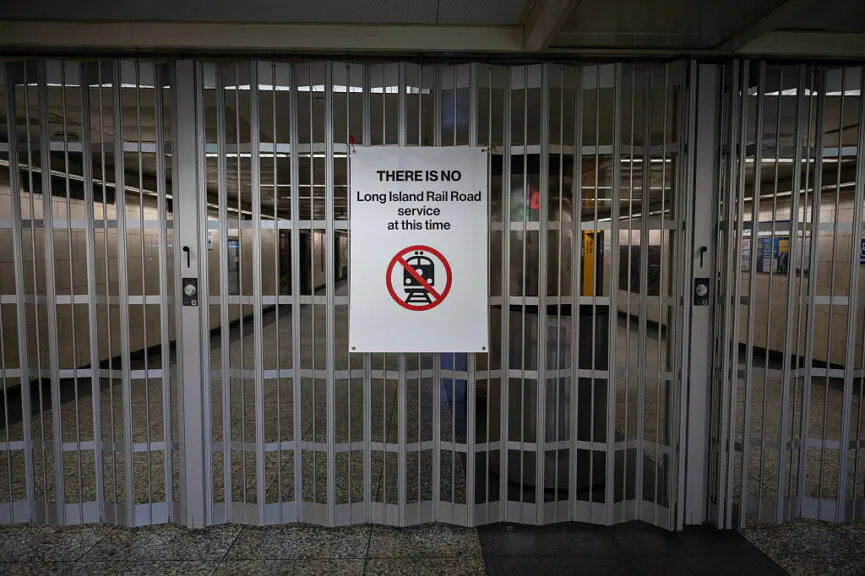
Thousands of Long Island Rail Road workers walked off the job Saturday morning, marking the end to failed negotiations and the start of a strike that could derail the nation’s busiest commuter rail system.
Five unions representing half the LIRR’s workforce — about 3,500 people in all — began the strike at midnight, the first in 32 years. The walkout comes after three years of failed negotiations with the Metropolitan Transportation Authority, the state agency that controls commuter rail lines and the New York City subway system.
As of Saturday morning, the LIRR — which serves around 300,000 passengers a day — is shut down. The MTA’s website encourages riders to work from home, noting that the strike “will cause severe congestion and delays” and “have a devastating impact” on riders, many of whom use the railroad to commute to work in Manhattan.
Unions and the MTA failed to come to an agreement on annual raises and healthcare premiums for workers. The unions requested a retroactive 9.5% pay increase to cover the past three years, on top of a 5% increase for 2026. MTA chief Janno Lieber told the New York Times that the agency was willing to increase pay for LIRR workers, but that union leaders refused its offer, pushing instead for concessions Lieber says would “implode” the agency’s budget.
Union leaders say that LIRR workers have not received a raise since 2022 and are grossly underpaid. But these union members made $136,000 on average in 2025, making them some of the highest-paid rail workers in the country.
Victor J. Blue/Bloomberg via Getty Images
The Trump administration reportedly attempted to broker an 11th-hour compromise, to no avail. The Department of Labor has been without a leader for around a month following scandal-ridden Secretary Lori Chavez-DeRemer’s departure.
The Labor Department has yet to comment on the strike. Union leaders, meanwhile, are trumpeting the strike with characteristic bravado.
“The LIRR owns this strike,” Teamsters President Sean O’Brien said in a statement. “Union workers have sacrificed so much for the railroad for years while consistently bargaining in good faith for a fair contract.”
“Hundreds of thousands of commuters rely on our members’ labor every day,” O’Brien added. “The LIRR is stranding passengers while denying wages, benefits, and respect to … hardworking union members.”
“This strike would not have happened if the MTA and LIRR offered our members the reasonable terms the government recommended multiple times. But management refused,” Brotherhood of Locomotive Engineers and Trainmen President Mark Wallace said Saturday. “We hope LIRR gets serious soon to avoid further unnecessary disruptions for hundreds of thousands of New Yorkers. They know where to find us when they’re ready: on the streets.”
“The L.I.R.R. is more stable now than it has been for generations,” New York Governor Kathy Hochul said in a statement. “The decision by some unions to strike over demands that would threaten that progress is reckless.”
Hochul’s bête noire, New York City Mayor Zohran Mamdani, posted on X late Friday that he was “continuing to closely monitor the ongoing contract negotiations involving the LIRR.”
The MTA will begin operating free shuttle buses to make up for the strike on Monday, though the agency warns that the buses are not enough to make up for the railroad. The New York Yankees are set to face the New York Mets at Citi Field on Saturday, an event that would ordinarily generate heavy railroad traffic.
On Friday, the New York State Comptroller’s Office said that the shutdown could cost the New York metro area $61 million a day in lost economic activity. That number could increase if the strike stretches into Memorial Day weekend.
.png)
.png)