
 Spencer Klavan
For now, Facebook is still technically called Meta. But the “metaverse,” Mark Zuckerberg’s ambitious virtual reality project, is in shambles. Tech outlets reported last week that the company would be sunsetting Horizon Worlds, its VR social media platform. Then CTO Andrew Bosworth clarified that Horizon Worlds would remain operational, even if users could expect little in the way of updates or new content. The parallel reality that Zuckerberg invited his clientele to dream of will linger quietly on — like the mostly forgotten game “The Sims,” that nerds of a certain age sometimes spin up for old time’s sake, except with real people pretending to be virtual instead of the other way around. Meta’s rebrand was perhaps a bit premature.
But then, it wasn’t so much the “Meta” part that grated. It was the “Verse”: the all-encompassing and boundlessly presumptuous claim about how life would be from now on. Pretensions to metaversality were part of the enthusiasm for “Web 3,” a supposedly epochal transition from a world of siloed apps and websites to a paradise of digital interconnectivity. It was one of those tech projects that consists of a doomsday scenario presented unblinkingly as a sales pitch. In “Snow Crash,” a 1992 cyberpunk fantasia, the novelist Neal Stephenson gave the name “metaverse” to a digital world that his characters would escape into when socioeconomic conditions conspired to make their embodied lives unbearable.
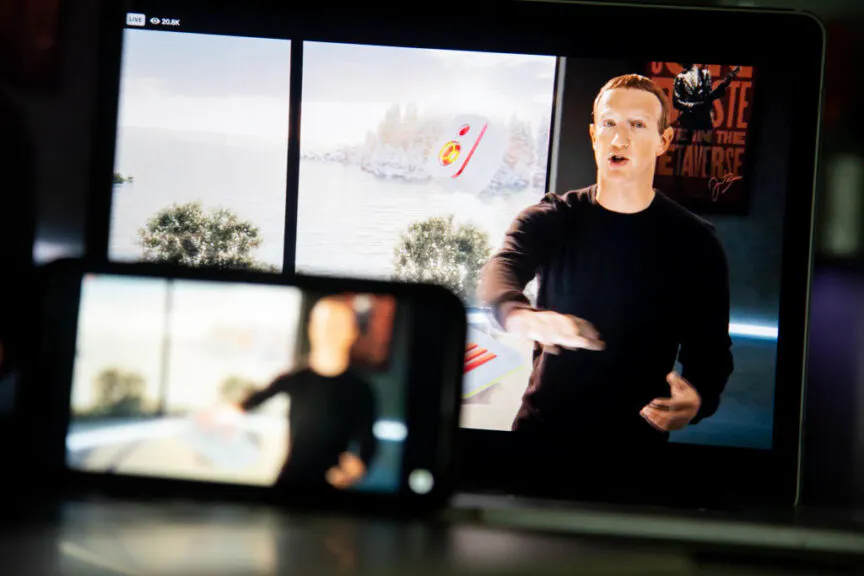
Zuckerberg, striding confidently through a sea of early adopters wearing insectoid VR helmet-goggles for a photo op, didn’t seem to notice how viscerally unappealing the whole thing was. He comes across as totally deaf to these sorts of concerns, although maybe acting that way is part of his job. It also has to be said how profoundly the mood back then was affected by COVID-19, which spiked people’s screen time and created the impression that everything was getting ported to the cloud.
Michael Nagle/Bloomberg via Getty Images
Lots of things were, but it was silly not to expect an imminent counter-revolution once people grew disgusted with the effects of too much scrolling. In the first round of mass layoffs that followed his pandemic hiring spree, Zuckerberg regretfully acknowledged that he had seen the rush of users to the site and “predicted this would be a permanent acceleration.” Whoopsie. The four most foolhardy words in the English language are “if present trends continue.”
Present trends generally do not continue. In “The Age of Surveillance Capitalism,” the social psychologist Shoshanna Zuboff used the word “inevitabilism” to describe how technologists labor to make their designs seem inevitable “when they are actually meticulously calculated and lavishly funded means to self-dealing commercial ends.” What Zuboff called “the prediction imperative” puts tech companies in “the reality business,” where profit models depend on passing off corporate aspirations as unalterable, world-historical developments that must and will take place. Then the only question becomes whether you’ll get on board or, in the words of Ebenezer Scrooge from the 1951 adaptation of Dickens’s “A Christmas Carol,” “be crushed under with the weak and the infirm.” This is why product launches so often look and sound like something out of Hegel’s Lectures on the Philosophy of History, and why emissaries from the c-suite tend to talk like Thanos from “Avengers: Endgame”: “I.Am.Inevitable.”
What I want to propose is that inevitabilism is neither unique to tech nor especially modern. It’s just the standard advertising strategy for aspirants to global power. In 1817, anticipating the arrival in London of a colossal pharaonic statue from Egypt, Percy Shelley and Horace Smith embarked on a friendly competition to write a poem on the theme of monarchic pride. Shelley won with “Ozymandias,” a sonnet on the ruins of a dead king’s towering monument whose “vast and trunkless legs of stone” stand on a pedestal inscribed with the words “‘My name is Ozymandias, King of Kings. / Look on my works ye mighty, and despair!’ / Nothing beside remains. Round the decay / Of that Colossal Wreck, boundless and bare, / The lone and level sands stretch far away.”
The real Ozymandias was Ramesses II, god-king of Egypt’s mighty New Kingdom. The Greek version of his name, which Shelley used for his title, came from the royal epithet he adopted at his coronation: Usermaatre Setepenre. It means roughly “Strong Justice and Chosen one of Ra,” the Sun God. Shelley neither invented nor exaggerated Ozymandias’ claims to ultimate power. The statue’s inscription in the poem is a rough paraphrase of a real one quoted by the Greek historian Diodorus Siculus: “King of Kings am I, Osymandias. If anyone would know how great I am and where I lie, let him surpass one of my works.”
Ozymandias, Nebuchadnezzar, Sennacherib, Ashurbanipal…they came and they went. It used to be standard practice for imperial monarchs to boast of their sacred, eternal, and universal dominion. The fiction is appealing because it offers things people crave: permanence, stability, order, and certainty about the future. It’s tragic because, as Shelley observed, none of these are things that even very good men can guarantee. The sands of time’s desert are littered with trunkless legs. Nothing beside remains.
Understand these things, and you understand the politics of the Old Testament. The constant refrain of the Hebrew Prophets was that people look for eternity in the wrong places. “Put not your trust in princes”: again and again, the Jews of ancient Israel were invited to observe the wreckage of dynasties whose total dominion was once depicted — plausibly, at the time — as inevitable.
As it winds down its VR program, Meta will be diverting its resources and attention toward Artificial Intelligence. AI technology has so far proven vastly more useful and workable than the metaverse. It seems unlikely that we’ll look back on it as a passing fancy. At the same time, the predictions about the world AI will make — its powers to transform the universe, or come to life, or usurp God — have all the flavor of inevitabilism.
The same people who went all-in on the metaverse have moved on with undiminished confidence to telling us that AI will change everything, everywhere, all at once, that the whole thing is a fait accompli, that it’s pointless to speak of exercising restraint. “Look on our works, ye mighty, and despair.” I submit that we will continue to fall for this routine, chasing like hamsters after the next forever, just as long as we expect a company or a king to secure the future of the universe. If we want eternity, we will have to look elsewhere.
* * *
Spencer A. Klavan is co-host, with his father Andrew Klavan, of the “Klavans on the Culture” podcast. He is associate editor of the Claremont Review of Books and author, most recently, of “Light of the Mind, Light of the World: Illuminating Science Through Faith.”
The views expressed in this piece are those of the author and do not necessarily represent those of The Daily Wire.
.png)
.png)

