In 1960, nearly 85% of prime-age adults (those between 25 and 54) were married. Today, that figure has collapsed to roughly 54%.
However, the topline marriage data conceals that America’s marriage rate is propped up by immigrants. While 64% of foreign-born adults in America are married, fewer than 52% of native-born American adults are married. That’s a 12-point gap. Without the steady arrival of immigrants who still prioritize marriage, America’s marriage rate would be even lower and, consequently, so would the birth rate.
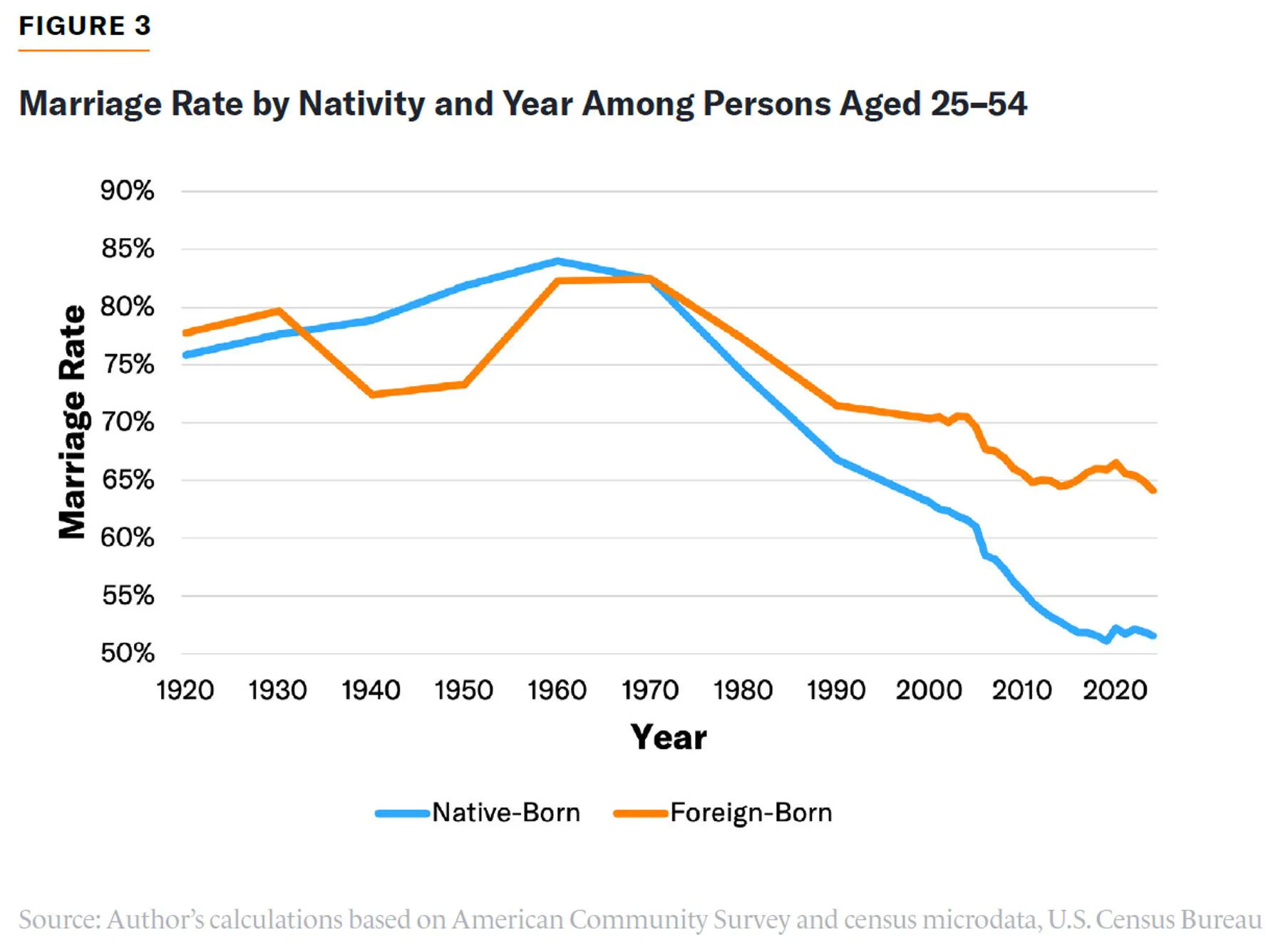
At first, one may think that immigrants are more likely to be married because many of them arrive through marriage. But two facts disprove this argument. First, there was no gap in the marriage rate between immigrants and natives as early as 1970. And second, when we divide immigrants by how old they were when they first came to the United States, it becomes clear that the younger immigrants are when they arrive in the United States, the more they look like the average American when it comes to marriage. Culture is driving the decline in marriage, and immigrants and their children are unfortunately assimilating into America’s low-marriage culture.
When you look only at immigrants who arrived in the United States before turning 18, and thus well before marriage-based immigration could explain their presence, they still marry at a higher rate than native-born Americans. But when you compare immigrants who arrived before age 10 to those who arrived as teenagers, the pattern is unmistakable: the more years an immigrant spends growing up in America, the less likely they are to ever marry. The marriage gap between native-born Americans and immigrants who arrived as young children has completely vanished this century.
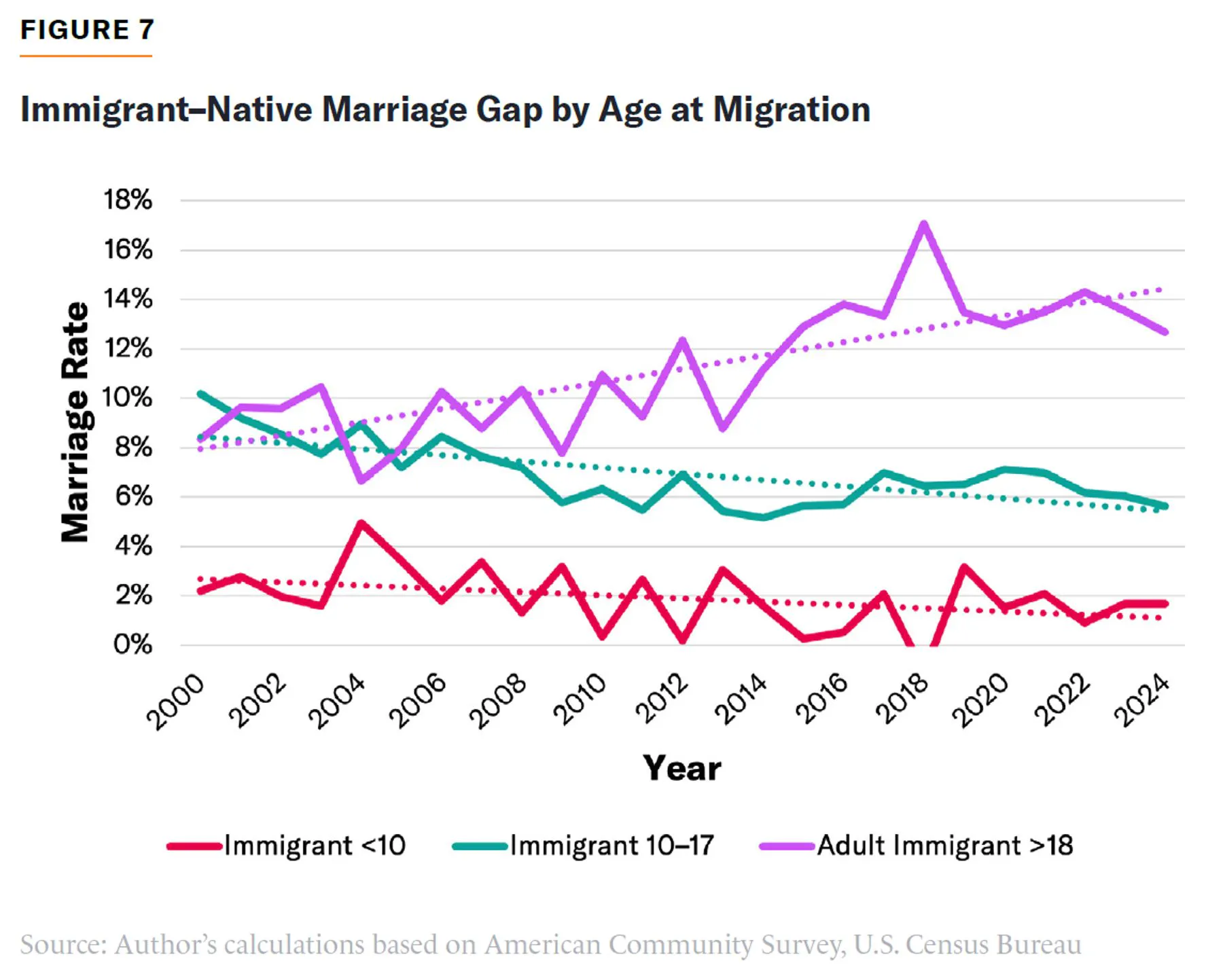
This is what assimilation looks like, except in this case, it is a bad thing. Immigrants aren’t bringing some exotic disease called “low marriage rates” with them. They’re catching it in America.
It raises a question that should haunt every American who still believes families are the building blocks of a free society: What exactly are immigrants assimilating to?
The answer becomes even more disturbing when you look at the second generation, that is, the U.S.-born children of immigrants. Second-generation Americans grew up in households with two married parents under one roof at rates their native-born peers did not. They lived in neighborhoods that were more likely to provide upward mobility, and they enjoyed unparalleled opportunity in the richest country on earth. By every reasonable theory of how culture is transmitted, they should be the strongest defenders of marriage.
Yet, they aren’t. The children of immigrants don’t just match the marriage rates of multigenerational Americans; they often underperform them.
Among college graduates, the children of immigrants are less likely to marry than college graduates whose families have been here for generations. The pattern holds across every major ethnic group: white, black, Hispanic, and Asian. The kids who grew up with married parents are now marrying at lower rates than the kids who didn’t.
After controlling for age, education, and ethnicity, Americans with one immigrant parent marry at a rate 3.3% less than their multigenerational peers. For Americans with two immigrant parents, the gap widens 4.8 percentage points. Whatever cultural advantage their parents brought from abroad reverses in a single generation.
The most striking case is among black Americans. Black immigrants marry at a higher rate than native-born blacks. While about 55% of black immigrants aged 35–39 are married, only 35% of native-born blacks are married at the same age. Yet second-generation black Americans marry at roughly the same rate as multigenerational native-born black Americans.
The same story repeats in every ethnic and educational subgroup. Approximately 85% of Asian immigrants in their late 30s are married — the highest rate of any subgroup studied, and consistent whether they have a college education or not. Yet only 63% of the American-born children of Asian immigrants get married: over a 20-point drop from the Asian immigrant rate. A similar phenomenon occurs in Hispanic immigrants’ marriage prospects, which collapses to match native-born Hispanics in a single generation.
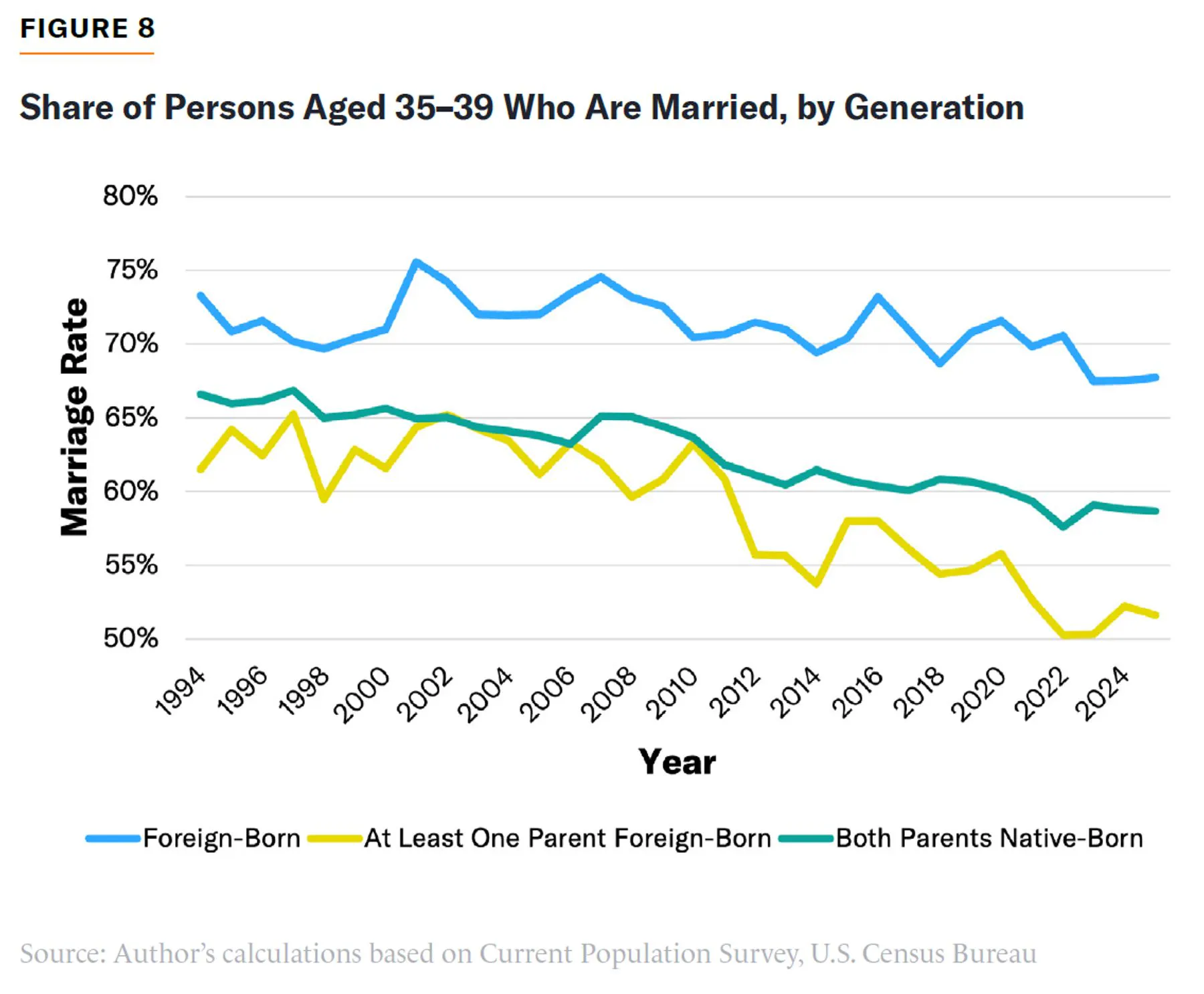
So what are young Americans assimilating to? They’re assimilating to an American culture that increasingly treats marriage as optional and unnecessary. The children of immigrants are immersed in a culture saturated with messaging that careers come first, that commitment is risky, and that families are a “lifestyle choice” rather than the foundation of human flourishing.
The sad consequence of immigrant marriage assimilation is that the third generation won’t be as numerous or prosperous as the second. For defenders and detractors of immigration alike, this poses ironic challenges. Defenders of immigration often point to the fact that immigrants exhibit conservative values by being more likely to marry, but this doesn’t last. Opponents often say that immigrants don’t assimilate, but in this case, they do, however undesirable. If immigrants and their children marry less often, then they will have fewer children and should be less threatening to the native population in the eyes of opponents.
The decline of marriage isn’t mainly a story about economics, but one about culture. The children of immigrants are marrying less often than their peers whose families have been here for generations and whose parents were less likely to be married. Immigrants are assimilating into American marriage norms. Conservatives really shouldn’t want that to happen.
***
Daniel Di Martino (@DanielDiMartino) is a fellow at the Manhattan Institute and an economist.
.png)
.png)