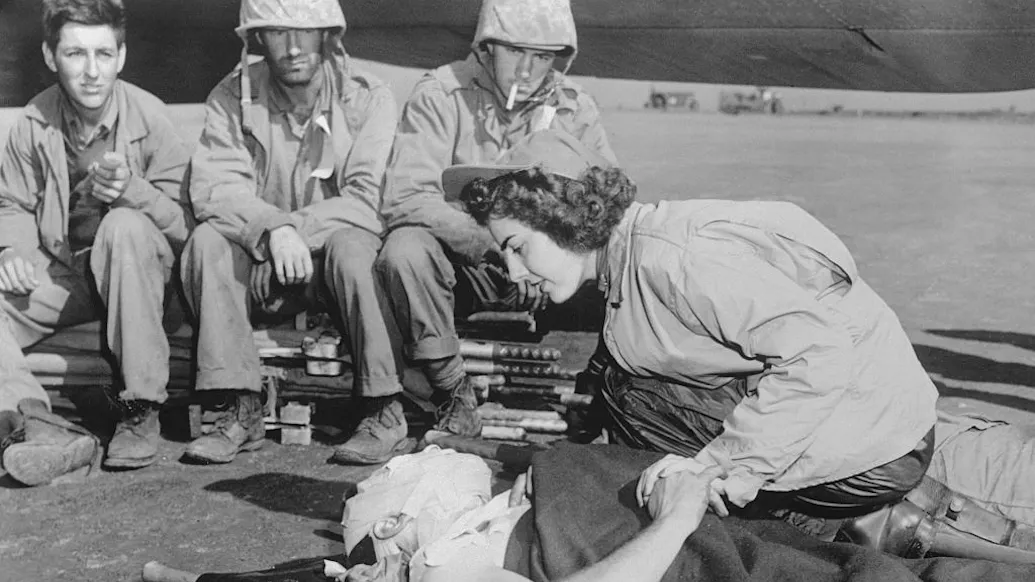
Twelve women, handpicked for a radical new program, helped to turn the tide of battle in the Pacific during World War II.
Those twelve women, who hailed primarily from small towns across the United States, were trained to fly — on unpressurized aircraft — into some of the most dangerous battlefields in the Pacific theater to evacuate thousands of desperately wounded American soldiers.
Author and Hunter College Professor Leah Garrett spoke with The Daily Wire about her forthcoming book on the topic — and she explained why she’d felt so compelled to tell the stories of those heroic women.
“My last book was ‘X-Troop,’ about Jewish commandos who were given secret identities as Englishmen so that they could serve as British commandos,” Garrett said during a telephone interview. “I wanted to turn to the Pacific because my great uncle was a medic in the Pacific. I had heard this rumor that there was a group of women who flew into Iwo Jima, and I thought it was impossible.”
“I was completely shocked that it was a true story — these 12 women were hand-picked to fly from Guam to Iwo Jima to deal with this shortage of medical care,” Garrett explained. “And as I scratched below the surface, I realized that not only was the story true, but that these women had saved thousands of lives between Iwo Jima and then later Okinawa.”
“It was so important not only because of the lives they saved, but because they were so heroic and they never saw that as heroism. They were just doing their jobs,” she added.
Garrett noted that traditional history lessons, even in the United States, often gloss over just how brutal the war in the Pacific was — largely because the Empire of Japan at the time approached war in a very different way than most Western countries.
Their culture viewed surrender as cowardice, so they were wholly unprepared to deal with American prisoners of war — which led to many of those prisoners being treated very badly. While medics wearing the traditional Red Cross armband were often treated as non-combatants in the European theater — meaning that they were protected under traditional rules of engagement — Japanese soldiers routinely targeted them. Those two major differences combined made evacuating the wounded a high priority, since treating them on the battlefield would likely only make them targets.
The questions that remained were simple: how could they be effectively evacuated and who could manage those evacuations?
The answer they came up with was equally simple: Navy nurses.
Twelve women — all of whom had already completed nursing school and chosen to join the U.S. Navy — were selected to launch the program. Those twelve women who had joined the Navy expecting to spend time on ships were suddenly subjected to rigorous physical training — including distance-swimming tests — as well as training to fly in unpressurized aircraft. Flying without doctors onboard, they were made fully responsible for the wounded soldiers in their care and even given the authority to instruct pilots to lower altitude to adjust cabin pressure when necessary.
On the ground — often in areas that were still not fully under American control — the women had to quickly evaluate casualties and determine who needed to be evacuated first. They loaded casualties from Iwo Jima while Japanese soldiers and snipers were still all over the island, and then they did it again in Okinawa.
“Two things really shocked me,” Garrett said of her time spent researching the nurses. “The Navy knew how dangerous this was, and the women probably knew how dangerous this was — but the visceral action of the danger still shocked me, and the women remembered everything. These women were alone on the planes with no doctors, and somehow hardly anyone died on these flights … I didn’t realize that the female nurses played such a big role in bringing those men back to health.”
Garrett also discussed the importance of telling stories like this one — especially as the United States celebrates its 250th birthday — as patriotism has become a political football of sorts.
“Nowadays people don’t realize how patriotic people were at that time. They never questioned what duty meant; they never questioned what patriotism meant. Women, particularly from the Midwest, just put their hands up, rolled up their sleeves, and served,” Garrett said — and noted that the women looked back on their service, even though it was difficult, with fondness. “These were truly the greatest years of their lives. They were helping America win the war, they were saving men, and they got a great deal of meaning out of serving.”
“In America, if you just scratch below the surface, we find countless stories of American heroism that can still speak to us today,” Garrett added. “These women who put up their hands in America’s darkest hour, none of them knew that they had this inside them, and they impacted so many lives. The smaller stories matter. Mary, for example, had never wanted to fly. She joined the Navy because she thought she’d be on a ship — and she was on one of the first flights to land amid live fire. So what did she do? She just sucked it up and did her job.”
Garrett’s book, “The Flight Nurses’ War: The American Women Who Saved Thousands of Lives at Iwo Jima and Okinawa,” is scheduled for an October 13 release.
.png)
.png)

