 Brad Schaeffer
It’s hard to believe this summer marks six decades since the Beatles, the greatest of pop-rock bands, released the album that truly catapulted them to that title. And I’m not talking about “Sgt. Pepper’s Lonely Hearts Club Band.” Rather, I mean the album that consistently ranks among the greatest of all time: “Revolver.”
“Revolver” was the seventh studio release by the Fab Four. It came at a seminal moment for them as musicians and artists. After their appearance at Candlestick Park in August 1966 — the same month the LP was released — the boys decided to quit the road and focus solely on exploring the studio to its fullest. They no longer wanted to be hindered by creating music they would then have to reproduce live as a stripped-down quartet (not that anyone in the shrieking crowd could have heard the music anyway).
And so, “Revolver” became the Beatles’ first post-tour-mindset album (I’ll explain what I mean later). It came on the heels of another phenomenal record, “Rubber Soul,” released just eight months earlier. Although this preceding album still contained traditional pop love songs, it also began moving into, for lack of a better term, more mature territory with songs such as “In My Life,” “Norwegian Wood,” and “Nowhere Man,” along with perhaps the band’s first oblique foray into psychedelia: the addictive “Think for Yourself,” with its distorted fuzz bass.
I mention the previous album because some Beatles aficionados posit that “Rubber Soul” and the subsequent “Revolver” could have meshed well as a double album. Well, yes and no. In terms of simply delivering one great tune after another from first track to last, I place them on equal footing. But when it comes to taking a leap into uncharted musical territory, “Revolver” is where we see the transition in full.
All one needs to do is listen to the opening tune, George Harrison’s “Taxman.” It sounds, well, different — right down to a driving bass line and Paul McCartney’s blistering guitar solos that erupt throughout the song. One immediately understands that this was not “The Ed Sullivan Show” Beatles anymore. Freed from having to ask, “Alright lads, how will this sound live?” the Beatles let the entire studio become their instrument. And they played that instrument like virtuosos.
In “Revolver,” the listener is offered a Venetian hour for the ears — and the mind: a haunting string-octet elegy (“Eleanor Rigby”), wonderful horns (“Got to Get You Into My Life,” “For No One”), winsome melodies (“Good Day Sunshine”), sweet tenderness (“Here, There and Everywhere”), ripping guitar duos (“And Your Bird Can Sing”), an exposition of Indian music (“Love You To”), and even the whimsical undersea tale of “Yellow Submarine,” with Ringo Starr taking up the vocals while the boys make sailor talk and nautical sounds in the background.
However, the real “we’re not in Kansas anymore” moments come from John Lennon’s LSD-inspired creations. The monochord drone of “Tomorrow Never Knows” makes Pink Floyd seem like yacht rock (“Turn off your mind, relax, and float downstream / It is not dying”). And the fractured “She Said She Said” (“I know what it’s like to be dead”) plunges us into the bewildered and dislocated mental state of someone on a mind-expanding acid trip.
The LP was released in August 1966, when “Wild Thing” by the Troggs topped the Billboard charts. It was a fascinating musical moment historically: “Revolver” arrived just as pop music was pivoting from straightforward rock toward psychedelia, experimentation, and studio-driven albums. The Beatles were not the only ones evolving, of course. The year 1966 saw a remarkable wave of experimentation that also produced “Pet Sounds,” “Blonde on Blonde,” “Freak Out!,” and other ambitious studio works, as popular music rapidly evolved from straightforward rock-and-roll into a vehicle for artistic exploration. A creative arms race, if you will. Still, “Revolver” — raw, edgy, avant-garde, kaleidoscopic, and at times unsettling — ushered in a sound that would go on to define the rest of the 1960s.
Even the title hinted that the lads had broken out of their pop-idol shell and that what lay inside was going to blow the listener’s mind. Which it did. Unlike earlier Beatles albums with straightforward titles, “Revolver“ feels conceptual even before you hear the music — mechanical, psychedelic, and kinetic all at once. It is as if anyone putting on his headphones is being warned that the musical journey ahead will not move neatly from song one to song two to song three, but rather, in McCartney’s happy turn of phrase, “here, there and everywhere.”
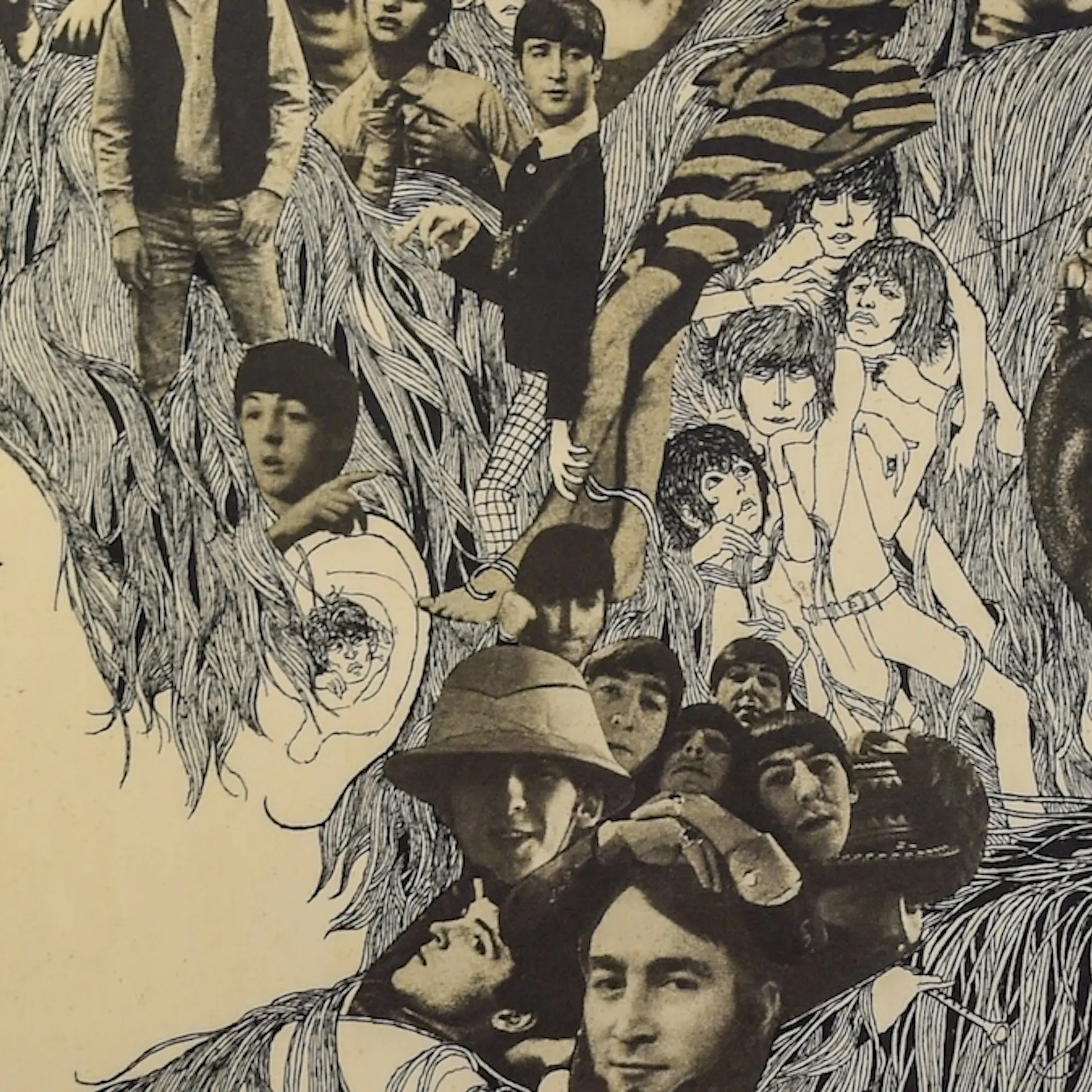
And then there is the cover art. Unlike the clean, traditional group photographs that had defined earlier Beatles albums, the cover of “Revolver” was a stark, surreal black-and-white collage of swirling line-drawing caricatures and fragmented photographs created by Klaus Voormann, who won a Grammy for the work. Instead of affable mop-tops in suits, we see the Beatles presented as mysterious, introspective, and slightly unmoored. The photographs of the eyes Voormann inserted into the sockets of his four Beatles renditions belong to the actual musicians themselves, lending the artwork an eerie realism. Even before the needle touched the record, the cover telegraphed a dramatic artistic break from the band’s earlier image, suggesting something stranger, more experimental, and more psychologically complex than the polished Beatlemania of only a few years earlier.
All of this tends to overlook the ultimate reason for the success of “Revolver” — and its longevity now. (I have little doubt that, like Bach today, the Beatles’ music will still be ubiquitous 300 years hence, pulling succeeding generations into its creative embrace.) The reason is simple: It is an album without a bad track, one in which so many songs were instant classics that it beggars belief.
And let us not forget that at the band’s core were extraordinarily talented musicians. Great musicality is evident throughout the album. Ringo’s drumming, for example, was a vital part of the musical brilliance of “Revolver,” from the tumbling fills of “She Said She Said” and the relentless groove of “Tomorrow Never Knows” to the punchy, economical precision of “Taxman.” His inventive approach has prompted many modern drummers to cite “Revolver” as one of the finest examples of creative rock drumming ever recorded.
The tightly synchronized and remarkably intricate twin lead-guitar lines played by Harrison and McCartney on “And Your Bird Can Sing” showcased a level of precision rarely heard in rock music at the time, while their harmonized passages anticipated the dual-lead guitar style that would later become a hallmark of bands such as The Allman Brothers Band, Lynyrd Skynyrd, Thin Lizzy, and Iron Maiden. Harrison, meanwhile, helped bring a beautifully played sitar to the forefront of Western popular music, adding yet another expansive element to the track list.
In the late 1960s and throughout much of the 1970s, “Sgt. Pepper’s Lonely Hearts Club Band” was widely regarded as the Beatles’ unquestioned masterpiece. By the 1990s, however, critical opinion had begun to shift toward “Revolver,” which many listeners and music writers felt was tighter, more varied, less concerned with its own artistic importance, and more musically adventurous from track to track. Today, the argument that “Revolver” is the greatest rock album ever recorded is no longer seen as contrarian, but as a thoroughly mainstream critical view.
Part of the record’s critical ascendancy may stem from a misconception finally being put to rest. Because 1967’s “Sgt. Pepper’s Lonely Hearts Club Band” was the first Beatles album produced after the band quit touring, it was often presented as the moment when they fully embraced psychedelia and studio experimentation, thus magnifying its artistic importance. But in 1966 the Beatles performed no songs from “Revolver” live. So even though they were technically still touring when they began writing the album, it seems clear they already knew what the next chapter would be — and chose not to wait to begin writing it.
And it is a story that will never grow old.
***
Brad Schaeffer is a commodities fund manager, a columnist, and the author of three books. You can follow him on Substack. His latest book, “A War For Half The World: Why the Real Battle for the Future was Fought in the Pacific,” will be released in February.
This article is part of Upstream, The Daily Wire’s new home for culture and lifestyle. Real human insight and human stories — from our featured writers to you.
.png)
.png)

