 Anna Gustafson and Savanna Donaldson
As America approaches its 250th birthday, one might expect to see a nation eager to celebrate its inheritance. Instead, American pride has fallen to new lows, and the reason runs deeper than politics. A cultural phenomenon has taken hold within our institutions, eroding national pride at its root.
The problem comes down to a matter of loyalty versus hatred for one’s country.
Both phenomena have a name. The former is patriotism, expressed by a love of home, a national attachment shaped by loyalty to the values and goals of a country.
The latter is seldom identified, but the great British conservative thinker Sir Roger Scruton gave it a name: Oikophobia.
Sir Roger defined it as “the repudiation of inheritance and home.” The Greek root oikos denotes a dwelling place or a home in the fullest sense, which encompasses one’s home country and its inheritance: its history, culture, beliefs, and institutions.
And today, there is a tangible rise of oikophobia.

Awakening/Getty Images
A 2025 Gallup poll asked adults, “How proud are you to be an American — extremely proud, very proud, moderately proud, only a little proud or not at all proud?”
In 2001, 87% answered extremely or very proud. Today, that has fallen by a third to a disheartening 58%.
The remaining 40% certainly fall short of patriotism — 9% claimed they were not at all proud to be American, 11% attested to be only a little proud, and 19% were moderately proud. Nothing to boast about, for this is the grip of oikophobia. And it is exacerbated in certain groups.
Pride in America varies vastly between political parties, pointing to perhaps the root of the problem. Among Republicans, 92% were extremely or very proud to be American, and the figure for independents was 53%. But among Democrats, the rate plummets to 36%.
These numbers reflect a curious trend. For Democrats, their pride seems to fluctuate with current events and politics: President Trump in office, George Floyd’s death, January 6 — the list goes on.
Conservatives, on the other hand, appear to derive their pride from America’s history, its traditions, and its achievements — the unshaking character of our nation.
This is the difference between oikophobia and patriotism.
However, it is important to understand that oikophobia is not just a lack of pride or the expression of criticism. In fact, a healthy nation ought to reflect on its past and seek improvement. Oikophobia, by contrast, rejects national inheritance. It reframes history as something to be dismantled rather than understood.
Since the oikophobe — better, the oik — is so consumed by repudiation, one might expect him to simply leave the home he so thoroughly disdains.
Oddly, they instead choose to rule it. And they can be found across the most critical cultural institutions — museums, academia, and media, to name a few.
But these oiks are not working for the sake of public benefit, mind you. They infiltrate the public sphere and act as operatives of the Culture Wars, bending, or rather reframing, American history to their will: to paint America as systemically racist, oppressive, and cruel, all in order to tell what can only be described, in Scruton’s own words, as “a tale of shame and degradation.”
This tale is told in different ways depending on the institution.
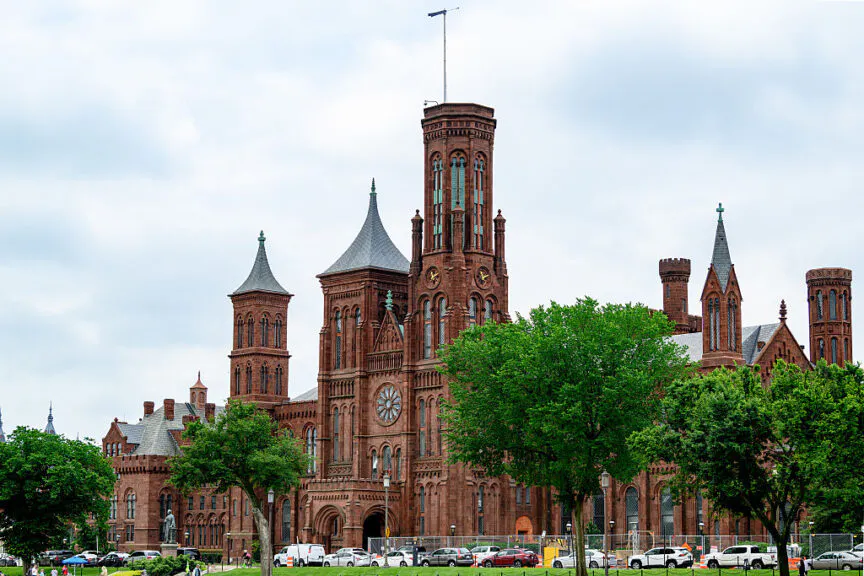
Take first the Smithsonian — the home of America’s national museums that attract visitors from all over the country. As an institution that is nearly two-thirds publicly funded, it bears a responsibility to American taxpayers.
Yet it fails in nearly every way. The National Museum of American History, for instance, cannot even deliver an objective narrative of American history. Instead, it indoctrinates visitors with left-wing ideology and sows shame among Americans, all in an attempt to make them reject their national identity. It treats slavery, imperialism, political polarization, and identity politics as the defining characteristics of the United States.
Roy Rochlin/Getty Images
Undeniably, these are elements of our history, some more important than others, but when elevated above all else, they cease to inform and instead distort the American narrative.
And this is where oikophobia becomes most visible — through omission, interpretive framing, and moralizing language. What is emphasized, what is forgotten, and how the story is told is a much more insightful story.
Institutions like the Smithsonian are respected worldwide, and for them to show such blatant disrespect to the very heritage it is meant to preserve is nothing short of disgusting.
Its leaders also make it abundantly clear that they are oiks themselves.
Dr. Anthea Hartig, director of the National Museum of American History, never misses the chance to recite lines about how the Smithsonian Institution resides on the stolen land of native tribes or how her white privilege has afforded her her station in life. Both statements are meant to signal that the American story begins and remains in illegitimacy rather than achievement.
Nothing is further from the truth.
Like museums, academia too has been affected. Critical race theory tells young, impressionable students that institutions are not to be trusted, for they are inherently racist. Campuses not only allow but even enable protesters who threaten Jewish students and faculty, harass law enforcement, camp out on shared student grounds, and chant violently, anti-American sentiments. Conservative students self-censor so as not to be canceled.
The media is not free either. An excellent example of this is the ongoing conflict in Iran. Just a few weeks ago, Secretary of War Pete Hegseth called out the press for its lack of discipline and honesty, for its habitual practice of sowing shame and fear.
Referencing Operation Epic Fury, Hegseth asks why no one has run a story on the bravery and tenacity of American soldiers. Not MSNBC. Not CNN. Not even Newsmax.
Hegseth shamed the press corps for being irresponsible and for “undermining the success” of the American military. “How about we talk about how special America is,” he said, “that only we have these capabilities.” And then he even conceded, “I think it’s too much to ask.”

Credit: Photo by Mandel NGAN / AFP via Getty Images.
Unfortunately, he may be right. This is yet another example of the ways in which oikophobia now permeates the most influential institutions, degrading national unity by diffusing doubt.
In the 2004 essay The Need for Nations, in which he coined the term oikophobia, Scruton quotes Goethe’s Faust, “What you have inherited from your forefathers, earn it, that you might own it.”
Though he was writing about Europe of the early 2000s, Scruton’s analysis applies almost perfectly to contemporary America. He says that we must “earn again the sovereignty that previous generations so laboriously shaped from the inheritance of Christianity, imperial government and Roman law. Earning it, we will own it, and owning it, we will be at peace within our borders.”
The trouble with oikophobia is that it makes such ownership impossible. It breeds a class of followers who, set in their ways to redefine the nation according to their disdain for it, feel entitled to reject the very inheritance of their birthright. Thus, they will never earn it. And they will never own it.
Where gratitude should exist toward our forefathers, oiks replace with grievance. They say that America is not a nation striving toward its ideals, but one defined solely by its failures. And when that story is perpetuated through museums, classrooms, and the media — the very venues tasked with shaping national attachment — it does not remain abstract. It becomes formative. It becomes defining. It reshapes how Americans see their country, and ultimately, whether they believe it is worth loving at all.
This is the cost of the rise of oikophobia — a battle to define what it means to be American.
But the answer is simple: our American inheritance is worth conserving.
* * *
Anna Gustafson is a Research Assistant in the Allison Center for National Security at The Heritage Foundation.
Savanna Donaldson is a former member of Heritage’s Young Leaders Program.
.png)
.png)