
This article is on Ohio’s response to “Medicaid Millions,” a Daily Wire series exposing billions of dollars in dubious “personal services” payments where people are paid to spend time with their own family.
***
Ohio says it has safeguards in place to cut down on fraud and abuse of Medicaid home health care, but one of the biggest tools to verify care is actually taking place has been rendered useless.
The Daily Wire’s investigation of the multi-billion dollar a year Medicaid industry in Ohio has raised concerns about abuse of a program in which people are paid to visit the homes of elderly poor people and provide “cooking,” “cleaning,” and other non-medical services that even include “companionship.”
In response to those concerns, the Ohio Department of Medicaid said it is “aware of concerns involving home health care activity” in Columbus, and “has been actively investigating these matters since prior to the publication of The Daily Wire series.” It touted an “extensive set of safeguards” in place to ensure aides are actually going to homes.
The key component is “mandatory electronic visit verification capturing date, time, and service location,” a feature that is required by federal law. But Ohio Republican Governor Mike DeWine’s administration inserted massive loopholes including making the verification optional.
The 21st Century Cures Act, passed by Congress in 2016, mandated that states require electronic visit verification, or EVV, by January 2020 for the riskiest category of “personal services” – non-medical services like cooking and cleaning – and by January 2023 for in-home nursing. Yet for years, Ohio simply paid providers even if they didn’t submit any electronic evidence, according to a 2024 audit by Auditor of State Keith Faber.
Faber’s audit, examining payments in 2022, found that 44% of personal services claims had no electronic verification. The situation was similar for home nursing. “This resulted in approximately $1.1 billion in claims not supported by an EVV visit,” the audit found.
The audit said if the state has an electronic validation system, then using it should be a “condition of payment.” A spokeswoman for the Ohio Medicaid Department, Stephanie O’Grady, told The Daily Wire that this was done in March 2025.
But shortly before EVV was made mandatory, it was neutered as a fraud prevention tool. The most important feature – GPS coordinates captured by an electronic device – was made optional and defaulted to “off.”
“Effective July 1, 2024, GPS functionality within any EVV application or device may only be activated with the signed consent of the individual receiving services — valid for one year and revocable at any time,” O’Grady said. “The approach allows the person receiving care to make an informed decision related to privacy protections for individuals receiving home and community-based services.”
O’Grady disclosed to The Daily Wire that GPS is turned off for nearly half of home visits, with reliable coordinates present in only 53% of electronic records.
The patient was also supposed to sign their name to show that the patient and aide were actually together, but that, too, was removed in 2024, Faber’s audit flagged.
Earlier this year, Ohio’s attorney general Dave Yost, whose office is tasked with policing Medicaid fraud, testified that the rollback of safeguards made his job difficult.
“Until about a year ago [GPS] was required, now it’s optional,” he told legislators in March. “I do not know for the life of me why it went away, but I respectfully ask you to put in statute where no vendor, no bureaucrat can object to legitimate monitoring.”
“While we had the GPS, you could see where the person was, they had to drive to the house of the person they were providing services for, you could see how long they were there. That record makes it much harder to do the fake billing where they say they went to five houses but really sat at home,” he said.
Ohio state lawmaker Josh Williams, a Republican from Toledo, says there was no reason why the recipient of a government service would object, or be able to object, to the government verifying that the person being paid by the government to help him actually showed up.
“It seems like the DeWine administration continues to protect the bad actors. And I’m frustrated as a legislator, I’m frustrated as a taxpayer. I’m frustrated because I don’t think we should be providing protection for these individuals,” he told The Daily Wire. “We’re not checking any of your personal information. We’re making sure that the person that is assigned to your case is actually going to your residence.”
“You want to be a Medicaid provider in the state of Ohio for home health care aid, we should be able to track your location data during the times in which you’re asking for payment,” he added.
He said that a common fraud scheme involves a patient and caregiver colluding to have the government pay for nonexistent work — in which case the patient could now simply refuse GPS verification of the caregiver’s presence.
“You have family members going to provide services to an elderly individual, and on many occasions, they’re not even showing up, but they’re getting paid. That family member is not going to report their nephew or their cousin or their niece for not showing up. That’s part of a widespread, broad fraud that we’re seeing,” he said.
Williams has introduced a bill to make GPS mandatory again. But even then, it appears that GPS data could easily be faked.
Faber’s audit said that Ohio spent $146 million contracting with Sandata, a company that produces EVV devices and software, resulting in Ohio providers being able to use Sandata’s software for free. Nonetheless, the state allows home care providers to use their own software instead, potentially including software that simply transmits fake coordinates rather than ones coming straight from a mobile device’s sensors.
The vulnerabilities don’t end there. Ohio also permits the electronic records to be manually adjusted. In 2022, “34 percent of all EVV entries were manually adjusted,” Faber’s audit found.
Additionally, ten percent of aides are exempt from EVV because they live with the patient, often a family member, O’Grady said.
Yost, who resigned as attorney general last week for a job in the private sector, said in his testimony that in addition to DeWine’s rules, Ohio laws also make it difficult to prove and punish Medicaid fraud.
The attorney general’s Medicaid fraud unit isn’t authorized to use subpoenas to gather information, he said. If someone is actually investigated, charged, and convicted, their punishment will be light because Medicaid fraud is “capped as being less serious than other theft, as a third degree felony,” he said.
Red state blues
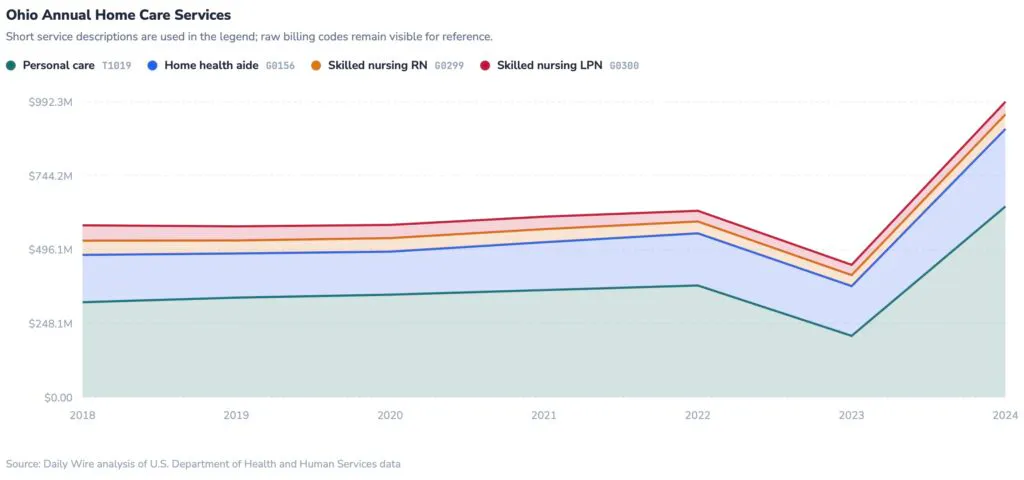
The Medicaid scandal in Ohio has exploded under an all-Republican leadership. In fact, the historical dollar amounts in this series, relying on data through 2024, likely understate the ongoing cost, because DeWine drastically increased the pay rate for home health providers in 2024.
The increases took effect as “part of Governor Mike DeWine’s commitment to making sure every Ohioan receives quality care and that providers receive support to continue delivering the highest level of care for Ohio’s residents,” a press release said. “The rate increases are historic in nature, totaling approximately $3.4 billion per year,” including home health and other Medicaid spending.
DeWine has been accused of being soft on fraud, particularly after a spokesman once called fraud in the state’s Somali hotspots “the cost of doing business.”
Last week, Vivek Ramaswamy secured the Republican nomination to replace DeWine next year. Responding to The Daily Wire’s reporting, he said that states have “turned a blind eye to this level of rampant fraud” despite the fact that “in a modern era of AI, you have a toolkit that allows you to detect aberrant abnormalities.”
That’s partly because of an incentive issue with how Medicaid is set up, he said. Medicaid is run by the states, but is largely paid for by the federal government. That means it’s up to states to stop waste and fraud, but they don’t always have a strong financial motivation to do so, because it would decrease federal dollars to the state.
Ohio’s Medicaid program is set to be in the hole $33 billion over the next few years due to federal changes aimed at stopping states from gaming the numbers to offload even more of the burden to the feds.
Vice President JD Vance, also from Ohio, said in response to The Daily Wire’s series: “I’m directing the task force to look into it and take immediate action to prosecute any fraudsters involved and stop all further payments as appropriate.”
Ramaswamy noted that there is “uppercase F fraud, and also lowercase F fraud, which may be technically legal but doesn’t comport with anyone’s sense of who should get these dollars.” Those cases could necessitate changes in law or policy to stop the bleeding.
Aggressive Medicaid “waiver” programs such as those the feds have allowed Minnesota and Ohio to run are particularly vulnerable to abuse, and have exploded in usage. Medicaid takes up nearly half of Ohio’s general revenue fund, and spending has doubled in recent years.
Yet even as the red flags are hard to ignore — the percentage of people claiming to be autistic is exploding the dubious levels, for example — there has been aggressive, almost blatant pushback against using common and affordable technology to provide basic safeguards.
Nationally, a group called “Stop EVV” launched a “media toolkit” showing pictures of disabled people holding signs with messages like, “I’M THE EMPLOYER. IT IS MY RIGHT TO SCHEDULE, SUPERVISE & SIGN MY EMPLOYEE’S TIMESHEET.” The site pictured a bald eagle and American flag and called stopping GPS tracking a “civil rights” issue.
Ohio’s Department of Medicaid says that “all allegations of fraud are investigated,” and further that many of the companies identified by The Daily Wire “are subject to ongoing investigation” by the state. It said it is unable to comment on those investigations.
But Faber, the auditor — who is running for attorney general — has been warning of abuse that mirrors The Daily Wire’s findings. He recently told the legislature that 38% of Ohio home health spending was in Franklin County, and that of that, 41% – or more than 15% of all home health care spending in the state — is spent in a four mile radius.
Faber’s audit found that in 2022, there were 2,479 home health companies in Ohio, which were paid $1.8 billion. That means 10% of all home health companies in the state are located in the seven buildings owned by one landlord in Columbus’s Somali neighborhood, which was highlighted in our second installment.
The data analyzed by the Daily Wire, finding a quarter billion dollars to companies in seven buildings, covered from 2018 to 2024. It understates the total because data for smaller companies is not available for privacy reasons.
Parker Thayer, an investigator for the Capital Research Center, contributed reporting.
.png)
.png)

