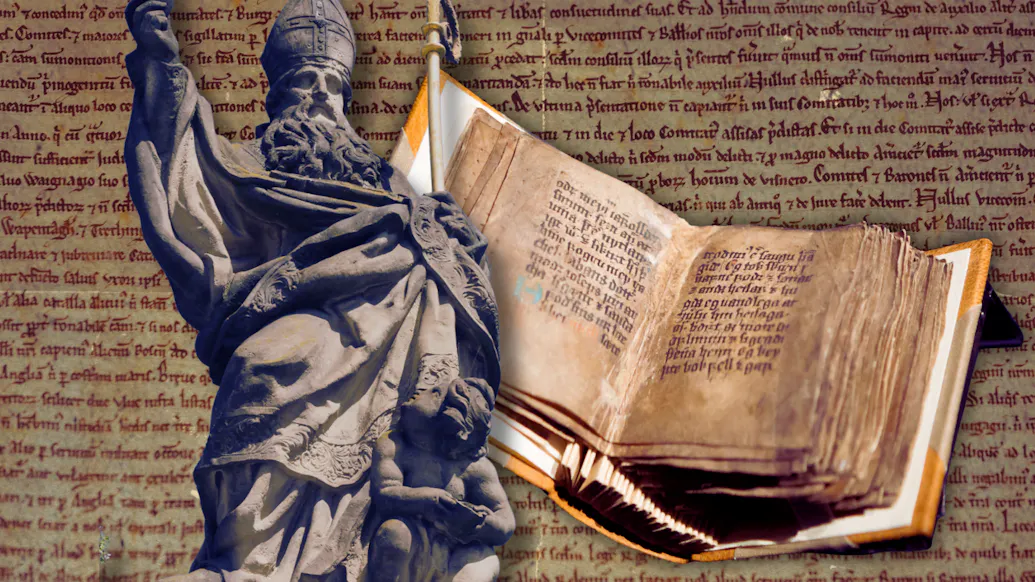
Scholars have discovered two previously unknown sermons by St. Augustine of Hippo while translating an 11th-century manuscript from a German monastery, shedding new light on one of Christianity’s most influential theologians.
University of Würzburg Latin scholar Christian Tornau discovered the sermons while translating a manuscript originally from Bad Doberan Abbey in Germany. The manuscript contained copies of six sermons attributed to Augustine.
“Two of the six sermons are previously undiscovered writings by Augustine,” Professor Tornau said.
Because forged works attributed to Augustine are common, Tornau and his colleagues initially suspected the sermons were inauthentic, The New York Post reported.
After identifying Augustine’s trademark humor, references to his North African Christian tradition, and a distinctive style of prayer, however, Tornau and a panel of 20 Latin scholars concluded: “they are indeed authentic.”
Augustine, who was born in what is now Algeria, is regarded as one of Christianity’s most influential theologians. His writings, including Confessions and The City of God, helped shape medieval philosophy and Western thought.
The newly discovered sermons focus on the biblical account of King Saul and the Witch of Endor from the First Book of Samuel. In the story, Saul seeks guidance from God before a battle but instead turns to the Witch of Endor, asking her to summon the prophet Samuel, who foretells Saul’s death.
Tornau told Fox News Digital that Augustine’s interpretation of Saul’s repentance was the “most remarkable element” of the sermons.
While many Christian scholars throughout history viewed Saul as an unrepentant villain, Augustine interpreted the story as suggesting Saul made peace with God before his death.
“In any event, it is indicative of Augustine’s [independence] of mind and his willingness to think everyone, even those who appear most evil, [is] capable of salvation through the grace of God,” Tornau said.
“This combines intellectual honesty and episcopal humility in a remarkable and very Augustinian way.”
The sermons also revisit one of the Bible’s longstanding theological questions.
“The story [also] raises a theological question: ‘Why can a necromancer summon the spirit of a prophet?’” Tornau said. “This in turn opens up the theodicy problem: ‘how can an omnipotent God allow this or is he not really omnipotent?’”
According to Tornau, Augustine explored whether the encounter was merely an illusion or whether God permitted it, using the account to examine the relationship between divine providence and evil.
Tornau is working with the publisher Corpus Scriptorum Ecclesiasticorum Latinorum (CSEL) to bring Augustine’s sermons to the public.
.png)
.png)