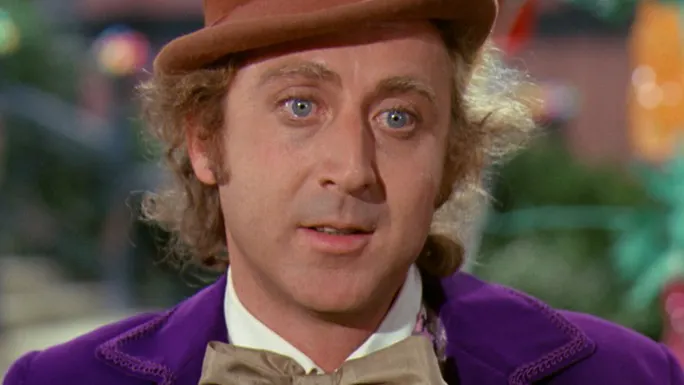
If you do the math, although he lived a nice long life until dying Monday at the age of 83, The Mighty Gene Wilder really wasn’t with us for very long — “us” being his devoted fans. He burst into our lives in 1967 when he was already 34-years-old, which is an ancient age to start a movie career. His last movie, the forgettable “Another You,” came just 24 years later. Over the next ten years or so, there would be a handful of television appearances (including a failed sitcom), but for most of us he was gone forever in 1991.
It is probably not a coincidence that in 1989 he lost his beloved wife Gilda Radner to a terrible cancer, or that in 1990 his most famous screen partner, Richard Pryor, was already ravaged by multiple sclerosis. Other than a couple of cameo appearances, “Another You” would also be Pryor’s last film.
Many comedians feed off personal tragedy and the infinite well of anger that often accompanies it (see: Pryor, Richard). Maybe Wilder was the exception. Although his characters seethed with a wonderful undercurrent of rage and untapped aggression, maybe he was in reality a genuinely sweet man who couldn’t bring himself to drop that water bucket in order to feed the muse. Maybe the untimely and unthinkable loss of his wife and friend broke something in him forever, just like it will most of us.
Regardless, it is a shame. Wilder was just 57 when he left the big screen. Sure, his legend was already cemented by a string of timeless performances, but let’s be greedy and imagine what could have been.
Wilder’s talent was such that he was a comedian who shined in the 1970s and early 1980s — the era of no less than Pryor, Carlin, Cosby, Belushi, Rickles, Akroyd, Newhart, Woody, Murray, Winters, Dangerfield, and Monty Python; a Murderers Row of geniuses allowed to shine as bright as the extent of their talents would allow, and did so during the glorious and way too short era that existed between the fall of Hollywood Production Code and the ever-climbing fascist walls of political correctness.
Such was Wilder’s talent that it is easy to imagine him in his middle age and dotage playing — yes! — the villain; the kind of role Albert Brooks played in “Drive” or Dangerfield knocked out of the park in “Natural Born Killers.”
Imagine Wilder playing Jimmy Dimmick, the role director Quentin Tarantino gave himself in “Pulp Fiction.” No, seriously, just stop and imagine Wilder’s supreme gifts, his touch of madness, his unspoken threat to fly off into hysteria, repositioned away from comedy and into drama.
Despite two nominations (acting in “The Producers,” co-writing “Young Frankenstein”) Wilder never won, nor was he even awarded an Honorary Oscar. So you’ll pardon me if I don’t whip out a violin for “Selma.”
I was fortunate enough to come of age in the era of Wilder. For those looking to relive the magic or those who missed it, here are, in my humble opinion, Gene Wilder’s seven timeless classics.
1. Bonnie and Clyde (1967)
How fitting that Wilder arrived in the very film (along with “Easy Rider”) that crumbled the censorious Production Code and changed Hollywood forever.
Despite the presence of Warren Beatty, Faye Dunaway, Estelle Parsons, Gene Hackman, and Michael J. Pollard, as kidnapped undertaker Eugene Grizzard, in his few scenes, Wilder takes total command of the movie by singlehandedly controlling the shifting mood and tone. He is the best part of a dazzling work of cinematic art.
2. Willy Wonka and the Chocolate Factory (1971)
Errol Flynn as Robin Hood, Vivien Leigh as Scarlett O’Hara, Marlon Brando as Vito Corleone, Robert Mitchum as Max Cady, Christopher Reeve as Superman, Margot Kidder as Lois Lane, Gene Wilder as Willy Wonka. These are the greatest casting decisions Hollywood ever made.
Peter Sellers reportedly begged for the role. A handful of other geniuses like Joel Grey and John Cleese were considered. But there was really only one choice to play Willy Wonka — Mr. Gene Wilder.

What Wilder understood about the character was that Wonka was not an eccentric, what he was, rather, was angry and embittered — seething with resentment towards a mercenary world that forced him into seclusion to guard his secrets and personal privacy. From the opening scene where Wonka pretends to be crippled (Wilder’s invention) straight through to where he literally screams in poor Charlie’s face, Wilder’s live wire performance keeps your guard up throughout.
Thanks to one of the all-time great film performances, “Willy Wonka and the Chocolate Factory” is at heart nothing less than a revenge film, a wonderfully mean-spirited adventure where we watch a mercurial and even dangerous candy maker use the Deadly Sin of wrath to set traps and serve vengeance upon a handful of small children who represent the Deadly Sins of gluttony, greed, lust, sloth, envy and pride.
Without Wilder there would be none of that, and this box office flop would be remembered as just another bloated 1970’s widescreen musical.
Instead it is a legitimate masterpiece.
3. Blazing Saddles (1974)
Brought in at the last minute to replace the alcoholic Gig Young, Wilder is perfect as the Waco Kid, an unassuming but deadly gunfighter. He is also a walking anachronism, which of course is perfect for a classic comedy full of them.
4. Young Frankenstein (1974)
Wilder conceived and co-wrote (with director Mel Brooks) this affectionate but still hilarious homage to those still wonderful Universal horror films of the 1930’s and 1940’s. There’s nothing cheap at work here. Wilder isn’t interested in deconstructing a classic or anything approaching dirty humor. “Young Frankenstein” is filled with an abiding love for what it spoofs and is enjoyably naughty, as opposed to raunchy.
One of my favorite childhood memories is sitting in the dark at the drive-in and hearing the endless laughter coming from all those cars.
Perfect movie. Perfect memory.
5. Silver Streak (1976)
After three movies with Mel Brooks, Wilder would find a second partnership of perfection with Richard Pryor.
“Silver Streak” was a box office smash, making the equivalent of $220 million today. The over-arching story, a Hitchcockian/wronged man murder mystery on a train, is a little weak. It’s the burning chemistry between the two stars that keeps you coming back.
Pryor teaching Wilder how to be black is as good as life gets.
6. Stir Crazy (1980)
Another Wilder/Pryor smash ($315 in today’s dollars) and a genuine classic without a single bad joke or false move.

7. The Woman in Red (1984)
Maybe this doesn’t deserve a place above “The Producers,” “Start the Revolution Without Me,” “The Frisco Kid,” and a handful of others, but I have a sentimental attachment towards what would be Wilder’s last good film. I also respect it.
Yes, the movie is imperfect and Stevie Wonder’s title song makes you want to punch a blind man, but…
Wilder, who directed and adapted the script from a French film, plays Teddy Pierce, an Everyman who becomes obsessed with Charlotte (Kelly Le Brock). Although happily married, he risks it all to possess this goddess, who is also married.
Wilder’s clumsy, sweaty pursuit of Le Brock is laugh-out-loud funny, as is Gilda Radner’s vengeful Ms. Milner. That’s all well and good, but there is so much more going on here.
Wilder could have easily made his character more sympathetic by portraying Teddy’s wife as a shrew, or by having him learn the hard way that the grass is not greener. In other words, Wilder doesn’t go for the obvious role of a sad sack Who’s Not Going To Take It Anymore or a man who needs to Learn To Appreciate What He Has. Instead, that quiet, oppressed rage is back, and Wilder presents to us a character who sees in the unobtainable his own ho-hum life of missed opportunity and passion. And at any cost, including the destruction of a family, he will have his revenge.
The final reveal, where we learn that it wasn’t the girl Wilder wanted but rather the excitement of the chase (as he sets his sight on another woman), takes a while to come to terms with and to appreciate.
And that was Gene Wilder’s gift, and why his powder blue eyes never focused on a single thing in front of him. He was always distracted, looking off just a few moments into the future to that moment when he would pull the rug out from underneath you; and laughing the whole way, down you would go, equal parts bewildered and appreciative of this one-of-a-kind genius.
Follow John Nolte on Twitter @NolteNC
.png)
.png)