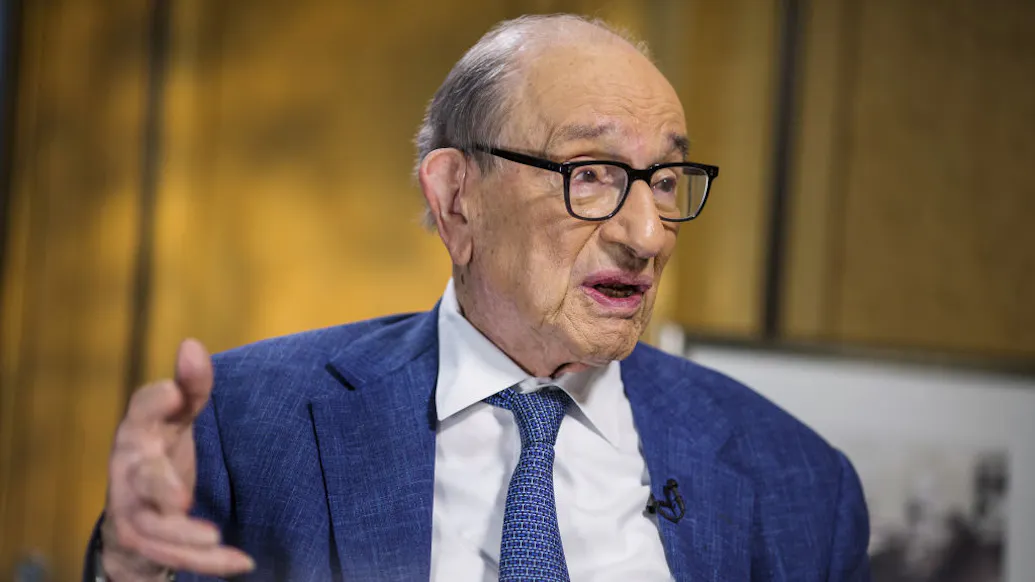
Alan Greenspan, the influential economist and former chairman of the Federal Reserve, died on Monday. He was 100 years old.
Greenspan’s wife, NBC News anchor Andrea Mitchell, said the former Fed chairman died at home from complications related to Parkinson’s disease.
“He was a giant of a man who helped shape the U.S. economy for decades under presidents of both parties, but was always honest in acknowledging his mistakes,” Mitchell said.
“To me, he was my husband, who shaped my life from our very first date in 1984. He had ‘irrational exuberance’ for baseball, the Washington Commanders, tennis, golf and music, especially jazz,” Mitchell added. “He will be remembered for his brilliance and his kindness. Being his life partner was the joy of my life.”
Greenspan, who was appointed by former President Ronald Reagan as the 13th chairman of the Federal Reserve, led the Central Bank for nearly 19 years, serving under presidents from Reagan through George W. Bush. His tenure was the second-longest in the institution’s history, surpassed only by William McChesney Martin, who led the Fed from 1951 to 1970.
Greenspan is credited with steering the United States’s monetary policy from the end of the Cold War to the start of the digital age. His tenure saw “Black Monday,” when the Dow Jones Industrial Average dropped 22%, the burst of the dot-com bubble, and 9/11.
After leaving the Federal Reserve, Greenspan was awarded the Presidential Medal of Freedom, the nation’s highest civilian honor, by President George W. Bush.
Greenspan began his career on Wall Street as an equity research analyst at the investment bank Brown Brothers Harriman. He served as an informal domestic policy coordinator for Richard Nixon’s 1968 presidential campaign and officially entered public service under President Gerald Ford, as chairman of the Council of Economic Advisers from 1974 to 1977.
Reagan appointed Greenspan as Fed chairman in 1987. Greenspan developed a reputation for holding interest rates steady, particularly during periods of rapid technological innovation such as the age of the computer. He argued that a more accommodative monetary policy could help sustain economic growth and support productivity gains driven by technological advancement.
The Fed’s newest chairman, Kevin Warsh, implied he might take a similar approach with the onset of artificial intelligence. “Like Alan, I intend to fill the role of chairman with energy and purpose, just the way Chairman Greenspan did.”
Treasury Secretary Scott Bessent, who gets breakfast with Warsh every Friday morning, said earlier this year that, “The Fed needs to have merely an open mind. The open-minded maestro, former Fed Chairman Alan Greenspan, resisted premature rate hikes during the technology boom of the 1990s — and history proved him right.”
The Federal Reserve remembered his legacy in a statement early Monday morning.
“The Federal Reserve notes with deep sadness the passing of Alan Greenspan. Chairman Greenspan served as the 13th Chairman of the Board of Governors from 1987 to 2006, and his contributions to monetary policy and economic thought left a lasting mark on this institution, on the broader field of economics, and on the country.”
Former Federal Reserve Chair Ben Bernanke, who succeeded Greenspan, also paid tribute to Greenspan.
“He was a great central banker who helped lead his country through almost two decades of prosperity,” Bernanke said. “I always found him generous with his time and insights. We are still learning from him, even if he is no longer with us.”
.png)
.png)