 Jason Miyares
In Kibbutz Be’eri, the air inside a child’s bedroom was still. Behind a small bed, a doll lay where it had fallen. The wall above it was scarred with bullet holes and blood stains.
The scene needed no explanation. An Israeli girl had hidden behind her bed as Hamas terrorists rampaged through her home, clutching her doll in the dark and hoping to survive. However, she was found and murdered for nothing more than existing.
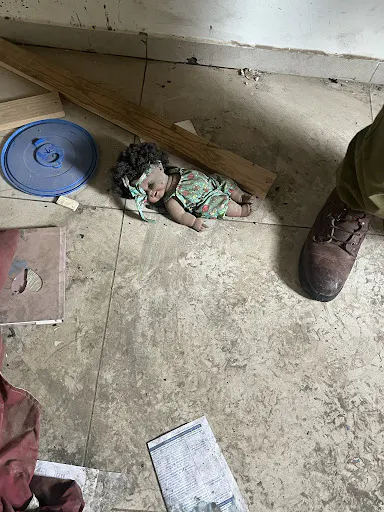
Credit: Jason Miyares
As the father of three teenage daughters, this room left an indelible impact on me during a post-October 7th visit to Israel, and I worry about what it means that the world has largely moved on already.
The October 7th massacre revealed how quickly some will rationalize evil when the victims are Jewish. The same hatred that fuels barbaric terror against Jewish civilians in Israel does not stay contained. It spreads, adapts, and rebrands itself globally with new slogans and justifications.

Credit: Jason Miyares
Here in the United States, antisemitism has reemerged across the political spectrum in recent years. On the far left, it is generally dressed up in ideological language, presenting hostility toward Jews as moral or political virtue, and often merges into the legitimization of Islamist aims.
On the far right, it has evolved too, from old nationalist branding into a foreign-amplified “groyper” rhetoric targeted at young men who feel alienated, rootless, and eager for a cause.
To comprehend why antisemitism keeps returning, one must realize what it offers — a shortcut around reason. Once hate hardens into a kind of faith, words lose their meaning, and arguments no longer need to make sense.
In the aftermath of October 7th, antisemitism moved from the margins to the mainstream. In Virginia, Jewish students were prevented from walking on sidewalks at the University of Virginia. Outside agitators tried to occupy the Virginia Commonwealth University campus. At George Mason, antisemitic threats led to law enforcement intervention.
After returning home from my trip to Israel, the first image I saw on TV at the airport was of American students waving Hamas flags and chanting pro-terror slogans.
Virginia had a duty to act, and we did so quickly. Our efforts were rooted in an understanding that the fight against contemporary antisemitism requires a multi-faceted strategy, spanning policy, law enforcement, and education, with a focus on concrete steps to prevent violence before it occurs.
We prioritized training for law enforcement. Hundreds of Virginia State Police officers have participated in antisemitism awareness seminars, facilitated by the Combat Antisemitism Movement (CAM), where they learned to identify and counter extremist threats, resulting in real-world outcomes that have made Virginia’s communities safer.
We focused on maintaining order on college campuses. To do so, we met with the general counsels of every public higher education institution in Virginia to help them navigate First Amendment questions while ensuring schools had increased security and resources. Working with law enforcement agencies and university leaders, we proactively prepared for the unrest seen in other states before it arrived in the Commonwealth.
We ensured families and students understood their rights, providing clear guidance on how to report and file formal complaints when antisemitic discrimination occurs. For elementary, middle, and high schools, the Task Force developed a new curriculum module about Jewish religion, culture, and history to counter distorted narratives about the Jewish people that frequently circulate among students.
In 2025, we became involved in a case where three young Jewish siblings were expelled from their school after their parents complained about antisemitic harassment one child suffered at school. The eventual settlement saw the school agree to implement a new nondiscrimination policy, including adoption of the International Holocaust Remembrance Alliance (IHRA) Working Definition of Antisemitism.
Important action was taken against support for foreign terrorist organizations when we initiated a criminal investigation into potential violations of state charitable fundraising laws by Hamas-linked Americans for Muslims in Palestine (AMP).
I was also proud to participate in Virginia’s first-ever state-level summit against antisemitism, organized by CAM in June 2024.
Reflecting on my term as attorney general, I remember that child’s room in Be’eri and the abandoned doll. It strengthens my resolve to refuse the world’s excuses and insist on better.
As Virginians and as Americans, we should be clear-eyed about what antisemitism is, honest about how it proliferates, and unafraid to counter it wherever it appears. That is what this moment in history calls for.
***
Jason S. Miyares served as Attorney General of Virginia (2022-2026) and is now a member of the U.S. Advisory Board of the Combat Antisemitism Movement (CAM).
.png)
.png)