The WNBA has a rule saying only women can play. What it doesn’t have, at least publicly, is an explanation of what exactly makes someone a woman.
Enter Enes Kanter Freedom.
The former NBA player is putting that question to the test after ESPN reported that multiple sources around the league said he and fellow former NBA player Royce White are not eligible to play in the WNBA.
There’s a reason two former NBA players suddenly want into the women’s league.
Both men have declared themselves women and eligible for the 2027 WNBA Draft. The move is meant to force the league to confront a question that has been hanging over it for weeks.
Who qualifies as a woman under WNBA rules?
Article XIII, Section 1(a) of the WNBA’s collective bargaining agreement states: “Only players who are women are eligible to play in the WNBA.”
That’s it.
Michael Reaves/Getty Images
The agreement does not go on to define the word “woman,” and the WNBA does not have a publicly available policy governing the eligibility of transgender or intersex athletes, according to ESPN.
So when Fox News host Laura Ingraham pressed Freedom Monday night on whether he is actually a transgender woman, Freedom turned the question back to the league’s rules.
“Listen Section 13 right Uh Article 13 Section 1 says if you identify as a woman then you’re allowed to play,” Freedom said.
Ingraham asked whether that meant he was identifying as a woman.
“I identify as a woman, sure, yes,” Freedom responded.
Freedom’s description goes further than what the CBA actually says. The agreement does not state that simply identifying as a woman makes someone eligible. It says only that players who are women may play, without publicly explaining how the league determines who meets that requirement.
And that’s the loophole Freedom is trying to expose.
“But right now if you identify as a woman you’re allowed to play and I am identifying as a woman and I am I should be allowed to play it,” Freedom told Ingraham.
The WNBA didn’t find itself answering questions about transgender athletes because of Freedom, however.
That started with Indiana Fever guard Sophie Cunningham.
Cunningham set off a national debate earlier this summer when she spoke out against men competing against women and girls.
“I got a lot of negative feedback about me hating trans. And I’m like, I never once said that,” Cunningham told ESPN. “I think that I am here to extend love. But I also think with that love is truth, being honest. And I want to protect young girls in a locker room, or young girls in sport who shouldn’t have to go against biological men.”
Cunningham later described her position as “common sense.” Her comments turned what had largely been a broader political debate into a very real WNBA headache.
Protests and counterprotests began following the Fever on the road. Other players weighed in. The league was suddenly facing questions about who should be allowed to compete in women’s basketball.
There was just one problem. There wasn’t actually a transgender player attempting to enter the WNBA.
Freedom and White decided to change that.
Freedom played 11 seasons in the NBA, while White was a first-round NBA Draft pick in 2012. Both men declared themselves women and eligible for the 2027 WNBA Draft, transforming a largely hypothetical debate into a direct challenge to the league’s eligibility language.
Freedom then took the fight courtside.
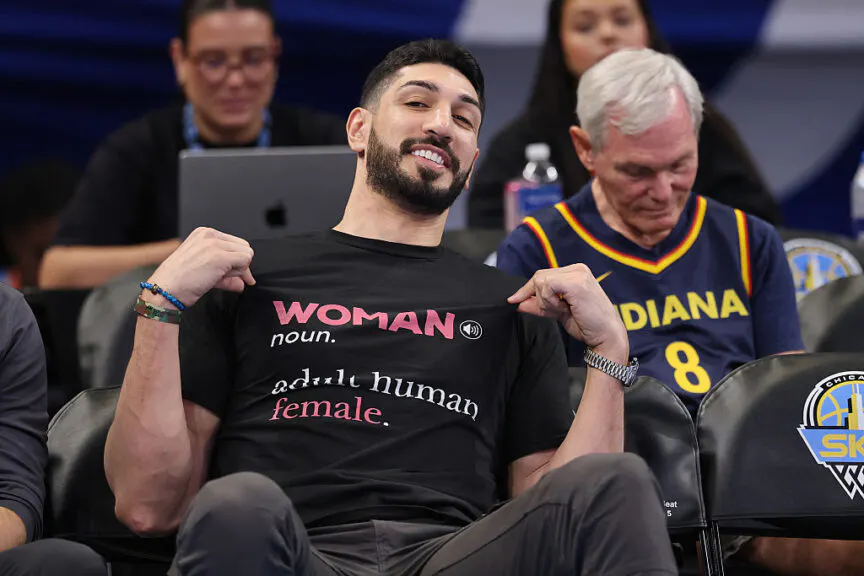
He attended Sunday’s Indiana Fever game against the Chicago Sky wearing a black shirt that read, “WOMAN noun. adult human female.”
During a timeout late in the third quarter, Sky guard Natasha Cloud confronted Freedom, and Freedom took several steps toward the court before security intervened and escorted him from Wintrust Arena.
“I just got kicked out of a @WNBA game for supporting WOMEN!” Freedom wrote afterward. “Let that sink in, AMERICA!”
A day later, ESPN reported that sources around the league said Freedom and White would not be eligible to play.
ESPN also reported that there are currently no cases requiring the WNBA to make an eligibility determination and that the league plans to continue researching and reviewing the issue. No known transgender woman has played in the WNBA.
That leaves Freedom with essentially the same question he started with: if the WNBA says he isn’t eligible, what exactly is the rule that makes him ineligible?
Freedom said he’ll follow it if the league spells it out.
“If they ever come out and say ‘Okay we are changing the rules,’ I respect their decision,” Freedom told Ingraham. “I will, you know, follow the rules.”
For now, the league’s written rule remains remarkably simple: only women can play in the WNBA.
Freedom’s challenge is just as simple.
Define one.
.png)
.png)