Humanoid robots programmed to win foot races, boxing matches, and street dance competitions may soon be reprogrammed with a very different strategy in mind: combat.
Communist China, according to recent reports, is eyeing technology showcased at the recent World Humanoid Robot Games for battlefield use. Reuters reported on Monday that the People’s Liberation Army’s official newspaper called for a move to develop combatant capabilities in the humanoid robots that danced, ran, and boxed at the games.
During the games, some robots completed the 100-meter dash faster than track-and-field legend Usain Bolt’s world-record time.
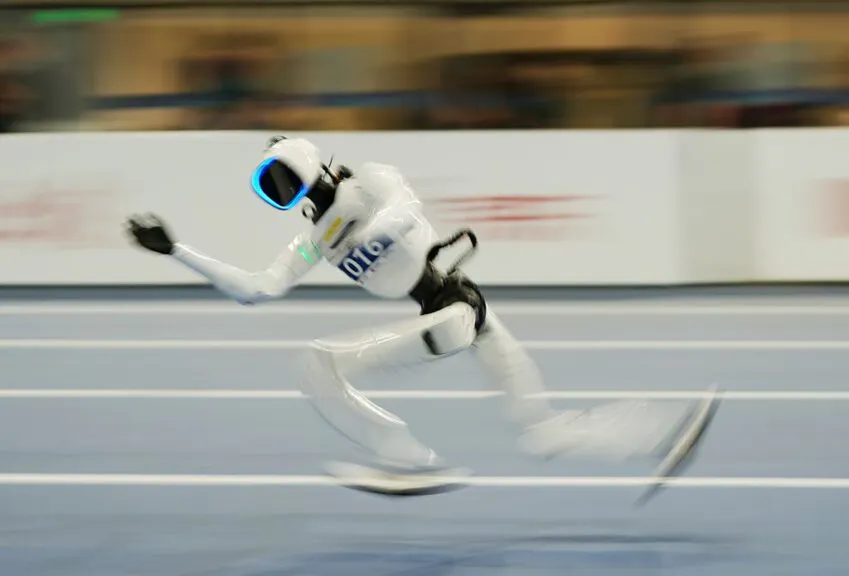
Cui Jun/Beijing Youth Daily/VCG via Getty Images
Boxing matches showed the robots’ potential in hand-to-hand combat.
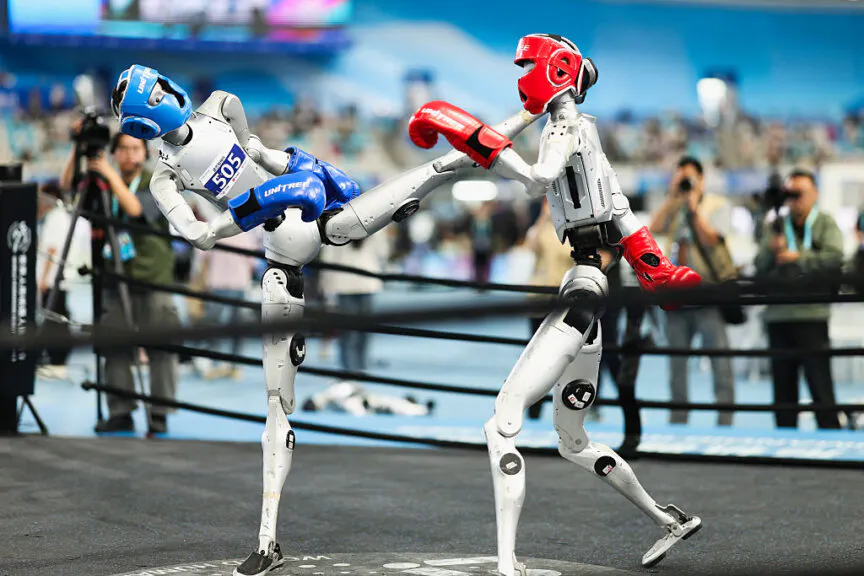
Lintao Zhang/Getty Images
Reuters, after reviewing “more than 100 Chinese military procurement notices, academic studies, patents, official publications, government records and defense-company materials,” concluded that the Chinese government has dramatically accelerated robotics research and development for eventual battlefield use.
According to BofA Global Research, Chinese developers and manufacturers account for about 95% of humanoid robot shipments in 2025.
China is not the only nation moving toward robot-centered combat missions.
The United States military recently tested unmanned ground vehicles (UGVs) within formations of M2A4 Bradley infantry fighting vehicles. Video from the exercise shows at least five FireAnt unmanned ground vehicles (UGVs) being carried into operations by the Bradleys during the U.S. Army’s Pegasus Charge 3 experiment with the 1st Cavalry Division.
US Army Bradley fighting vehicle was filmed carrying five small AI-powered robot swarm units on its side racks during exercises at Fort Hood, previewing a future where armored vehicles serve as motherships for expendable ground robots.
The FireAnt robots weigh about 27 kg each… pic.twitter.com/s848StbikD
— Clash Report (@clashreport) August 27, 2026
Robotics systems have also become a major factor in recent conflicts around the world, including the fighting involving Iran and the war between Russia and Ukraine. A recent report indicated that Russia has used an experimental navigation system that relies on artificial intelligence to guide unmanned drones toward targets in Ukraine.
In that case, human operators programmed the drone’s navigation system to key in on a generalized target—a particular building, a military base, or a gas station—and the AI was supposed to fine-tune the target once it was within range.
The risk of using such technology in combat — whether in drones or humanoid robots — is that AI is far less likely to distinguish civilians from combatants, and without a human operator, it would be much harder to stop an errant robot in real time.
.png)
.png)