
As the risk of fighting between the United States and Iran threatens to reignite, China is caught in a bind, trying to protect its interests without getting dragged into the conflict.
Although China may soon feel pressure from reduced energy flows through the Strait of Hormuz, Beijing’s approach so far has been defined by restraint, risk management, and opportunism, according to experts interviewed by The Daily Wire.
“For Beijing, the primary objective is to mitigate the downside,” said Elizabeth Economy, a Hargrove Senior Fellow at the Hoover Institution with expertise on Chinese domestic and foreign policy. “This includes navigating through the threat of a global economic recession, managing its disparate relations with countries in the Middle East, and ensuring that it maintains access to the energy it needs.”
Roughly 45% to 50% of China’s crude oil imports pass through the Strait of Hormuz. In 2025, more than half of its crude oil and nearly one-third of its liquefied natural gas came from the Middle East, according to Columbia University’s Center on Global Energy Policy.
Official Chinese government data shows 42% of its crude (about 4.9 million barrels per day) comes from Saudi Arabia, Iraq, and the United Arab Emirates. An estimated additional 12% comes from Iran, according to Kpler, even though Beijing has reported no Iranian imports since 2022. Oil from the Iranian-linked illicit “dark fleet” is often relabeled as from other countries, or transferred to different ships to disguise its origin because of U.S. sanctions.
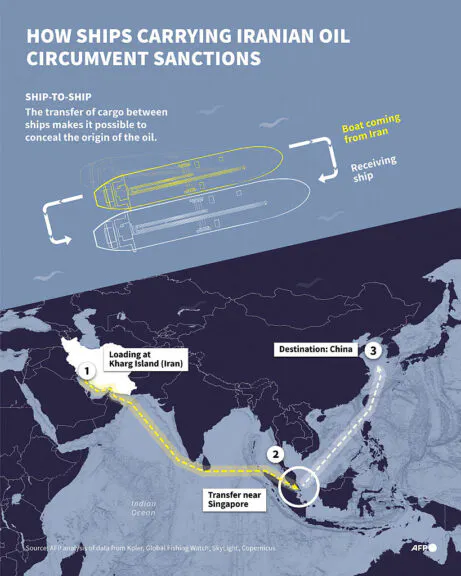
Infographic with map showing how oil from Iran is transported to China circumventing sanctions with transfers to other vessels near Singapore (Graphic by AFP via Getty Images)
The U.S.-imposed blockade on vessels traveling to or from Iranian ports and its coastline has put increasing pressure on the regime and its primary buyer: China.
“Beijing has reportedly been in contact with Tehran on shipping and de-escalation issues and has urged restraint,” Craig Singleton, a senior fellow at the Foundation for Defense of Democracies, said.
One vessel that drew international attention this week was the Rich Starry. A sanctioned-tanker bound for China and carrying roughly 250,000 barrels of methanol loaded in the United Arab Emirates, it appeared to transit the Strait of Hormuz before turning back toward Iranian waters after encountering the blockade.
The United States expanded the blockade last week to target Iranian-linked sanctioned vessels worldwide. These ships, known as the “dark fleet,” have allowed Tehran to continue exporting oil despite sanctions by using tankers with obscured ownership, falsified tracking data, and other methods to conceal the origin of Iranian crude — much of which flows to China.
That expanded effort was enforced in the Indo-Pacific for the first time this week, marking a shift beyond the Middle East as U.S. forces intercepted and boarded the Iran-linked sanctioned M/T Tifani.
Even if the blockade continues, China has significant reserves to cushion the impact of the blockade or conflict in the short term.
Overnight, U.S. forces conducted a right-of-visit, maritime interdiction and boarding of the stateless sanctioned M/T Tifani without incident in the INDOPACOM area of responsibility.⁰⁰As we have made clear, we will pursue global maritime enforcement efforts to disrupt illicit… pic.twitter.com/EGwDe3dBI3
— Department of War 🇺🇸 (@DeptofWar) April 21, 2026
“The impact on China’s energy access appears relatively limited,” said Singleton. “China has spent years building up significant strategic reserves and investing in alternative energy sources, including nuclear and renewables, to buffer against supply shocks.”
According to geospatial analytics firm Kayrros, China had roughly 1.39 billion barrels of oil in storage — enough to cover about 120 days of net crude imports at 2025 levels. Additional oil is still in transit, awaiting customs clearance, or in floating storage in Asia.
Still, those buffers are not a long-term solution. Beijing may eventually turn to demand reduction measures, including curbing consumption or allowing state-owned energy firms to raise prices, according to the Columbia University-run center.
Smaller Chinese refineries, known as “teapot refineries,” could feel the pressure first. Many shifted from Venezuelan crude to cheap Iranian oil after the United States moved against Venezuelan leader Nicolas Maduro. Operating on thin margins, these refiners are particularly vulnerable to price spikes or prolonged disruption.
“In terms of price, China is facing the same problem the rest of the world is,” Michael Sobolik, a Senior Fellow at Hudson Institute focusing on U.S.-China relations said. “Their smaller refiners are struggling, for sure. But in terms of supply, Beijing will be fine, at least for now.”
“But the longer this conflict goes on, the tougher it’ll become,” he added.
China’s reliance on Iranian oil also creates broader diplomatic challenges.
After the United States and Israel launched attacks on Iran in Operation Epic Fury, the regime responded with rocket and drone attacks on its Arab neighbors, including Bahrain, Cyprus, Iraq, Jordan, Kuwait, Oman, Qatar, Saudi Arabia, and the United Arab Emirates — many of which China depends on for energy and trade.
That leaves Beijing trying to maintain ties with both Iran and its regional rivals at the same time.
Sobolik said China’s own role in supporting Iran’s missiles adds another layer of complexity.
“It supplied rocket fuel for Iranian missiles, and Tehran has fired those missiles at its Arab neighbors,” Sobolik said. “Beijing needs good relations with those countries for energy reasons, so Beijing may encounter some difficult diplomatic dynamics ahead.”
Though a continued conflict could force China to diversify or take sides, experts say a major shift is unlikely for now.
“Iran has historically been a discounted and politically useful supplier for Beijing,” said Singleton. “Over time, this could create stronger incentives for China to diversify supply, but a full realignment would likely require a more durable disruption or a fundamentally different regime in Tehran.”
Though China was rumored to play a role in pushing negotiations that led to the April 8 ceasefire, experts say Beijing’s role may have been more limited.
“It looks like China leaned on Iran to accept a round of negotiations in Pakistan,” said Sobolik. However, he cautioned that Beijing’s influence over Tehran has clear limits.
“China can’t guarantee Iran’s safety, nor can they compel the regime to give up its quest for nuclear weapons,” Sobolik said.
China also refrained from publicly taking a high-profile diplomatic role in negotiations, to have flexibility and avoid being blamed if talks failed.
Economy said this approach “minimizes China’s political risk and enables Beijing to avoid blame or embarrassment if the negotiations stall or collapse.” It also helps China avoid being “called out for hypocrisy when it talks about protection of international law and respect for sovereignty, given its support for Russia’s war in Ukraine.”
The Iran conflict may be a topic in the upcoming U.S.-China summit scheduled for May 14–15, when President Donald Trump is set to meet Xi Jinping in China, but experts say the conflict has not significantly damaged relations between the two countries.
“It has introduced additional friction, particularly around energy flows and the blockade, but it does not appear to have fundamentally altered the broader trajectory of the relationship,” said Singleton. “Both sides still seem interested in managing tensions and preserving space for engagement where possible.”
Economy offered a similar assessment, saying the conflict has not derailed ties ahead of the summit, which remains a priority for both governments.
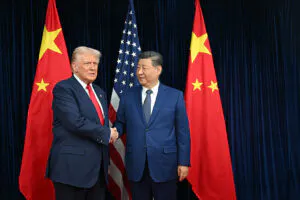
US President Donald Trump (L) and China’s President Xi Jinping shake hands as they arrive for talks at the Gimhae Air Base, located next to the Gimhae International Airport in Busan on October 30, 2025. (Photo by ANDREW CABALLERO-REYNOLDS / AFP) (Photo by ANDREW CABALLERO-REYNOLDS/AFP via Getty Images)
“I don’t think it has soured the relationship,” Economy said. “The summit remains a priority for both Trump and Xi, and the issues they will be discussing are largely bilateral in nature.”
She added that the meeting could still be postponed if the blockade or a more active conflict against Iran is ongoing.
“The biggest focus for the summit — barring a new major international crisis — will be trade,” Economy said. “It is the one channel that both countries are most eager to stabilize.”
Sobolik noted that both Trump and China have “been careful to maintain positive rhetoric,” with one exception: reports that China was considering selling surface-to-air missiles to Iran.
“There were reports that China was about to sell surface-to-air missiles to Iran, which would’ve targeted U.S. helicopters and close air support planes flying over Iran,” he said, adding that Treasury Secretary Scott Bessent has also threatened secondary sanctions on Chinese banks with Iranian accounts.
China responded by denying the reports, calling them “purely fabricated” and threatening to take “countermeasures” if such tariff hikes were implemented.
China is not simply reacting to the ongoing conflict — it is also looking for openings to advance its broader geopolitical vision.
“Is there an opportunity to demonstrate the value of China’s alternative order,” Economy said, “for example by underscoring the value of mediation over military action and the weakness of the U.S.-led alliance system in managing the conflict?”
That balancing act of minimizing risk while probing for advantage has become the defining feature of China’s response to the war.
.png)
.png)

