
Sen. Bernie Sanders (I-VT) says he wants to ban artificial superintelligence and subject violators to penalties his office compares to illegally developing nuclear weapons.
Sanders plans to introduce the legislation with Rep. Greg Casar (D-TX).
“Entities shall be subject to the corporate death penalty, and persons shall be subject to not more than 20 years in prison, which is similar to existing penalties related to unlawfully developing nuclear weapons,” according to a summary released by Sanders’s office.
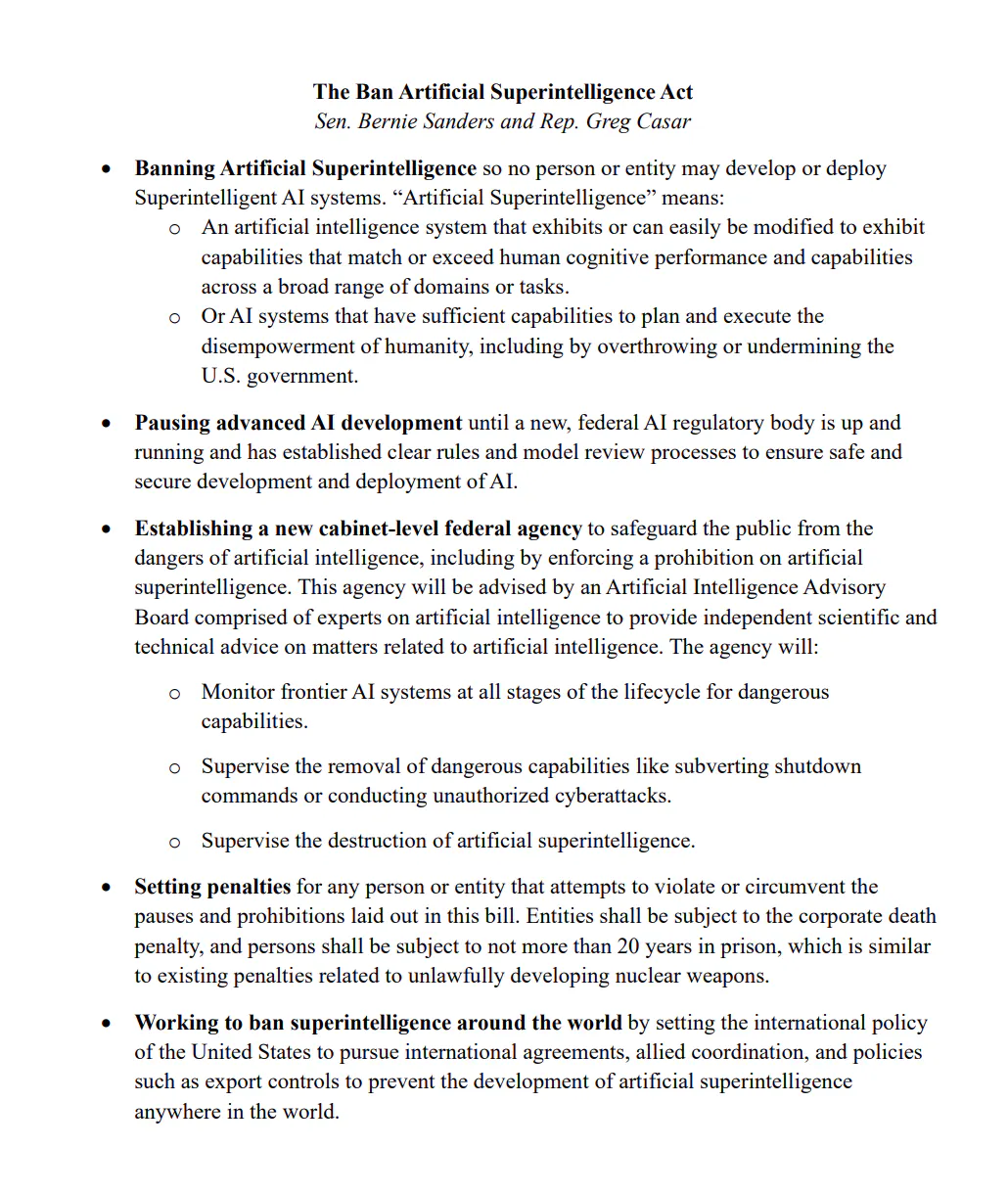
The forthcoming legislation highlights a growing divide between those who view AI as the future and those who fear it could ultimately threaten humanity. The proposal would ban artificial superintelligence and temporarily pause development of other advanced AI systems until a new federal regulator establishes safety rules and a process for reviewing powerful models.
The proposal would also establish a Cabinet-level agency to “supervise the destruction of artificial superintelligence” and monitor frontier AI systems at “all stages of the lifecycle.”
Entities attempting to violate or circumvent those restrictions would face the “corporate death penalty.” The term generally refers to forcing a company to dissolve or revoking its authority to operate, but Sanders’s office did not explain how the punishment would work or whether a company’s assets would be liquidated. Individuals who violated the restrictions could face up to 20 years in prison.
Sanders argued that the severe restrictions are necessary because the country’s largest technology companies cannot guarantee that increasingly capable AI systems will remain under human control.
The summary defines artificial superintelligence to include AI systems capable of planning and executing “the disempowerment of humanity,” including by overthrowing or undermining the United States government.
The proposal was announced one day after G20 representatives concluded a two-day Innovation Ministerial in Chapel Hill, North Carolina, to discuss the future of technology policy and development.
The Trump administration invited several of the world’s most prominent technology executives to make the case directly to international officials. Nvidia CEO Jensen Huang, OpenAI CEO Sam Altman, Meta CEO Mark Zuckerberg, Tesla CEO Elon Musk, Palantir CEO Alex Karp, and other top tech CEOs participated in the ministerial.
Huang warned officials that countries risked being left behind if they failed to embrace AI.
“The worst outcome is you don’t take advantage of it,” he said.
At the conclusion of the ministerial, participating governments reached consensus supporting pro-innovation policy frameworks and the adoption and development of emerging technologies.
That approach places the Trump administration firmly at odds with Sanders’s proposal. Given President Donald Trump’s push to accelerate American AI development, the proposal appears unlikely to receive White House support during his administration. It nevertheless presents a dramatically different vision for the future of federal AI policy.
.png)
.png)

