 Nathan Lord
The global conversation around artificial intelligence is framed as a technology race.
Yes, America is in an AI race, but that race will be over before it even starts if we do not secure reliable fuel to power it.
From a technical advancement standpoint, the AI race is a challenge of intellect: algorithms, chips, and computing architecture.
From an energy standpoint, however, it is a question of wisdom: Do we have the wisdom to make the right decisions now, to prioritize and properly utilize the abundant, affordable, and reliable energy resources we already possess?
AI runs on massive, continuous amounts of electricity. The nations that can deliver power at scale, at the lowest cost, and with the highest reliability will lead not only in AI, but in manufacturing, economic growth, and national security.
China understands this reality. In fact, China now generates more than twice as much electricity as the United States and continues to expand power infrastructure at a pace the U.S. has not matched in years.
If America intends to lead in AI, we must prioritize natural gas. It is the only fuel source today that is readily deployable, scalable, reliable, and affordable.
For the first time in more than half a century, U.S. electricity demand is growing at a sustained rate. The Department of Energy estimates the U.S. will need 50 to 150 gigawatts of new electric capacity within the next decade, describing the challenge as the Manhattan Project of our time.
A single large data center can consume as much power as a heavy industrial facility. Data centers are modern-day industrial factories, operating 24/7 and requiring uninterrupted baseload power.
We must use wisdom when locating these facilities. Power generation can be built almost anywhere, but fuel cannot. Our grandfathers understood this. Steel mills and petrochemical plants were built near power plants, and power plants were built near fuel sources.
When new power demand is located far from the fuel source, costs rise, timelines stretch, and risks multiply. Long-haul transmission adds expense, energy loss, permitting complexity, disruption, and public opposition. Electricity is expensive not only to generate, but to move.
The most efficient solution is also the simplest: build new power demand on top of the fuel supply.
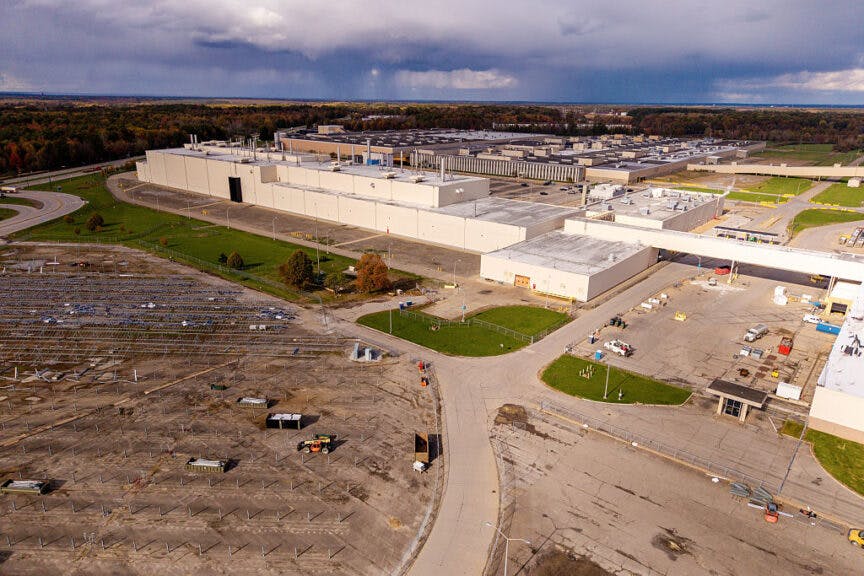
Kyle Grillot/Bloomberg via Getty Images
There are two regions in the U.S. that are uniquely equipped. More than 80% of U.S. natural gas production is concentrated in two strategic regions: the Gulf Coast and the Shale Crescent USA (Ohio, West Virginia, and Pennsylvania). If these three states were a country, they would be the third-largest natural gas producer in the world, producing roughly one-third of all U.S. natural gas.
Natural gas in the Shale Crescent is among the lowest-cost in the industrialized world, roughly three to four times cheaper than Europe and Asia, and among the lowest-priced in the United States.
For high-load users like data centers, AI infrastructure, and advanced manufacturing, proximity to reliable baseload power is a strategic advantage.
Across the country, data centers are already struggling to secure power. Utilities are issuing moratoria, interconnection queues stretch into the next decade, and grid operators warn that demand is outpacing supply.
America cannot out-AI China if China out-powers the United States.
The path forward is not mysterious, but it does require political will and wisdom. Natural gas must be treated as a strategic national asset, and the lowest-cost, lowest-risk path forward is to locate new data centers and power-intensive infrastructure directly on top of the fuel supply.
If we make that choice now, we can secure the energy foundation our AI future requires.
* * *
Nathan Lord is the President of Shale Crescent USA, a non-profit organization whose mission is to encourage business growth and create high wage jobs in Ohio, West Virginia, and Pennsylvania. Nathan is a graduate of Marietta College and earned his MBA from Liberty University.
The views expressed in this piece are those of the author and do not necessarily represent those of The Daily Wire.
.png)
.png)