Democrats’ sweeping midterm victories could revive billions of dollars in proposed tax increases, potentially raising federal income tax rates for some Americans, while putting President Donald Trump’s tax-cut agenda in their crosshairs.
The party has campaigned on expanding tax credits and offering relief to lower-income families, but several Democratic proposals would also impose significantly higher taxes on wealthy Americans, businesses, and investors.
Democrats won control of both chambers of Congress in Tuesday’s elections, giving them greater power to advance their legislative agenda. But Trump remains in the White House, meaning any tax legislation would still need his signature or enough congressional votes to override a veto.
One of the most detailed proposals comes from Democratic Sen. Cory Booker (NJ), whose Keep Your Pay Act would dramatically expand the standard deduction and Child Tax Credit while increasing taxes on higher earners. Under Booker’s plan, the standard deduction would increase from $16,100 to $37,500 for single filers and from $32,200 to $75,000 for married couples filing jointly. The proposal would also increase the Child Tax Credit from $2,200 to $4,320 for children under 6 and $3,600 for children ages 6 to 17, with an additional $2,400 bonus in the year a child is born.
But those expanded benefits would come alongside tax hikes. Booker’s plan would increase the top two federal income tax rates from 35% and 37% to 41% and 43%, respectively. The higher rates would affect taxable income exceeding $256,225 for single filers and $512,450 for married couples filing jointly. Those earning more than $640,600 individually or $768,700 jointly could face a top marginal rate of 43%.
Another proposal from Democratic Sen. Chris Van Hollen (MD) would impose an additional 10-percentage-point tax on income exceeding $1 million for individuals and $2 million for married couples. The tax would apply to wages and investment income, including capital gains and dividends.
Democrats are also targeting corporations. Senate Democrats, including Sens. Chuck Schumer (D-NY), Ron Wyden (D-OR), and Elizabeth Warren (D-MA), have proposed quadrupling the federal tax on stock buybacks from 1% to 4%. Companies buy back their own shares to return money to shareholders, and the practice can increase the value of remaining shares. A higher tax could make buybacks less attractive and change how companies return money to investors.
Democratic leaders have also pledged to reverse Trump’s tariffs and restore expanded Affordable Care Act subsidies, which could affect both consumer costs and federal spending.
Those proposals, however, would require new legislation to become law. In the meantime, Trump’s tax cuts remain in effect.
Republicans enacted sweeping tax relief under Trump’s One Big Beautiful Bill Act in July 2025, making the seven federal income tax brackets permanent and preserving rates of 10%, 12%, 22%, 24%, 32%, 35%, and 37%.
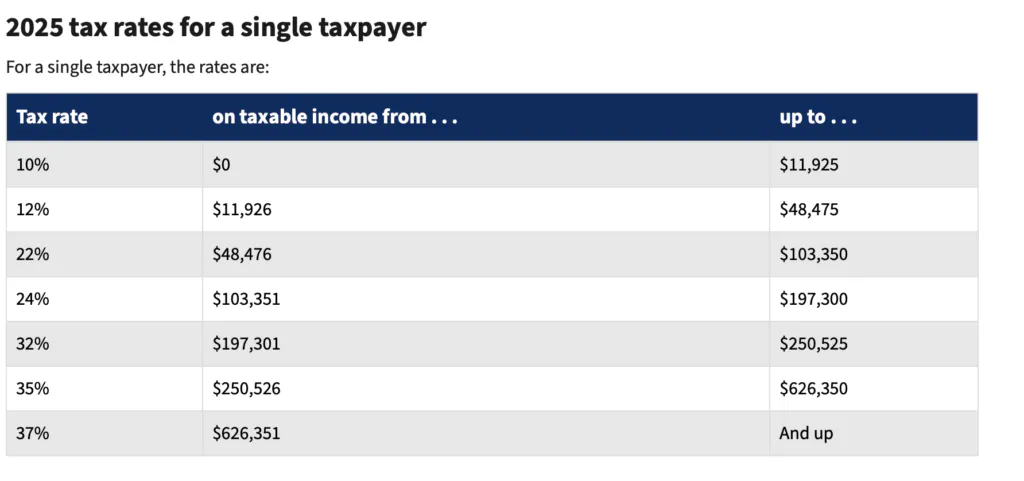
IRS.gov: screenshot
The law also introduced tax breaks for American workers and families, including deductions of up to $25,000 for qualified tip income and $12,500 for qualifying overtime compensation ($25,000 for married couples). Eligible seniors 65 and older can claim an additional deduction of up to $6,000 per person, while families can claim up to $2,200 per qualifying child. The law also increased the state and local tax deduction cap to $40,000 for many taxpayers.
The individual income tax rates and expanded standard deduction are permanent under current law, while several other provisions are scheduled to expire after 2028.
Despite Democrats’ newly won congressional power, Trump can veto legislation he opposes. The president has already signaled that he is willing to work with Democrats if they are willing to, frankly, not be “insane.”
“They’ll send over things that are insane, and I’ll veto them,” he told Fox News on Tuesday. “And after a couple of months of vetoes, they’ll call, and they’ll say, ‘How do we get this stuff done, and we’ll work together.'”
Democrats could also attempt to use budget reconciliation to pass certain tax measures with a simple Senate majority, but reconciliation has restrictions, and legislation would still require the president’s signature.
For now, Americans’ federal tax brackets and existing tax breaks remain unchanged. But Democrats’ victory gives the party a renewed opportunity to pursue an agenda that could mean higher taxes on high earners, investors, and businesses — potentially putting some of the tax relief enacted under Trump at risk.
Related: Dems Campaigned On Affordability But Their Victory Threats Reveal Another Priority