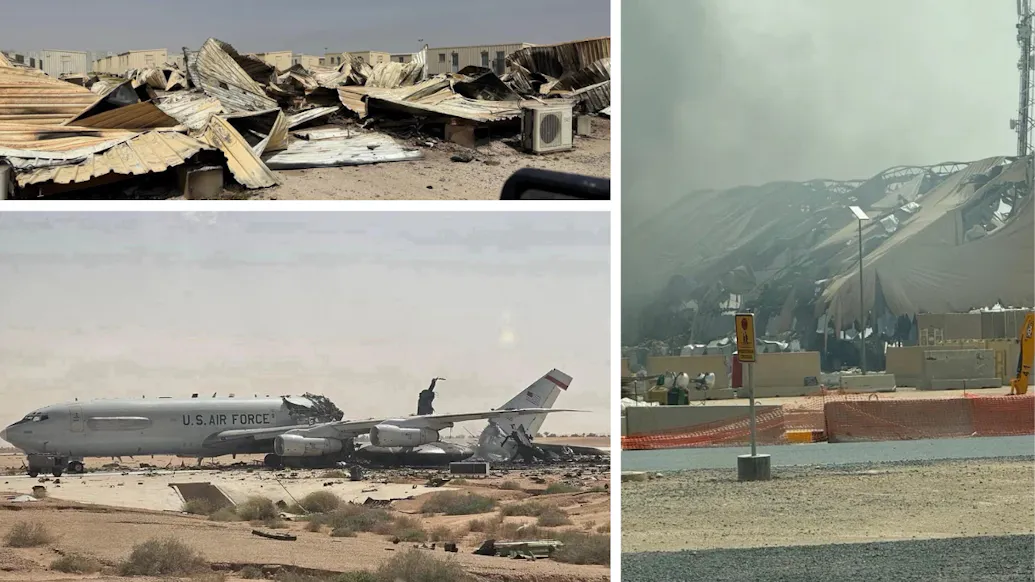
New images showing damage at U.S. military positions across the Middle East are raising questions about how Iranian missiles and drones were able to reach American bases despite the United States’ extensive air-defense capabilities.
The photos, obtained exclusively by CBS News from active-duty service members, show damage at U.S. positions including Prince Sultan Air Base in Saudi Arabia, Camp Buehring in Kuwait, and Camp Arifjan in Kuwait. One image shows the tail of a Boeing E-3 Sentry aircraft severed from its charred fuselage at Prince Sultan. Other images show damaged buildings, vehicles, and trailers at U.S. installations.
Jonathan Schanzer, executive director of the Foundation for Defense of Democracies, told The Daily Wire that the images illustrate several vulnerabilities the U.S. military now faces, including the locations of American bases, the volume of Iranian attacks, and the availability of defensive munitions.
“The bases are getting hammered. And, in my view, a lot of that actually stems from proximity to the Islamic Republic,” Schanzer said. “It’s really hard to defend against incoming missiles and rockets when you only have a few minutes to respond.”
Bases in Qatar, Bahrain, and Kuwait are close enough to Iran that American forces can have only minutes to respond to incoming attacks. That raises a broader strategic question for the Pentagon about whether some U.S. positions should be moved farther from Iran’s weapons systems, Schanzer said.
“I think one thing that the Pentagon has to now wrestle with is this question of, do we move? Do we start taking bases and place them further afield so that they are not in the target range of the Islamic Republic?” Schanzer said. “I think specifically about the Qatari base, Al Udeid. I think that’s a big one. I think there are questions about Bahrain, and Kuwait, and others as well, maybe even UAE.”
But moving bases would not eliminate the threat entirely.
Schanzer pointed to attacks farther away, including against bases in Jordan, as evidence that geography is only part of the problem. The U.S. military has also had to contend with the sheer number of missiles, rockets and drones being fired at American and allied positions.
“It’s an inability to defend the volume of incoming,” Schanzer said. “And we have to, at some point, start to make decisions about what we allow through and what we don’t.”
The other major vulnerability involves the weapons being used to defend U.S. forces.
The challenge extends beyond the number of weapons being fired. Schanzer said the U.S. has also burned through significant quantities of expensive “standoff” weapons and missile-defense interceptors during the conflict. Replenishing some of those systems could take two to three years.
“That needs to be addressed,” Schanzer said, pointing to the need for the Pentagon, White House, and Congress to increase funding and communicate urgency around expanding production.
Schanzer said the defense industry is prepared to increase output, but manufacturers need contracts and funding to do so.
“We need someone to open the spigots for us so that we can build the weapons that the country needs,” he said.
The U.S. has deployed missile-defense systems including Patriot and THAAD during the conflict and has also conducted strikes against Iranian air-defense sites, radar systems, and other military infrastructure.
Asked whether the U.S. could have done more to reduce Iran’s ability to launch attacks, Schanzer said the U.S. “went pretty hard.” But he said the campaign also exposed the difficulty of using expensive weapons against lower-cost Iranian targets.
“We started spending exquisite munitions that cost millions of dollars on targets that cost $100,000,” Schanzer said.
That dynamic, Schanzer said, eventually created diminishing returns for the U.S. campaign, which he believes may have led the Trump administration to halt attacks.
Schanzer said the conflict demonstrates how a militarily weaker country can still impose costs on a far more powerful adversary.
“Weaker states can hold out, they can exploit the situation, and hurt American interests, even when they’ve been defeated on the battlefield,” Schanzer said.
But he cautioned against viewing Iran’s ability to strike U.S. positions as evidence that Tehran is winning the war.
“Iran is not winning this war,” Schanzer said. “They are getting hammered, day in and day out, and economically as well as militarily.”
Instead, he said, the attacks illustrate the challenges of asymmetric warfare, in which a weaker adversary can keep targeting American interests even after suffering significant losses.
Schanzer said the U.S. therefore needs more cost-effective ways to defend against drones and rockets that can be used in large numbers.
One potential solution is directed-energy technology, including lasers. Schanzer said the U.S. and Israel have been working toward using lasers to counter drones and rockets, though the technology is not yet fully ready.
Schanzer said Israeli forces have used Iron Dome interceptors in ways that have allowed them to engage ballistic missiles during their descent. He contrasted the cost of an Iron Dome interceptor, which he estimated at roughly $100,000 to $150,000, with the estimated $3 million to $5 million cost of an Arrow 3 interceptor.
For Schanzer, the broader lesson is clear: the United States needs to adapt both its defenses and its defense-industrial base.
“If there was ever a moment where we needed to understand that we need to get our act together and to begin to address the defense industrial base challenges that we have to meet the moment, this is it,” Schanzer said.
The images from U.S. bases, he said, should therefore be viewed not simply as evidence of individual strikes, but as a warning about the challenges posed by a new era of relatively inexpensive weapons being used against some of the world’s most sophisticated militaries.
The Trump administration did not respond to a request for comment in time for publication.
.png)
.png)

