
 Harry Khachatrian
Weekend Plans is our exclusive lifestyle feature where we highlight the real off-duty routines of the most exciting people in culture.
This week, we’re featuring Rachel Bovard, the vice president of programs at the Conservative Partnership Institute, a longtime Capitol Hill veteran, and one of Washington’s more entertaining wine evangelists.
***
There are few cities in the world more badly in need of good wine than Washington, D.C. This is not because Washington lacks alcohol. Quite the opposite. The city practically runs on it: hotel lobby bars, post-panel networking events, and congressional fundraisers where the conversation can often be less refreshing than a lukewarm glass of reception chardonnay. But wine, properly understood, is not merely alcohol. It is tradition, geography, agriculture, and hospitality — all the things that bring people together in a city whose principal export is disagreement.
Rachel Bovard understands this distinction.
Bovard is stuck at work when she notices the glass in my hand over Zoom.
“I see you have a glass with you,” she says. “I’m jealous.”
The glass, for the record, is Manzanilla sherry, which Bovard immediately approves of. “I went through a big sherry phase,” she says. “I love sherry.” This is the sort of sentence that quickly tells you Bovard is not merely a casual cabernet sipper but a genuine wine obsessive — and one with excellent taste.
She, unfortunately, is not drinking anything stronger than whatever one drinks between “a stacked bunch of meetings.” Bovard is at the office, where she is vice president of programs at the Conservative Partnership Institute, the Washington organization she helped launch in 2017 after more than a decade on Capitol Hill. She oversees programming and instruction, teaches Senate procedure, and, by her own admission, “nerds out” on institutional mechanics that would make the average voter reach instinctively for something fortified.
Behind her, just visible on camera, is office decor that typifies the temperament needed to thrive in Washington: framed press attacks. One is a David Brooks essay in The Atlantic lambasting Bovard — a piece that manages, with characteristic Brooksian restraint, to mention that he once taught students at Yale who went on to work at McKinsey. Another is a New York Magazine article that called her a “nursemaid.” Bovard found both “absolutely hilarious,” and her husband framed them for her as a Christmas present. I can think of no higher endorsement.
But when the subject turns to wine (the other source of sanity in D.C.), the congressional operator gives way to the enthusiast, the teacher, and occasionally the pedant. Washington has many people who can explain cloture. Far fewer can explain whole cluster fermentation or why putting ice in your rosé is an affront to both culture and civility.
The making of a wine enthusiast
Bovard came to Washington almost by accident. She arrived after college as an intern at the Heritage Foundation, with vague plans to go to law school and no particular expectation that politics would become her life. A professor had suggested that she might like Washington. He was right.
“I’d never been to D.C. before,” she says. “I came out here, and I loved it.”
A job on the House side followed, then the Senate, then CPI. Somewhere along the way, as she was working in the Senate and beginning to wonder whether there might be such a thing as life after politics, wine began to assume a more serious place in her imagination.
It had always been present. Bovard’s mother is Sicilian, and in her family, wine was not an affectation or occasional indulgence. It was “just with the meal,” she says, an ordinary element of family life rather than a performance of sophistication. She did not grow up, however, drinking grand cru Burgundy or vertical tastings of Barolo. She grew up in the 1990s, which she describes as “the era of jug wine.”
Yet even undistinguished wine carries cultural meaning. It brought family together and marked the meal as something shared. Only later, as a young adult in Washington, did Bovard discover that wine could also be a world of study.
She would go alone to wine bars in D.C., escaping roommates and the ordinary churn of young professional life. Vinoteca, now closed, was one of the places where she began tasting flights and asking questions. Champagne was the first style that pulled her in.
“Champagne is very much like something special has happened,” she says. “So we should drink it all the time.”
I nodded keenly; it is difficult to contend with the logic.
The first wine that truly stunned her, however, was Sassicaia, the famed Super Tuscan — a benchmark cabernet-based red from coastal Tuscany that helped redefine Italian wine outside the traditional appellation system. A bartender friend at Sonoma Wine Bar had a bottle and offered her a taste. Bovard had already tasted plenty of good wine by then, especially through formal study, but this was different.
“I have this bottle; do you want to try it?” she remembers him asking. “And he poured me a little bit, and I was like, ‘This is art.’”
That is the danger with wine. One minute you are an ordinary person enjoying a glass with dinner; the next, some bartender pours Sassicaia and you are discussing limestone soils, canopy management, and the regrettable tyranny of mass-market wines.
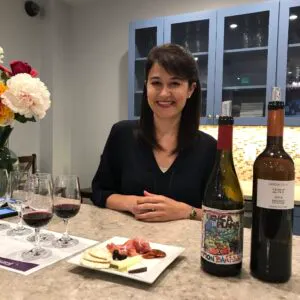
Bovard began studying under Kathy Morgan, then the only Master Sommelier in D.C., and trained through the Court of Master Sommeliers. The Court teaches wine theory and tasting but is ultimately service-focused, preparing students for the theater of restaurant wine service, where diners order the second-cheapest bottle and mistake the small first pour (meant only to confirm the wine is not flawed) for an invitation to imitate Robert Parker and compliment the Som on the wine’s merits as if they’re speaking to the winemaker.
Courtesy of Rachel Bovard
Then Bovard found the Wine & Spirit Education Trust, or WSET, which suited her better. It was more academic, more structured, and more objective. The Court may ask you to describe what is in the glass in front of a panel. WSET gives you a formal grid and a controlled vocabulary. Bovard liked that. Not everyone, she says, knows what “a tennis ball in your grandmother’s basement” smells like, but everyone can at least be trained to recognize gooseberry.
She reached the Level 4 Diploma program and completed nearly everything. Her research paper was on the gin renaissance, which sent her into London archives and gin houses while visiting a friend. She had only the sparkling and still wine exams left when fate intervened in the coolest but least sommelier-like way possible: Muay Thai.
“I broke my arm,” she says. “My writing arm.”
Two weeks later, CPI started. Life accelerated. She never finished. Marriage and children followed. Bovard now calls herself, with affection, a “truant WSET diploma graduate.”
In the meantime, she worked weekends at DCanter Wine Bar on Barracks Row while spending weekdays in the Senate. She taught regional classes, cabernet tastings, sparkling wine tastings, and a class called “$5 for $50,” in which people compared cheap and expensive bottles to see if they could tell the difference. Somewhere in this period, she learned one of the hard truths of the wine world: Wine is easier to love than to make a living from.
“Halfway through the program, I realized, like, you can’t actually make any money in wine,” she says. “So I was like, I guess this will just be a side hobby.”
Wine pairing like a pro
As hobbies go, it is not a small one. Bovard now does private events and cellar consultations. She also has, thanks to her husband, a hidden wine cellar.
When they met, he was not especially into wine. Then, apparently seeking to impress her, he went out and learned “a ton of stuff.” It worked. For a wedding present, he renovated a strange little kitchen area in the basement of her townhouse.
“It’s behind a Murphy door,” she says. “So you open it up, and it’s like a little hidden wine cellar.”
This, obviously, is what romance is supposed to look like. Some men buy flowers. Others build hidden cellars behind Murphy doors. The second category should not be underestimated.
Bovard’s cellar is not merely decorative. Her house pour is often Rioja Reserva because, as she puts it, “we just have so much of it.” Her ideal Friday night bottle, especially after a brutal Washington week, is Right Bank Bordeaux, usually Saint-Émilion — a Merlot-dominant red blend.
“It’s like a comfort wine for me,” she says.
Her guilty pleasure pour is not guilty at all: “probably Champagne,” she says, admitting that she has “a lot of expensive Champagne” that she drinks “on, like, a Wednesday.”
One of the many errors of modern life is the belief that Champagne should be reserved for weddings, promotions, and New Year’s Eve, as though the ordinary Wednesday did not already present sufficient grounds for consolation.
The wine that made her understand aged Champagne was a 1998 La Grande Dame from Veuve Clicquot, given to her after she finished her graduate program at George Washington University.
“It was like I’d never had aged Champagne before,” she says. “It was just citrusy and honey and beautiful.”
There is a particular sentimentality in drinking a wine whose grapes were picked before you were old enough to drink or even born at all.
“You’re uncorking this bottle, being like, I was a child in 1998, and now I am drinking this wine,” she says.
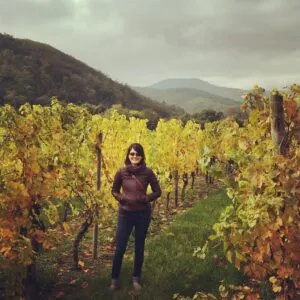
She wishes more Americans drank Alsatian wines. That is the region, more than any other, that seems to have lodged in her imagination. When she traveled there with a friend, the two visited Domaine Weinbach and tasted Riesling, Gewürztraminer, Pinot Blanc, and Sylvaner. Bovard was so taken with the wines that she solved the problem of limited luggage space with ruthless clarity.
“I literally threw out my clothes,” she says. “I can get new clothes. This wine, they don’t even sell in America, so I’m taking it home.”
Courtesy of Rachel Bovard
The wines of Alsace, she says, have “incredible tension” between sweetness and acidity.
“I find those wines to be just magic,” she says. “If you have an Alsatian Riesling with foie gras, it will blow your mind.”
Bovard also insists that classic pairings are classic for a reason: Fresh Sancerre with goat cheese. Burgundy with truffles. Champagne with fried chicken. “I eat Champagne and potato chips,” Bovard says. “People are just like, that is gross. I’m like, no, this elevates it.”
On the other hand, there are sins she cannot tolerate. The first commandment of Rachel Bovard’s wine law is simple: Do not put ice in white wine.
“I see this everywhere,” she says. “Don’t do it. Do not put ice in your white wine.”
The reason is both technical and moral.
“That winemaker has worked so hard to get the water out of that wine,” she says. “It’s an insult to him for you to put the water back in the wine.”
Drinking like Churchill
In Washington, Bovard is often asked to teach practical wine classes. Sometimes people want a Spanish wine night. Increasingly, they want Wine 101: how to open a bottle, how to order at a restaurant, what to keep in the fridge if they are dating someone they hope to impress.
She opens her classes by explaining why wine drew her in.
“Wine is family. Wine is culture. Wine is enjoying one another. It’s friendship; it’s celebration,” she says.
Wine is not a lifestyle accessory or a status marker, though it is frequently abused as both. It is one of the few remaining pleasures in our modern age that allows us to submit to things we did not invent: soil, climate, region, tradition. It is a rebuke to the fantasy that everything meaningful can be optimized, scaled, and delivered in identical form to every market.
Asked whether there is something conservative about wine, Bovard does not hesitate. Old World wine, she says, is rooted in inherited knowledge: when to prune, when to harvest, how to read the vine, the grape, the weather, the slope. Burgundy, which she once taught a class on, captures this especially well.
There, she says, the story goes back to the Middle Ages, when monks worked limestone slopes, observed the vineyards, and recorded what grew best where. Centuries later, that knowledge still informs how wine is made.
“It is tradition,” Bovard says, “standing on the shoulders of monks from the Middle Ages.”
This is why she worries about the homogenization of wine. The beauty of wine is that it reflects a time and a place. Terroir is not marketing. It is the reason a wine from one vineyard can taste different from a wine grown five miles away. She mentions ambient yeast fermentation in the Finger Lakes, near where she grew up in upstate New York. Rieslings made only miles apart could taste completely different because of local yeasts and uncontrolled fermentation.
“You can’t control the fermentation process,” she says. “It just starts when it starts and reflects what it reflects, and I love that.”
That, to Bovard, is where wine overlaps with conservatism.
“There’s a lot of these sort of what conservatives value, which is faith, family, tradition, the wisdom of our ancestors,” she says. “All of that is very heavily reflected in wine.”
It also belongs, Bovard believes, to friendship. She is troubled by the rise of young people abstaining from alcohol altogether, not because she thinks anyone should be drinking liquor every night, but because she thinks the movement risks losing something human. Wine’s role in civilization is not incidental. It appears in Scripture. It appears at weddings. It appears at tables. It softens the edges of social life and gives people a reason to linger.
“Wine’s in the Bible,” she says. “Jesus’ first miracle is turning water into wine. Amen.” We joked about a modern retelling of the miracle at Cana where one of the apostles abstains, claiming, “Thank you, Jesus, but my Oura ring says this will devastate my sleep score.”
More seriously, wine “facilitates the bonds that make us human.” The modern instinct to optimize everything, she says, “takes the fun out of life” and “takes the meaning out of life.” Temperance matters. But so does joy. There is something grimly comic about a culture that has managed to turn pleasure itself into another field of self-monitoring, where every glass must be weighed against sleep scores, biometric readings, and the neurotic suspicion that one has failed morally by enjoying dinner too much.
At the end, I mention a bottle of 2013 Dom Pérignon my fiancée gave me after our engagement, and how we are still waiting for the right occasion to open it. Bovard has a better rule.
“You know what they say,” she says. “You save your best bottle for your worst day.”
It is sage advice, and Churchillian in spirit: “In victory I deserve it. In defeat I need it.” Triumph may deserve Champagne, but despair has the timelier claim.
Before signing off, we agree that there should be some sort of group for conservatives who like wine.
“Yes!” Bovard says. “I love it. Let’s do it.”
The first meeting should probably begin with Champagne — appropriately, Pol Roger, Churchill’s favored house. On a Wednesday, if necessary.
***
Harry Khachatrian (@Harry1T6) is a film critic for the Washington Examiner. He is a software engineer, holds a master’s degree from the University of Toronto, and writes about wine at BetweenBottles.com.
This article is part of Upstream, The Daily Wire’s new home for culture and lifestyle. Real human insight and human stories — from our featured writers to you.
.png)
.png)

