 Bridget Riley
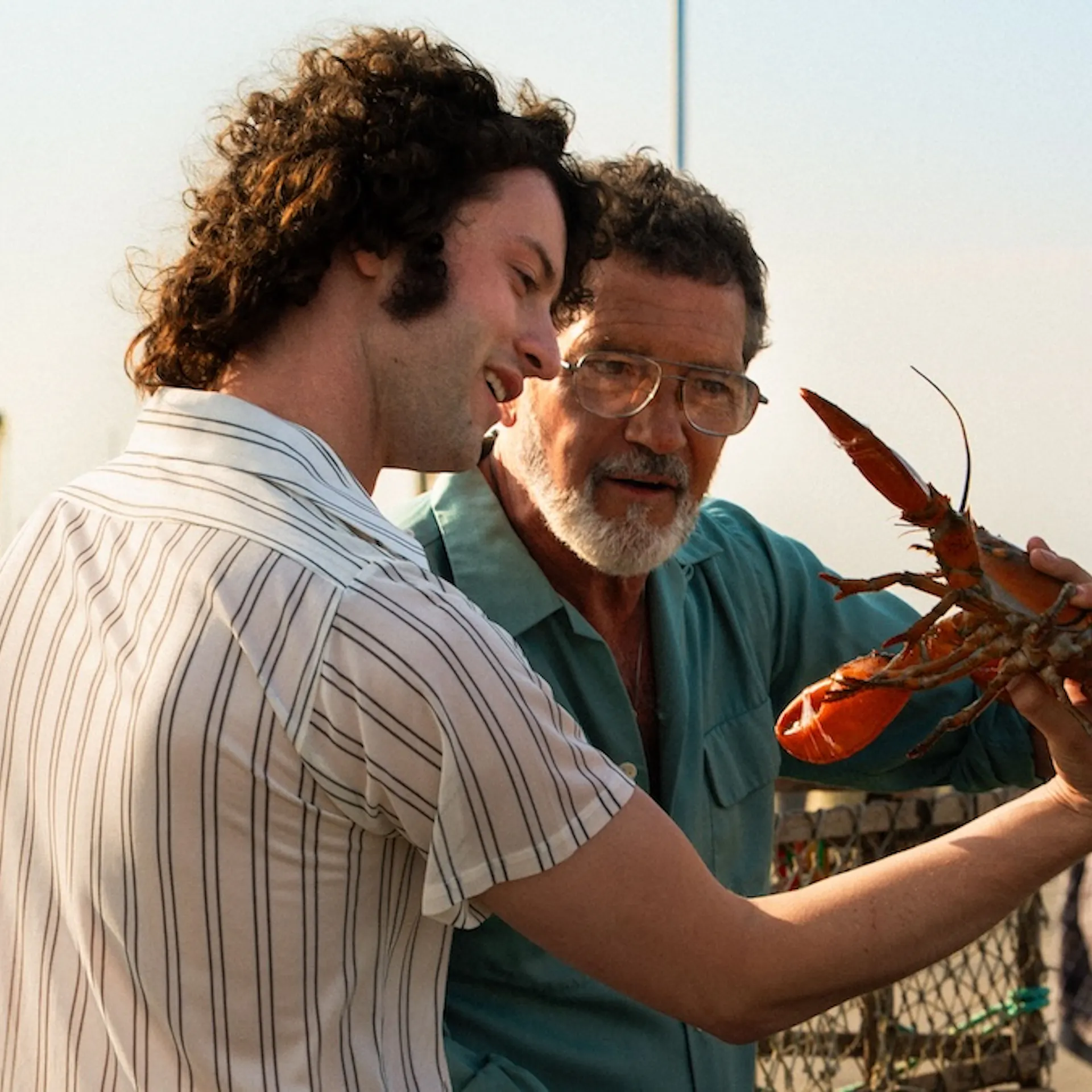
The new movie “Tony” tells the story of a pivotal summer in the life of the late chef Anthony Bourdain. While an arrogant and opinionated undergraduate at Vassar College, Bourdain dreams of a prestigious writing fellowship that comes to nothing, and rather than face the shame of failure, he flees to Provincetown, Massachusetts, in pursuit of a fellow student, Nancy. Shortly after arriving, he gets drunk, beaten up, and mugged. Scooped off the sidewalk, literally, by the staff of a local seafood restaurant, he is deposited on the porch hammock of the restaurant’s proprietor and head chef to sleep it off.
Realizing the next morning that he has no money with which to pay for even the most basic accommodation, young Tony agrees to wash dishes at the restaurant in exchange for food and the porch hammock. It is during this summer that Bourdain discovers his passion for cooking, decides to drop out of university, and applies to the Culinary Institute of America.
The movie is loosely based on the opening chapters of Bourdain’s blockbuster autobiography, “Kitchen Confidential.” While accurately recreating the scenes of drug-taking and debauchery Bourdain describes in his book, the film’s dramatic focus is on something else, young Tony’s relationship with the owner of this Provincetown restaurant, enigmatically referred to throughout as “Chef.”
This role is masterfully played by Antonio Banderas — surely securing a place on the Oscars shortlist for Best Supporting Actor — who portrays him as a stern but benign disciplinarian, giving Bourdain a shot when most would and probably should not have. The Chef’s rules are few but fixed, the most important being: “If you turn up late for work, you are fired.” Recognizing that the chaotic and angry Tony probably cannot master a wristwatch, he becomes the boy’s alarm clock, waking him up each morning by means of a large pan of seawater in the face. While under the Chef’s tutelage, Tony slowly turns his gaze off his own entitled ego and onto what is happening around him, specifically the food being prepared in the high-pressure world of a kitchen. Captivated by this messy but creative workplace, Tony becomes desperate to join it.
I won’t give away more of the plot as I want you to go see the movie, but will comment on one other aspect, which is quietly striking in a movie produced by the indie darling film studio A24. The Chef is a devout Christian. His second rule is that employees in his restaurant should not blaspheme the Lord’s name, and a third is that while Tony is under his roof, he must accompany him to church each Sunday. A recent interview with Banderas in the New Yorker referred to the Chef as “the story’s one unambiguously good man.” It is refreshing to see a Christian character portrayed so positively, unlike the usual suspects of hidden sexual deviant, hypocritical killjoy, or annoying do-gooder, which seem to be the standard treatment for “Christian character” nowadays.
The movie is realistic about how strong Bourdain’s personal demons remained, however, and never suggests the Chef’s intervention turned the boy’s life around. Such a simplistic plot would have struck a dud note given what we know about Bourdain’s drug problems and suicide in 2018. But it does make the observation that the Chef gave Bourdain something that enabled him to make a positive change of direction in his life. This change was achieved through patient, clear, and sometimes humiliating moral instruction, not just happy talk, lessons on self-acceptance, or behavioral tweaks.
You might not have noticed, but another movie this summer featured a mentor, this time someone actually called Mentor. In Homer’s epic poem “The Odyssey,” Odysseus entrusts the care and raising of his young son Telemachus to his friend, Mentor, while he himself is away fighting the Trojans. This is where we get the actual word “mentor” from, though the term was not popularized by Homer’s poem but much later in a 17th-century French story, “The Adventures of Telemachus.” This later tale was written by Archbishop François Fénelon, tutor to Louis, duke of Burgundy, the grandson and heir of King Louis XIV. In an early example of fan fiction, Archbishop Fénelon took the minor role Homer gave to Mentor and turned it into the central part of his own spin-off story.
“The Adventures of Telemachus” proved a publishing phenomenon back in 1699, becoming the single most widely read literary educational work in France in the subsequent century, and spawning multiple English translations during the next two centuries. So what did Archbishop Fénelon intend Mentor to teach the young Telemachus, which in turn the heir to the French crown and Fénelon’s own pupil might absorb?
Mentor teaches that the first rule of good government is self-government, that working from the inside out, a person needs first to be able to master himself before he can achieve greatness. Fénelon’s Mentor states that the ideal ruler must possess “a judgment that restrains and regulates [him], so that his whole work, however bold and animated, is perfectly consonant with propriety and truth.” This general cultivation of virtues should also “correspond with the designs of heaven.”
Mentor’s instruction is at times painful, such as when he pushes Telemachus — while dangerously infatuated with the beguiling nymph Eucharis — off a cliff. Safely in the sea below, both men can now swim to a raft Mentor has secretly built and escape the nymph’s island. Yet even if his intervention sometimes takes these physical, dramatic forms, it is the inner man Mentor is trying to mold in his mentoring of Telemachus, not just his outward behavior. His instruction reaches into Telemachus’s psychological depths — the very place the late philosopher and Christian writer Dallas Willard argued we live from.
As Willard wrote in “Renovation of the Heart,” “How we live in the world now and in the future is, almost totally, a result of what we have become in the depths of our being … that is where we understand our world and interpret reality.” By targeting this hidden interior, Mentor ensures that Telemachus’s eventual capacity to rule is not a mere posture, but the expression of a mature character.
This constructive, soul-shaping mentorship finds a literary counterpart in L.M. Montgomery’s “Anne of Green Gables” through the steadying guidance of teacher Miss Stacy. Recognizing Anne’s sharp but unruly intellect, Miss Stacy does not indulge the young girl’s impulses; she actively redirects them. She steers Anne away from the lurid and sentimental “potboiler” novels that feed her melodramatic tendencies, directing her toward serious literature that expands her mind. Through this disciplined academic rigor, Miss Stacy equips Anne to earn a place at Queen’s Academy, opening the door to college and a profession.
Mentors have huge power over their typically young and impressionable charges, which can be abused in the wrong hands. The opening scene of the 2014 movie “Whiplash” features an encounter between young jazz drummer, Andrew, and the charismatic but terrifying Fletcher, tutor at the fictional Schaffer Conservatory of Music. “Do you know who I am?” Fletcher asks, thus demonstrating that his version of mentorship is all about him, the Great Man, and not about his student. When Andrew is subsequently summoned to attend a rehearsal at 6 a.m., his smile of gratitude foretells that he is going to be desperately damaged by this weapons-grade narcissist before the end of the movie.
It is precisely such toxic, manipulative dynamics, exemplified by Fletcher’s abusive grandiosity in “Whiplash,” that have driven many away from traditional mentorship and into the arms of seemingly safer life coaching. Wary of the potential for authority figures to inflict psychological damage under the guise of high standards, contemporary culture seems increasingly to prefer the non-judgmental, client-centered approach of the life coach. Where a traditional mentor like Anne’s Miss Stacy demands self-discipline, moral growth, and the pursuit of objective excellence, the modern coach often focuses on unconditional validation, personal alignment, and embracing the “real you.” Yet, while this shift protects against the predatory narcissism of a Fletcher, it also risks abandoning the profound, challenging moral development that genuine mentoring provides.
Modern life coaching and micro-adjustment culture focus largely on functional optimization, offering superficial tweaks designed to engineer external career advancement, relational success, or professional efficiency. Take celebrity life coach Mel Robbins, whose viral “The High 5 Habit” instructs followers to look in the mirror every morning and literally give their own reflection a high five. It is the ultimate manifestation of the non-judgmental, self-validating ethos, replacing the demanding work of moral improvement with a low-friction, self-congratulatory gesture.
Life coaching culture promises small adjustments to help us feel better, but feeling better is not the same as becoming better. Who doesn’t want a constant stream of uncritical validation? But the humbling and uplifting truth that “Tony” reminds us of is that sometimes, instead of a cheerleader, what we really need is the wake-up call of a saucepan of seawater in the face.
***
Bridget Riley studied modern history at Oxford and completed a Ph.D. in medieval history at the University of Reading. She writes on history, culture, and the philosophy of religion.
This article is part of Upstream, The Daily Wire’s new home for culture and lifestyle. Real human insight and human stories — from our featured writers to you.
.png)
.png)

