
 Madeline Fry Schultz
This article is part of Upstream, The Daily Wire’s new home for culture and lifestyle. Real human insight and human stories — from our featured writers to you.
***
Pixar’s very first film came out in 1995, near the start of the dot-com bubble. Eight years before Myspace was invented, apps weren’t a thing, and the average cell phone was as big as a brick. So if kids weren’t riding their bikes or listening to cassette tapes, they were playing with toys.
It’s no surprise that “Toy Story” was a massive success. Over the years, the franchise has grown alongside its viewers, with “Toy Story 2” somehow tackling the existential dread of growing up and “Toy Story 3” arriving just in time to tug at the heartstrings of parents and adult children hugging goodbye at college. “Toy Story 4” was a fairly forgettable (if successful) romp through a dusty antique store, and “Toy Story 5” arrives this weekend as one of the year’s most-anticipated films.
For parents hoping to enjoy a clean summer blockbuster with their kids, it doesn’t disappoint. But for those who were expecting the introduction of an iPad-style character would meet the moment with a cautionary tale about technology, well, they might need to preach that lesson themselves.
In some ways, “Toy Story 5” is the most family-friendly installment of the whole franchise. The first few movies have some terrifying moments; now, there is no Sid to threaten to blow up the toys and turn them into new, Frankenstein’s monster-style creations; no disturbingly hairy collector to steal them; no pink bear to leave them falling toward a fiery trash heap; and no 1950s talking doll who seems like she walked right off the prop shelf from “Annabelle.” Today, the villains aren’t other toys, and the stakes are simple, as they always ultimately have been: We’re talking about the thoughts and feelings of kids and their playthings.
This is no small matter, at least when it comes to the kids, but it’s a welcome emotional scope considering the trailers that played just before the film. In one, a pair of friends risks losing all of their memories together; in another, the Cat in the Hat is inexplicably responsible for saving the entire world.
“Toy Story” movies believe that childhood matters, which makes this newest installment so frustrating. “Toy Story 5” doesn’t take its own stakes seriously. Kids’ childhoods are on the line; shouldn’t it matter how they spend them?
As the much-discussed trailer promised, the toys’ lives are upended by the arrival of Lilypad, the first piece of technology for eight-year-old Bonnie. Her parents, worrying that she’s struggling to make friends, order her a tablet. Lilypad then uses online games to connect Bonnie with friends from her dance class, who could be actual child traffickers for all we know. Somehow, the issue of parental controls never comes up.
Buzz Lightyear, Jessie, and the rest of the gang may be disappointed that they’re not getting played with now that Bonnie has her nose in her tablet, but at least she’s making friends, argues Lilypad, who has just enough vocal fry to sell her mission to make Bonnie fit in with the cool girls.
Though Lilypad has good intentions, her efforts at finding Bonnie friends result in the girl getting cyberbullied. That seems like a good case against tech for kids if I ever heard one. Yet somehow, this becomes framed as Lilypad’s honest mistake; once Jessie finds a new friend for Bonnie, Lilypad saves the day by connecting them online, proving that the world wide web is a tool that must be used judiciously in the hands of — elementary school students.
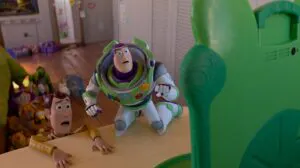
Photo courtesy of Pixar
The films have always held the tensions between the children’s and the toys’ needs: the toys’ need to be played with, and the children’s need to grow up. “Our mission on this planet is to make a child happy. To play!” Buzz tells dozens of other Buzz Lightyears, part of one of the latest movie’s most humorous plot lines. (Speaking of which, don’t leave the theater before the mid-credits scene.)
Jessie finally learns the lesson every toy has to face, which is that loving and leaving children is part of the deal. “Bonnie’s growing up,” she concludes. “And we don’t get to decide when and how that happens. All that matters is we were there at the right time to help her along.”
This would be a good realization, if it weren’t actually an acknowledgment from Jessie that “when and how that happens” might involve a good bit of tech. In the age of iPad kids, when some estimates suggest that as many as four in 10 kids get tablets by the age of two, this message is not just tone-deaf; it’s dangerous.
“We’re not getting rid of these devices, no matter how hard we try,” director Andrew Stanton said in the lead-up to the film’s release. “I’m always going to have my phone. I’m probably going to be partially addicted to it. So it felt right for the toys to have to grapple with that nuance.”
The tablet, Stanton said, is “just the next phase in Bonnie’s life.”
That’s a fatalistic way to look at things, especially for someone in the business of sparking kids’ imaginations.
On the upside, “Toy Story 5” is full of hijinks from the toys you know and love, and it’s sweet that millennials who grew up with the originals are now taking their own kids to the theater. But we millennial parents are also raising children during an unprecedented time in which kids’ mental health issues are skyrocketing — in part because of screens.
To pretend like giving your kid a tablet will simply lead to her making new friends and then ditching the screens, which barely ever did her harm, is either hopelessly naive or has a bit of a darker motive. The cynic in me suspects the $28 Lilypads now for sale online wouldn’t make quite as much profit had she been the villain.
My four-year-old came to see the movie with me, and while his favorite part was decidedly the “Buzz Lightmears” (so many of them!), his least favorite was Lilypad. She may have been designed ultimately to surprise us with her usefulness, but he wasn’t buying it. Fortunately, kids can see past the falsehoods adults tell to make us feel better about ourselves.
.png)
.png)

