 Ellie Bufkin
I was 18 years old on the morning of September 11, 2001, had recently graduated from high school, and was totally uninterested in attending college.
I’d been a shy kid and had only recently discovered a core group of rebel friends, unchaperoned barn parties, and Mike’s Hard Lemonade. Best Buy hired me as a cashier, and I was supposed to start my first day of training on Tuesday, September 11.
I’ve read a lot of recountings of that day over the years, ticking off the timestamps as one of four passenger airliners-turned-ballistic missiles crashed into a homicidal fireball.
But that’s not my memory of the early hours of that morning.
And 25 years later, I think there may be some value in remembering what September 11 actually felt like to an ordinary American kid, especially for people too young to remember a world before it.
My friend group had adopted me as a straggler about a year earlier, when my mom, my brother, and I moved to Frederick, Maryland, from Baltimore amid my parents’ bitter divorce. I didn’t have many friends at school. I had been a horse girl, kept to myself, possibly internalizing the turmoil at home, or maybe I was just a weirdo. Years of therapy have left that time a lingering mystery.
But there I was, finally breaking open as the funny, quirky girl in a group of kids that included several who had already been arrested or even had a stint in rehab.
I had long glamorized booze as a kid, but when we finally had access to it — a lot of it — I really became a fan of its unbridled ability to change me from awkward to awesome.
Boys even talked to me.
All this to say: I wasn’t in a dorm or a classroom the morning of 9/11.
I was wearing my clothes from the night before, hungover, and sitting disheveled in an old recliner placed randomly in a barn loft on my friend Christina’s mother’s property.
The loft was “finished,” as in there was plumbing, ancient carpeting, and electricity working at an unreliable level for us to never trust the freezer. As I recall, we also had a landline phone with a cheetah-print handset.
That’s the phone that rang with the first news of the attacks.
It was my friend Alexis, then a freshman at Towson University.
“Are you watching the news?” she asked at 8:55 a.m.
“Are you being serious?” I retorted.
What a question. I don’t think I’d ever once intentionally “watched the news” in my whole life.
“Some idiot just flew into the World Trade Center in New York.”
The World Trade Center, I thought, trying to recount exactly what — or where — that was.
I had been to New York once at that point in my life, on an overnight trip with my dad when I was a kid to see “The Nutcracker” at Lincoln Center. A great memory, but the World Trade Center wasn’t ringing any bells.
“What?” I asked. “New York?”
At the time, millennials were still reeling from the death of singer Aaliyah in a plane crash just days before. The news Alexis was delivering seemed much less important.
But she insisted I turn on the television. I did, flipping through the snow until I found smoky images from Lower Manhattan.
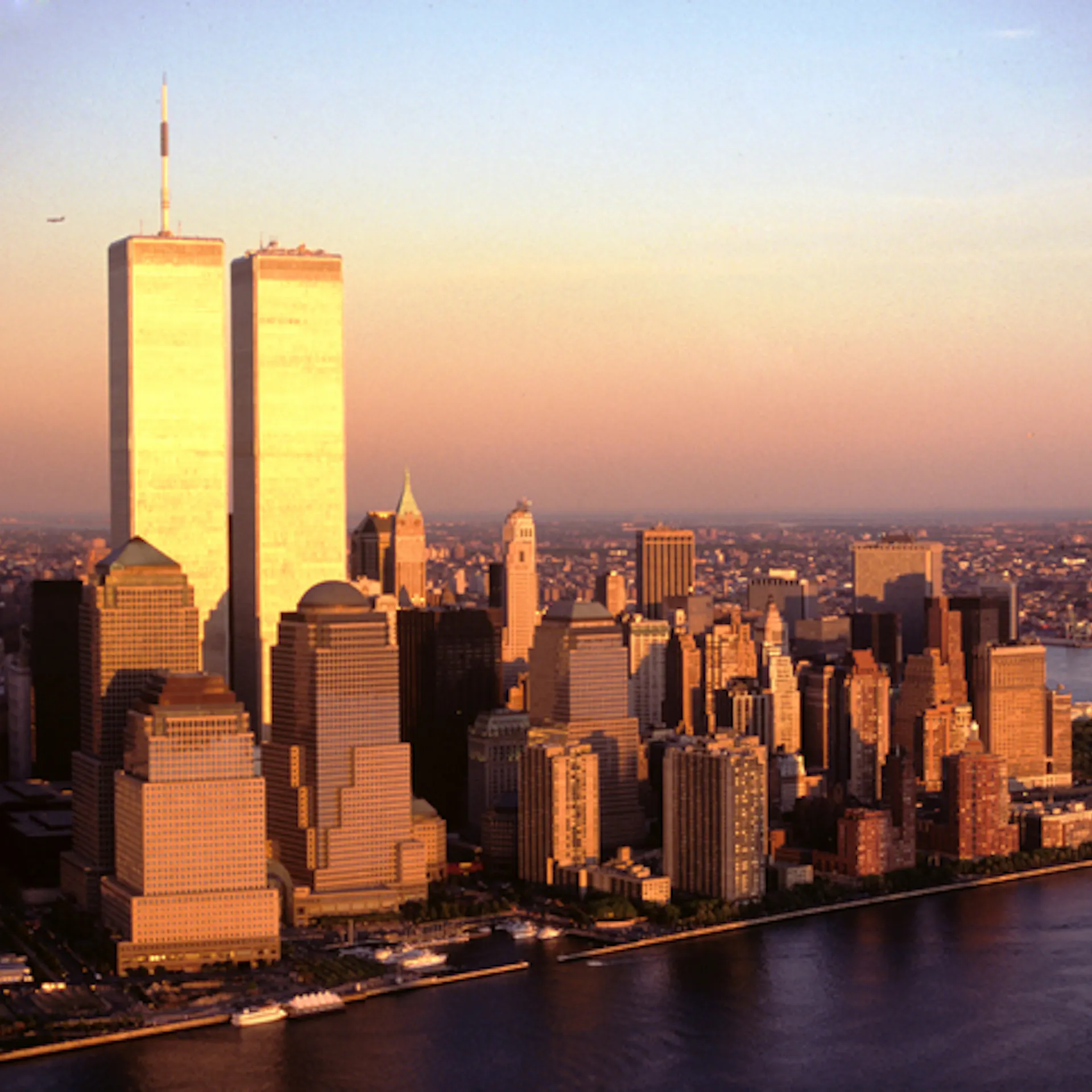
Oh, I thought. That’s the World Trade Center. The one with the two buildings.
It was suddenly familiar from movies I’d watched my whole life.
Only minutes later, I watched in confused horror as a second plane, as clear as the nose on my face, flew directly into the second tower on live television.
I don’t remember whether I was still on the phone with Alexis.
I didn’t immediately understand that we were under attack, because until that moment I hadn’t even fathomed that anything like this could happen.
Even though my feeble teenage mind couldn’t yet grasp terrorism, at that moment I understood one thing:
This was not an accident.
Christina had slept in the main house on the property, in her old bedroom, but came over to make sure I knew what was going on.
“This is crazy,” she said. “Someone’s trying to blow up New York.”
Yes. That made sense.
New York is being attacked.
We suburbanites thought of New York as its own glamorous and wonderful thing, foreign in its own right, close to us and still somehow unreachable. A tragedy was unfolding, yes, but it was in New York.
And watching the billowing smoke on television, we simply could not comprehend the profound chaos and loss of life happening there.
Pure panic was still to come.
It began for me with a call from my father to my Nokia cellphone, with its pink faceplate and light-up antenna.
He is a panicker by nature, but there was something unmistakable in his voice that morning that chilled me to my core.
“Where are you? I need to know where my kids are.”
“Uh, I’m in Frederick…”
He asked if I had shelter. He wanted to know where my brother was.
“School?”
My brother was a junior at a private school nearly 30 miles away.
He carefully explained everything he could from his far more mature knowledge of the world, warning me that cell towers would be overwhelmed and calls might not get through.
“We are under attack,” he said. “This is very serious.”
I was suddenly very awake.
And very worried.
Was there a reason to find a bomb shelter? I couldn’t fathom it. Surely Dad was overreacting.
Except it wasn’t just my dad.
It was everyone’s dad.
It was the newscasters.
Reports of crashes and explosions came in everywhere, some taking hours — and in some cases longer — to untangle. At one point, we heard the National Mall was on fire. Reports about the Pentagon mixed together with rumors about Chicago, Los Angeles, and other American cities.
Then we saw the images of the Pentagon.
We didn’t know how many planes had been hijacked. We didn’t know how many attacks were still coming.
As ignorant kids watching television in a barn loft in Maryland, it felt as though the entire sky might be full of hijacked aircraft.
Even the towers falling didn’t register for me as the singular, heart-stopping moment it appears in retrospectives now. It was almost beside the point.
Because by then, something I had believed in as firmly as I believed in anything was being eviscerated.
The America I had grown up in, safe, free and impenetrable, was disappearing on a clear, beautiful September morning.
And that childlike, almost comical ignorance I possessed that day would never be permitted to return again.
It’s been 25 years of knowing that anything could happen. Any day, any perfect morning could turn into hell on earth.
But over the years I have learned many things because of that morning.
It’s not luck that we haven’t had a repeat of that day. It’s vigilance, advocacy, strategy, policy, alliance, and yes – war, that have kept the door closed. It’s not guaranteed.
I have now spent years reading about the people who attacked us that morning, trying to understand what they believed, why they hated us, how they got access and opportunity, and the threats that remain. Maybe I would have found my way here anyway.
I’ll never know.
I envy something about generations too young to remember September 11. They cannot know what it was like to possess the almost absurd confidence in our own security that so many of us had before 9:03 that morning.
For thousands of families, the horror of that day was unimaginably greater. They lost parents, children, spouses, siblings, and friends.
I didn’t lose anyone I loved on September 11.
What I lost was much smaller.
I lost the certainty that another ordinary Tuesday would always come.
At 8:55 that morning, I was an 18-year-old girl in yesterday’s clothes, hungover, laughing at the idea that I might be watching the news. My biggest concern was making it to my first shift at Best Buy.
Eight minutes later, I watched an airplane disappear into the side of a skyscraper full of people.
Twenty-five years have passed. I know much more about that world now. I know the names of the men who attacked us. I know what they believed. I know what it takes to keep people like them from doing it again. And I know that the safety I once took for granted was never guaranteed at all.
But sometimes, when I think about September 11, I don’t think first about terrorists or wars or falling towers.
I think about that girl in the barn loft.
I think about how completely safe she believed she was.
And I wish, just for a moment, I could give her back the world she thought she lived in.
***
Ellie Bufkin is director of communications at the Foundation for Defense of Democracies.
.png)
.png)