For years, the world has been presented with a remarkably consistent image of Palestinians in the West Bank: poverty, displacement, humanitarian hardship, decades-old refugee camps, and an endless need for international assistance.
But a new report from the Israeli nonprofit Regavim offers a rather different view of life there.
The report, titled Real Estate Under Occupation, features photographs of 100 Palestinian properties across the West Bank, including castle-like residences, sprawling estates, private compounds, and lavish homes. According to Regavim, researchers photographed all 100 properties over the course of a single day, with the goal of providing a glimpse into Palestinian residential construction across the region.
“The narratives pumped out by the Palestinian propaganda machine are falling like dominoes,” Naomi Kahn, the director of the international division of Regavim, told The Daily Wire. “The Palestinian narrative of victimhood is a perverse manipulation of reality. Don’t buy it.”
Some of the homes could rival those seen in Beverly Hills, boasting gaudy architecture, ornamental landscaping, and luxury amenities: marble staircases, four- and five-story villas, private swimming pools, fountains, guest houses, elaborately paved courtyards, manicured gardens, electric gates, and private hospitality complexes designed for large gatherings.
While the extravagant homes are not representative of typical Arab housing across the West Bank, they offer a striking look at private residences in a region that is also one of the world’s largest recipients of international humanitarian assistance.
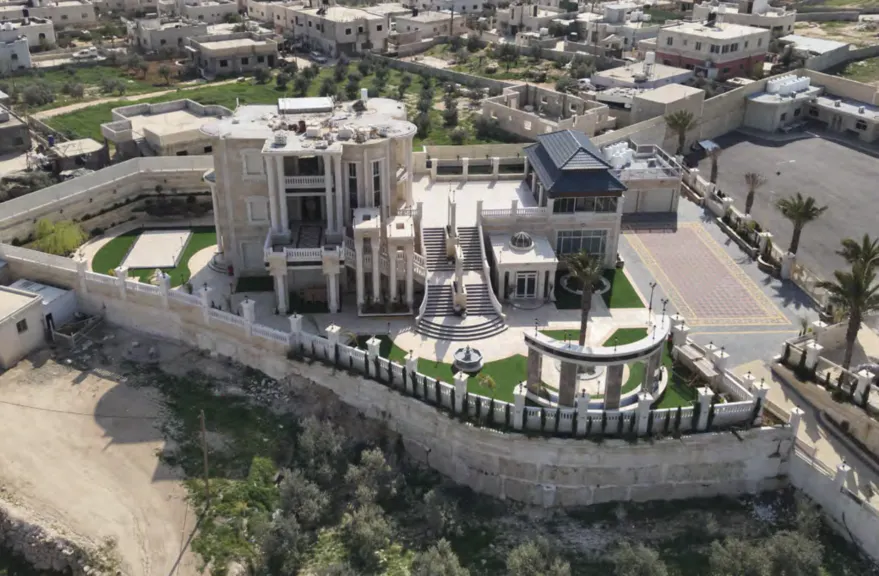
A large Arab-owned mansion in Khirbet Zif, West Bank (Regavim)
The first property featured in the report is in Khirbet Zif, an Arab village in the southern Hebron Hills. At nearly 12,000 square feet, the three-story residence is roughly five times the size of an average newly built single-family American home. It includes a double grand marble staircase with a hand-carved stone balustrade, Roman-esque pillars, two expansive balconies, a courtyard pavilion, and a palm-lined avenue.
The largest single-family property featured in the report is in Shukba in the Binyamin region. The castle-like estate spans roughly 51,700 square feet and includes at least eight balconies, a large private swimming pool, two guest pavilions, classical columns, extensive landscaping, a large stone perimeter wall, and scenic views.
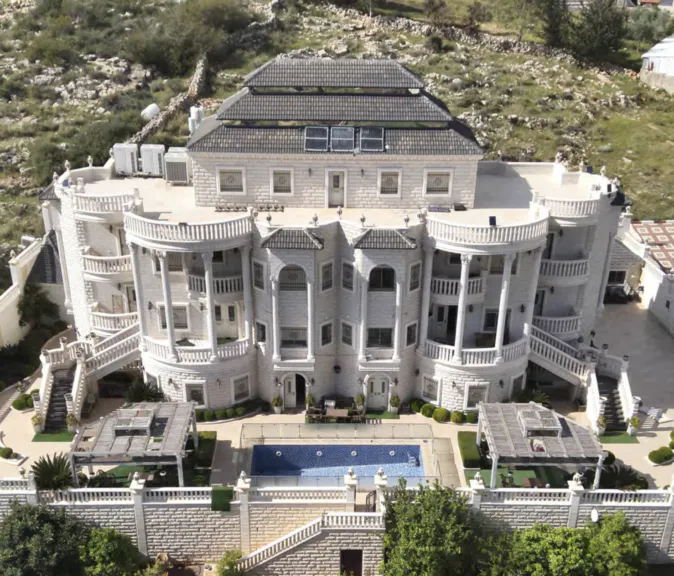
Arab-owned mansion in Shukba, West Bank (Regavim)
In Mukhmas, Regavim documented an enormous five-story, roughly 25,800-square-foot property with 11 balconies, carved stone columns, and covered outdoor seating areas. The neo-classical-style residence features dramatic arches, custom-designed windows, gray-tiled roofs, and large outdoor pavilions.
In Dir Samet in the Har Hebron region, a roughly 10,800-square-foot, three-story villa is designed like a modern palace, with tiered red-tiled roofs and seven covered wraparound balconies supported by classical stone columns. But the centerpiece is outside: a massive hospitality courtyard centered around a decorative fountain, with three covered guest pavilions, elaborate geometric paving, and extensive landscaping.
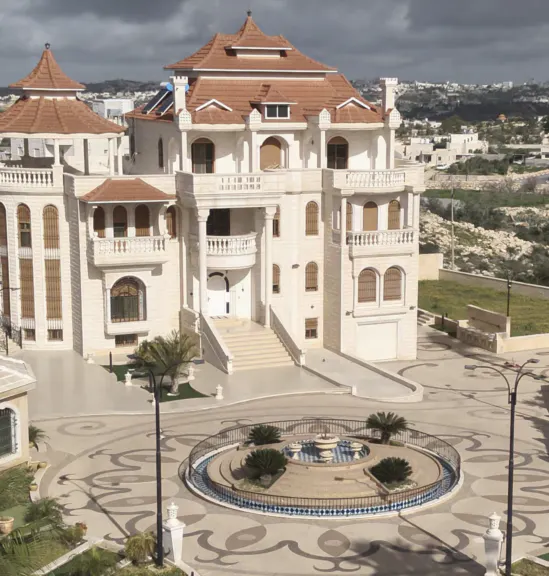
A modern palace-style villa in Dir Samet in the Har Hebron region, West Bank. (Regavim)
Khirbet Zif in the Har Hebron region features several other large residences, including a roughly 6,100-square-foot private three-story residence accompanied by a large hospitality area with a private swimming pool, expansive paved areas and a meticulously landscaped ornamental garden, a large sun terrace, a grand entrance with marble columns and a long, elaborately crafted front door.
Another roughly 6,900-square-foot property resembles a four-story stone castle, with sharply pitched tiled roofs, soaring ceilings, and Mediterranean-style arches. Its sprawling grounds include gardens, a traditional well, an artificial stream, and a wooden footbridge.
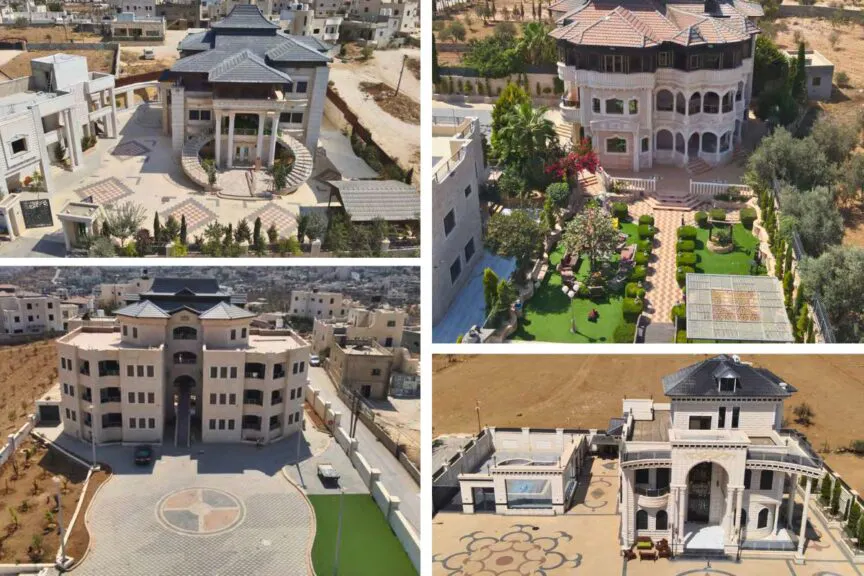
A compilation of lavish Palestinian residences documented in Khirbet Zif in the southern Hebron Hills, West Bank. (Regavim)
A third property is a roughly 16,700-square-foot, four-story residential building with six balconies fitted with modern glass railings and a spacious rooftop terrace — about the size of four standard NBA basketball courts combined. The property includes a large paved plaza, an ornamental orchard, and a grove of young palm trees.
Another roughly 6,600-square-foot villa blends classical grandeur with modern design. The three-story residence is approached through a vast courtyard paved in intricate geometric patterns and features two sweeping curved staircases with hand-carved stone balustrades, an imposing portico framed by massive marble columns and a secondary entrance with a gilded door.
In its sarcastic introduction, Regavim writes that the homes are intended to reflect “the harsh realities” Palestinians face, saying that “every brick tells the story of their oppression” and “every stairway speaks of their striving to rise above the cruelty of life under occupation.”
The report goes on to describe the photographed properties as evidence of “near-impossible living conditions,” “extreme want”, and “the paucity of resources.”
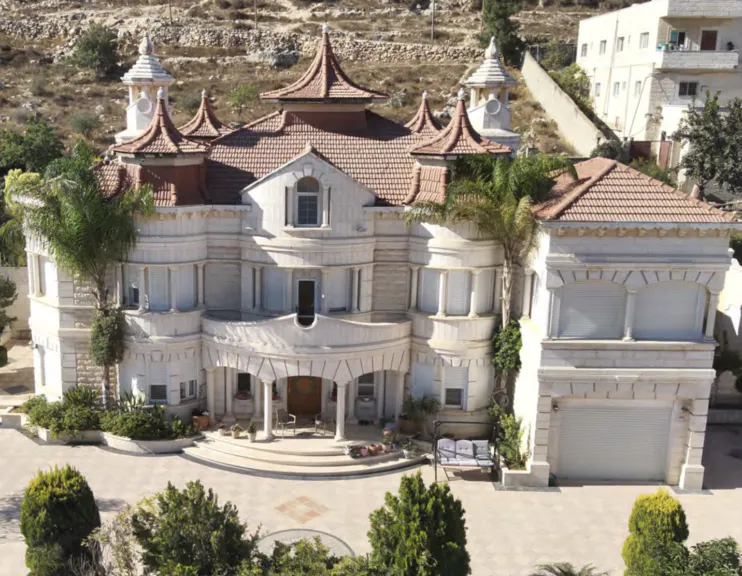
A castle-style residence in Al Khadeb, West Bank, featuring sharply pitched tiled roofs, arched windows and distinctive stone detailing. (Regavim)
While there is poverty in the West Bank, the report highlights a far more varied economic reality that challenges the notion that hardship alone defines Palestinian life in the West Bank.
The poverty rate in the West Bank was about 11.7% in 2023, before the October 7 Hamas attack, according to the World Bank. By December 2024, the World Bank estimated that short-term poverty in the West Bank had risen to 28.5%, driven in large part by the loss of jobs in Israel and the settlements following the restriction on West Bank Arab labor as a security measure to prevent further massacres.
The Palestinian Authority — the governing body in many Arab parts of the West Bank — has increasingly relied on international funding to keep its government operating.
Foreign aid to the PA jumped from roughly $204 million in 2023 to $681 million in 2024 and $741 million in 2025, according to an analysis by the Institute for National Security Studies.
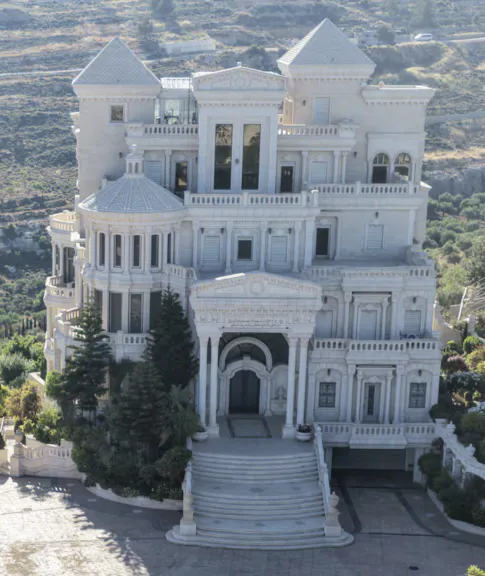
A six-story, 19-balcony residence in Husan, West Bank, with marble columns, soaring ceilings, polished floors, and a grand marble staircase. (Regavim)
Much of that funding has come from the West. In 2025, the European Union provided more than $405 million, while the World Bank provided approximately $226 million. Arab states, by comparison, provided roughly $106 million that year.
The PA’s own revenue streams have fallen far short of its spending. In 2023, it collected approximately $1.06 billion in domestic taxes and $430 million in non-tax revenue, or roughly 37% of its $3.99 billion in total expenditures.
“The Palestinians are the highest per capita recipients of foreign aid in the world. Higher than the people who are actually, really, verifiably living in famine-ravaged countries,” Kahn said. “Do European, American or Canadian taxpayers know where their money is going when it is showered on the corrupt, terror-supporting Palestinian Authority or what the actual needs of the Arabs of the ‘West Bank’ are?”
.png)
.png)