 Matt Walsh
We have uncovered new information and accusations about the cargo airline operating the Amazon Prime Air plane that crashed in Miami on Sunday, killing five people in a van inside the airport perimeter and in a Toyota Corolla outside the perimeter.
This cargo airline, called 21 Air, has a documented history of hiring foreigners who can’t follow instructions from air traffic controllers, as well as a reputation for hiring incompetent pilots who can’t pass basic training at other airlines, according to industry professionals who say they have first-hand knowledge of the company’s operations.
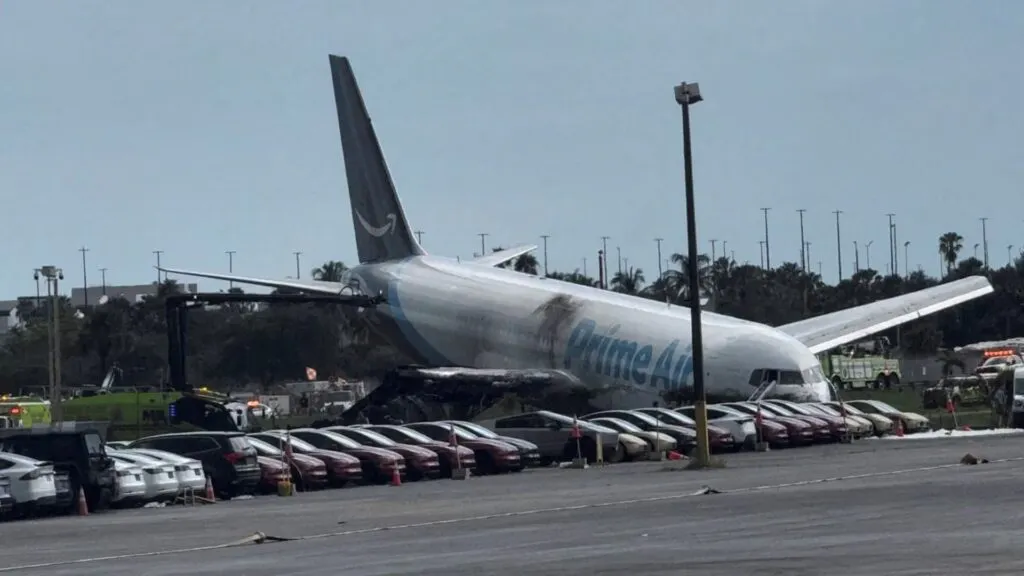
We’re going to go through the evidence as well as the implications for air travel in this country, which has become increasingly dangerous and “third-world.”
The crash footage was presumably shot by a plane-spotter, or someone who noticed the plane was having difficulty. As you watch, you will immediately realize that the pilots are responsible for the disaster. There is no question about it. They practically dive-bomb the runway, and they don’t even get all of the wheels down until they’re roughly halfway down the tarmac.
Watch:
There’s no need for an “aviation expert” to analyze this footage. Anyone who’s ever seen a plane land at any point in their lives understands the problem. This was a very unstable approach. They weren’t descending in a steady, predictable pattern. Instead, they were far too high and moving too fast.

According to radar data, they crossed a waypoint about four miles from the runway at 1,400 feet, which is 600 feet above where they should’ve been. The left-main gear is clearly off the runway for an extended period, even after the other landing gear made contact. That means the plane can’t stop effectively, because none of the systems that slow the plane down — the spoilers, the brakes, or the reverse thrusters — will work effectively — if at all — if the landing gear is not on the ground.
You can see from the following reconstruction just how long it took these pilots to put the plane on the ground. It’s not even close.
Watch:
good lord man they cruised so much runway in the air pic.twitter.com/VLmXgqa49K
— charlie ▲ obeygrey (@_obeygrey) September 7, 2026
So they’re about twice as high as they should’ve been, probably going around 30 to 40% too fast.
There could be a variety of reasons to explain why the plane was unable to make a normal approach. It’s quite possible wind contributed — thunderstorms were visible behind the plane.
Meteorologist John Morales reported a tailwind gust at the time the plane was landing, coming from the south at about 30 miles per hour. Normally, planes don’t land with a tailwind because it’s too dangerous. And until a few minutes before the plane touched down, there was no tailwind at all. There was actually a small headwind coming from the west until the winds suddenly shifted. So yes, it’s conceivable that the wind shifted at the last minute, making this approach substantially more difficult. It’s also possible that the pilots simply weren’t paying attention to their airspeed or altitude.
Whatever the case, it really doesn’t matter. Whenever a plane flies an unstable approach this close to the runway, in every single case, pilots are supposed to execute a go-around. That means they’re supposed to abort the landing, apply full throttle, and come around for another pass (or divert to an alternate airport, if necessary).
This is the fail-safe that solves all of these issues. And it’s not optional. They were descending at a rate of 2,000 feet per minute on their final approach, when the normal range is 500 to 800 feet per minute. Anything over 1,000 feet per minute on the descent is automatically an unstable approach that requires a go-around.
That’s not even considering how long it took them to actually put the plane on the ground — they blew past at least a third of the runway — which is another reason for a go-around. At any point, as they were flying over the runway, and even as the landing gear first made contact, they could’ve aborted. Instead, they drove the plane off the runway, onto a perimeter road, and killed several people.
In short, the only conceivable explanation for this crash is that the pilots had no business flying an airplane of any kind, much less a massive cargo plane. That’s not a debatable point. The footage makes it very clear. We don’t need to wait for the federal government to conclude a five-year investigation to determine that the pilots caused this crash due to their manifest incompetence.
So now the relevant questions are: Who were the pilots, exactly? Why did the airline hire them? What did their training look like? And what were regulators doing, instead of supervising this airline?
The first clue comes from the radio communications from this 21 Air cargo plane, just before the crash. To be clear, the callsign for 21 Air is “Cargo South,” so when you hear the pilot respond from “Cargo South,” that’s coming from the plane that ultimately crashed (Also, note that, in a two-person crew, the pilot making the radio calls usually isn’t flying the plane at the time). Here’s some of the audio compiled by a channel called VASAviation.
Watch:
The pilot clearly has a foreign accent, which by itself may not seem like a big deal. But then you think of all the foreign-born truck drivers who have been mowing down Americans on the highway, and you start to wonder: Does the same problem affect airlines? Is there an epidemic of unqualified pilots who can barely speak English, who have been imported into this country to fly cargo planes or even passenger airliners on the cheap?
This is a reasonable question to ask. And it becomes even more reasonable when you look at this letter from the FAA to the director of operations of 21 Air, dated May of 2023.
The letter grants 21 Air permission to “substitute a qualified and authorized check airman in place of an FAA inspector to observe a qualifying pilot in command who is completing the initial or upgrade training … during at least one flight leg that includes a takeoff and a landing.”
Yes, the FAA granted this cargo airline the ability to ditch the FAA inspectors and certify their own pilots for takeoffs and landings. There are a few restrictions on who the airline can substitute for the FAA inspector, but it’s up to the airline to ensure compliance with those restrictions. It’s basically the honor system.
The letter is the FAA allowing 21 Air to self-regulate, which has become a very common theme in the aviation industry (it’s one of the reasons those Boeing 737 MAX jets kept crashing). And this particular “exemption” is commonly issued to various airlines. But it’s abundantly clear that certain airlines — especially garbage airlines like 21 Air — should never have this authority. In this case, the FAA allowed 21 Air to get rid of independent FAA inspectors and basically self-certify their pilots for landings. Now it’s very obvious that their pilots are incapable of landing the planes.
So who are these pilots exactly? This is reporting from an engineer named Nick Plumb:
[21 Air’s] pilot group appears to have grown from around 20 in 2021 to 135 today, probably to support the 7 additional Boeing 767s Amazon shifted to it from Atlas Air [another cargo airline]. Public résumés show current pilots [at 21 Air] with prior flying careers in Venezuela, Colombia, Peru, Central America, Ethiopia and India. 21 Air also hires permanent residents and other work-authorized noncitizens. … How this little-known carrier scaled this fast may be worth digging into.
This caught my attention, so I decided to take a closer look at the reputation of 21 Air in the industry. Specifically, I pulled up dozens of posts on the forum Airline Pilot Central — one of the most popular message boards among pilots. If you’re a pilot looking for a new job and want to get a sense of the quality of a particular airline, this is almost certainly a site you’re going to visit.
Two years ago, the reputation of 21 Air was heavily discussed on the airline pilot forums because one user was interested in working there.
You have no idea the horrors that await you at 21Air. It IS the bottom feeder of all bottom feeders. Clapped out rust buckets from Sanford and Son. … The turnover is 100% because it’s so bad. … There is nothing good in anyone’s life going anywhere near 21Air.
Then there’s this:
Almost every pilot that left ABX [another cargo airline] for 21Air was asked to resign because of how poorly they did in training. The only person I’m aware of that wasn’t asked to resign was a prospective [captain] that got mad after he failed his ETOPS check and left out of spite. … The only thing I can confirm is that almost all the guys who left ABX for 21Air did so because ABX asked them to resign during training.
These two comments paint a very familiar picture. If you remember, just a few years ago, another Amazon Prime cargo plane — operated by a different carrier called Atlas Air — crashed into the water while on approach to Houston.
The cargo plane was being flown by Conrad Aska, a DEI hire who had no idea what he was doing in the cockpit. He constantly failed his training at other airlines, but Atlas Air hired him anyway (Atlas Air, of course, promoted DEI all over its website at the time).
It didn’t take long before Conrad Aska managed to fly a perfectly good airplane into the water. He accidentally pressed a switch that caused the plane’s nose to tilt slightly upwards — apparently because his gigantic watch hit the switch. And then in a panic, for reasons that make absolutely no sense, he decided to push the nose of the plane as far down as he could — disregarding all of his instruments, which told him that he was crashing the plane.
It’s one of the more unbelievable sequences to ever take place in modern aviation. It’s akin to accidentally pressing the accelerator pedal on your car, and then when the car lurches forward, you consciously decide to press down on the accelerator pedal for another 60 seconds until you crash into a wall going 100 miles per hour.
Watch:
That presentation was from the NTSB, which claims that the pilot became “disoriented.” That’s a very polite way of saying he didn’t have the IQ necessary to be a pilot. If your plane suddenly pitches up, and your response is to fly the plane directly into the ground, even when all your instruments are functioning normally, then you are not merely “disoriented”; you are a complete and utter moron. And indeed, it’s becoming apparent that total morons are being allowed to fly massive cargo planes all over the country. In particular, they’re getting hired by Amazon, or at least contractors for Amazon.
That’s why, seven years later, yet another Amazon plane has crashed in a very preventable, absurd fashion. The more you look into 21 Air, the more complaints you’ll find from other pilots about how the airline was destined for a major crash. Here’s another post where a pilot responds to someone who didn’t get a callback from 21 Air after an interview. The pilot describes a scenario in which a 21 Air cargo plane (working for DHL) caused a major incident in Newark.
[No] offense but it’s probably good they aren’t calling you. The other night we taxied behind a DHL cargo south [meaning a 21 Air plane] clapped out 767 in Newark. crew never turned on the beacon. Ground screamed at them twice for not following directions. The English was poor. Guess they don’t know how to handle a low altitude capture on the 76 cus they blew past 2,500 clearance and you could tell they were struggling to get the airplane on track and on altitude. ATC was livid. not Worth putting your certification on the line for a 36th street Venezuelan money laundering outfit. You be better off flying a paper airplane.
I’ll be the first to admit that I don’t understand everything in this post. But from what I can tell, with the help of Google, if we go line-by-line: the pilots of a 21 Air jet failed to turn on the beacon on their plane, which is used for avoiding collisions. They also got screamed at by ground controllers, presumably for being unable to taxi properly. And then, once airborne, they climbed beyond 2,500 feet without authorization, which endangered every other plane flying around Newark. And on top of all this, we’re told that a “36th Street Venezuelan money laundering outfit” is involved. That’s an apparent reference to the well-established use of cargo airlines to smuggle drugs and other contraband to Central and South America — although, we should note, there’s no evidence that 21 Air is knowingly involved in anything like that.
Nevertheless, the testimonials along these lines continued to roll in. Again, all of these are from a couple of years ago, before this recent crash. Apparently, 21 Air had earned the nickname “21 scare.”
I’ve heard some scary stories of friends jumpseating on 21 SCARE. … Terrain warning and [controlled flight into terrain] maneuvers, high altitude stalls, automation issues. … The majority of the pilots english is their second language. Amazing they haven’t bent up a 767 yet. They are also in cahoots with Cargojet, exploiting a loophole with temporary aircraft certificates and signing over airplanes from Cargojet to 21 air with a logbook entry and then operating domestic US flights, then signing the aircraft back over and flying back to Canada.
So yes, the person wrote that it was “amazing” that 21 Air hadn’t destroyed a Boeing 767 yet, given how terrible the airline is. And just two years later, that’s exactly what happened. They managed to destroy a jet and several vehicles in the jet’s path.
Obviously, we can’t vouch for the credibility of any anonymous post on the internet. I don’t endorse anything that these people are saying, for the simple reason that I can’t prove any of it. But in this case, there’s obviously reason to believe these critics have some idea what they’re talking about, given the events of this weekend. It’s a reasonable conclusion that they’re not simply making up the fact that this airline has major problems.
So the specific accusation here is that Cargojet (a foreign carrier) will land in the United States, then give control of the aircraft (on paper) over to 21 Air. And this is necessary because, by law, only domestic cargo carriers can fly from one U.S. city to another. This is actually a pretty well-documented phenomenon — whether you view it as a loophole or not, it appears to be legal. But the optics aren’t great, especially since Cargojet held a significant (roughly 25%) ownership stake in the holding company of 21 Air, and former Cargojet executives have taken senior roles at 21 Air. So it looks like 21 Air is basically a middleman for a foreign cargo company to get around the requirements of U.S. law.
There are other alleged benefits that 21 Air provides to this foreign airline. Reading on, from another poster:
You would not honestly believe what goes on there. It’s the management team that perpetuates the complete madness though. The [executives] are old buddies from the 36 street gangs back in the day. They don’t know any way else. The owners are real pieces of work and 21Air is set up to fly “Struck” freight if sister Cargojet goes on strike. You will be forced to get a Canadian validation to do this very thing. If you don’t you’re fired! … There is only one place worse than 21Air and that is World Atlantic. These two are where you go when no one else will take you. My surprise (not really) is that after all the incidents and poor training and conditions, the FAA lets these companies continue operate but no one else will fly the flowers (and the bodies and that famous white stuff) in and out of S.A. It’s really just that simple. You’re honestly better at Alligator Alcatraz than 21Air.
So that’s a thinly-veiled and unsubstantiated accusation that 21 Air is trafficking cocaine, among other things. He’s also saying that the primary purpose of the airline is basically to bust strikes that take place in Canada, and that the executives at the company are corrupt friends from other fly-by-night cargo operations in Miami.
Again, these are claims that may or may not be true. I have no idea. But after what just took place in Miami — with a 21 Air cargo plane flying the single worst approach ever caught on film, at least in memory — there’s no reason to automatically discount any of these posts. Everyone at this airline needs to be investigated. All of these pilots and industry professionals — everyone who made these posts — should be interviewed, at a minimum. Here’s one more post along these lines:
For the love of God stay as far away from this place as possible. You have no idea what you’d be getting yourself into! It is truly a bottom feeder of epic proportions. Management that has been on the same merry-go-round for years and years. They go from one bottom feeder to the next.
You can discount all of these claims if you want to. Certainly, there are plenty of small airlines that get similar complaints on forums like this — including airlines that have yet to have a single fatal crash. So maybe this is all slander from random people with an axe to grind. Maybe 21 Air only hires the most competent pilots available. Maybe the executives are supremely ethical people, and there was no way to prevent the crash that just took place in Miami.
But if that’s the case, you have to wonder why we’re not allowed to know the names, employment history, and qualifications of the pilots who were involved in the incident. This is obviously a matter of public concern. Five people are dead. A plane just careened off the runway at a major airport. We have a right to know who was involved, so we can figure out how to prevent pilots like this from ever getting hired again.
Whatever “privacy rights” these pilots have, they do not trump the public’s right to know what exactly happened. People are dead because of the actions of these pilots. So who are the pilots?
The government won’t tell us. And that’s not surprising, since the government has a clear conflict of interest here. It supposedly regulates the airlines. Public disclosure of the identity of the pilots could reveal government incompetence (or complicity) in certifying these pilots — just like the government certifies incompetent truck drivers all the time.
For their part, for obvious reasons, the airlines also want to bury the story forever. And we shouldn’t allow this. If the pilot, hypothetically, just got hired from Venezuelan Airlines or something like that, it would be a national news story — and rightfully so.
But this has become normal in the aviation industry. In late 2022, a United Airlines passenger plane departing Maui plunged 7,000 feet per minute to within 800 feet of the ocean, all because of pilot error. And to this day, we have no idea who these pilots were. They haven’t faced any kind of discipline, either.
Watch:
So the pilot wanted 5 degrees of flaps, and the first officer set 15 degrees instead. They didn’t realize it, and they nearly crashed as a result. The key detail here is that the pilots “self-reported” the mistake, which apparently grants them total immunity. The NTSB has concealed the pilots’ identities, and the airline hasn’t punished them, solely because they self-reported under the Aviation Safety Action Program (or ASAP), which is something the FAA apparently endorses.
This is a good time to mention that United Airlines is well-known in the industry for its aggressive DEI targets. They set a goal of having 50% of the students in their flight academy being “women or people of color.” They have all kinds of partnerships with various explicitly non-white organizations, including the Organization of Black Aerospace Professionals, the Latino Pilots Association, and the Professional Asian Pilots Association.
They heavily recruit from so-called “historically black colleges.” They are a DEI airline, in other words. And they know that, as long as its pilots “self-report” their mistakes, then there’s a good chance we’ll never find out their identities — or whether DEI was involved in their hiring.
Even in cases where we do ultimately learn the identities of the pilots, it takes a while. A couple of years ago, for example, an American Airlines plane crossed roughly 1,000 feet in front of a Delta flight with 145 passengers on board that was departing from Kennedy International Airport in New York. The American flight was supposed to turn right to cross Runway 31 Left, but crossed Runway 4 Left instead, where the Delta plane was taking off.
Watch:
This was seconds away from being one of the deadliest aviation accidents in history. And after the near-miss, the cover-up began. First, the crew didn’t report the incident to American Airlines. Instead, they flew all the way to London — a flight so long that the cockpit voice recorder was taped over. Then, when federal investigators tried to interview them, the crew (on the advice of their union) refused to cooperate.
The NTSB had to issue subpoenas to get them to talk. And it’s because of those subpoenas that we ever learned the names of these pilots. For more than a year after the incident, their names were redacted.
Finally, after the NTSB opened its public docket, we learned that the co-pilot, Traci Gonzales, claimed she had been distracted by a large number of weather alerts. She said that she was “unaware of the airplane’s position when the captain taxied onto runway 4L … She knew they were approaching a runway, but she did not realize they were approaching runway 4L.”
Meanwhile, the captain, Michael Graber, was equally clueless. He admitted he spotted big red lights — meaning “do not enter the runway” — but he disregarded them. “All of a sudden I saw that red glow and I just — right away I said something — that ain’t right. I didn’t know what was happening, but I was thinking something’s wrong.”
Obviously, none of these pilots should ever work again. But as far as we know, they’re still flying passengers around. The government hid their identities for months, until the heat died down. The pilots stalled the interviews for as long as possible. And now that we’ve determined the pilots were culpable, nothing was done.
To be clear, DEI is just one part of this story. Again, we still have no idea whether the pilots in the Miami crash were DEI hires or not. Yes, as a general matter, it’s true that DEI pilots are being protected, even after they nearly kill people.
We should also be honest about the fact that falling standards in the aviation industry are linked to various cost-cutting measures as well, including how companies outsource to contractors to lower overhead, skirt liability, and cause a “race to the bottom” to improve their revenues.
One of the reasons Amazon hires multiple cargo companies to fly these planes is to pit the companies against one another. Amazon wants the lowest rates. Rather than hiring one dedicated high-quality cargo airline, it provides an incentive for these bottom-feeding airlines to fight among themselves for the contract.
Foreign hiring, of course, is another related element of the story. So is the fact that the FAA allowed this airline to self-certify its own pilots for takeoffs and landings.
We’re extremely lucky that this accident — as horrible as it was — only involved a cargo plane and a couple of vehicles. As I’ve been saying for several years now, we’re on a trajectory where air disasters are going to become more common than ever.
We simply have too many planes being flown in very congested airspace, along with too many exemptions and DEI pilots.
The mid-air collision over the Potomac, which was caused by a female helicopter pilot, was a sign that something needed to change in this industry, and quickly. The crash of this Amazon cargo plane in Miami — and all of the warning signs that were missed — is a reminder that none of these changes have actually taken place.
In fact, it was just a few weeks ago that Marine One — the president’s helicopter — was allowed to come far too close to a passenger plane over Reagan Airport in D.C., because the controllers missed a key radio transmission from the helicopter.
This is the state of American aviation: we can’t even keep the president’s helicopter safe. We’re reliant on a small number of air traffic controllers who hate their jobs, foreign pilots who can’t speak English, and airlines that self-certify their own terrible pilots. This is a setup that makes many more disasters inevitable.
Until someone in the government has the foresight of random, anonymous pilots in an online message board, we can expect nothing to change — and every flight you board will carry a substantial, preventable, and unnecessary risk of total catastrophe.
.png)
.png)