 Ben Shapiro
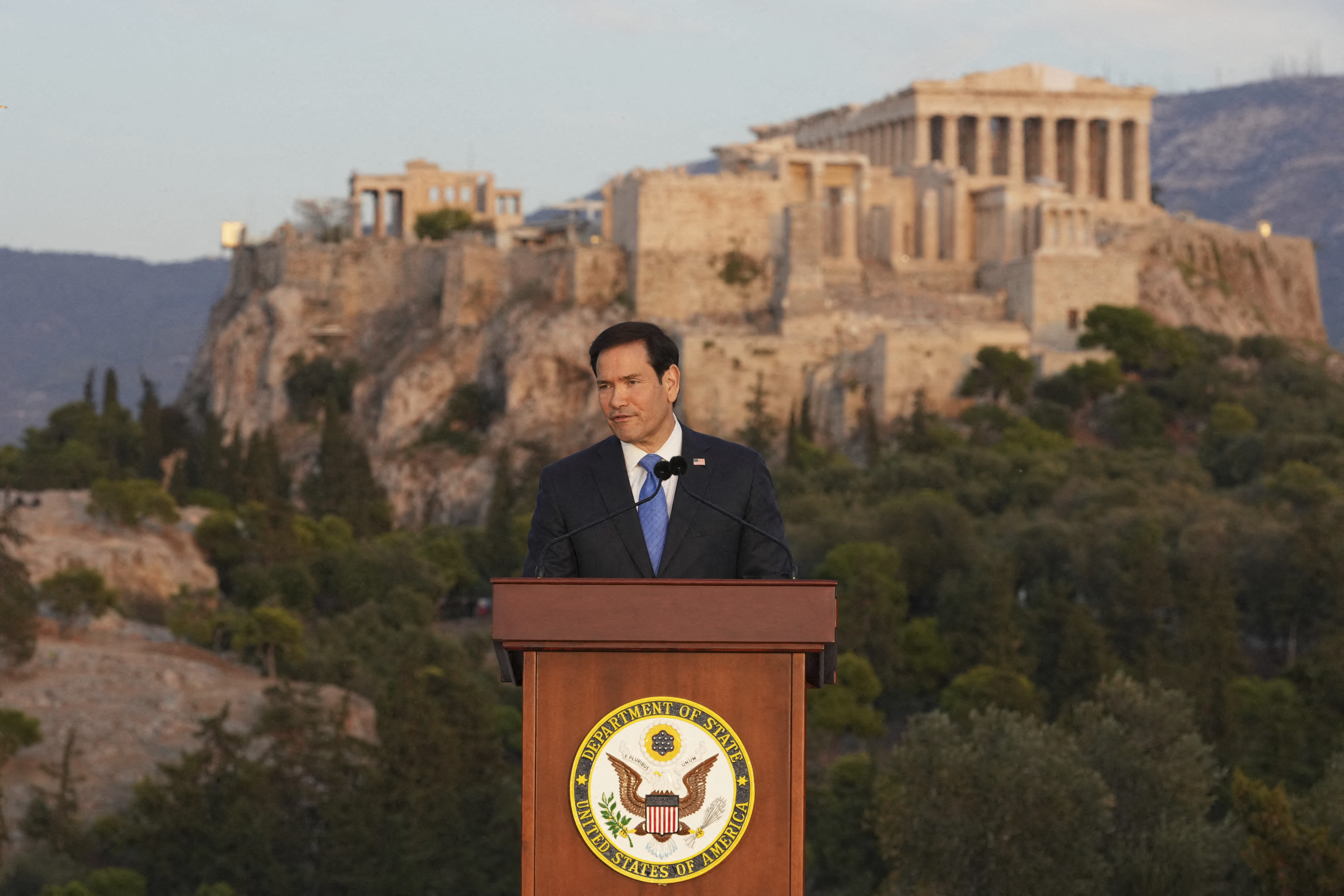
Secretary of State Marco Rubio gave an amazing speech yesterday outside the Acropolis in Greece.
It wasn’t just an amazing speech at one of the great sites of our civilization — I’ve been there, the backdrop is incredible — it was an important reminder that our achievements make America better, culturally, than the rest of the world. That is a good thing, and we should not be embarrassed.
If Marco Rubio isn’t planning to run for president one day, he should consider it, because the speech was great and his rhetoric is great for America.
Rubio started by talking about the Greco-Roman history of the American experiment:
The history of America, the history of my country, is covered with the fingerprints of antiquity. Greece is literally carved into the architecture of our government: in the towering columns, in the domes and the monuments across our capital city. The city where our Constitution was born – Philadelphia – is itself a Greek name.
The men who founded my country were fascinated by the heritage we inherited from yours. They were exceptionally well-read in history – they were vividly aware of their unique place in it – but no other age of the past held their attention or their imagination quite like that of antiquity.
This is true. The founders cited the Old Testament and Plutarch most often. Understanding the roots of our civilization is extraordinarily important to maintaining the vitality of the American experiment.

Then Rubio listed the essential traits that define the West, and you may notice a few of them not on the list. Government dependency? Not on this list.
Here, in Athens, we found the first full realization of all the essential traits that would come to define the West: fierce individuality and relentless ambition; daring exploration and invention; a yearning for discovery, for adventure, risk and glory. An insatiable curiosity about the world and the principles by which it operates, a hunger to know the mysteries of nature and grasp the secrets of the cosmos. An impatience with the notion of impossibility, chafing at all boundaries and limits, straining to peer into the depths of the unknown.
Right again. The risk-taking nature of Western civilization is based on a rational assessment of the world around us and rooted in the idea that human liberty and human freedom allow us to discover and conquer. As the Secretary of State made clear, when you obliterate that in favor of the “average,” you end up destroying your civilization.
Now I know that to modern ears, what I just described – this way of life – may sound odd; it may even sound cruel. The ideal of many ideologies in our time has, frankly, become a world of perfect safety, devoid of risk or failure, with neither the glory of victory nor the shame of defeat. Too often these days, we build downwards. We design our standards to ensure no one will lose; we preoccupy ourselves more with the comfort of the worst than the potential of the best. We hold the most exceptional things among us hostage to the average, the ordinary, the mediocre. The men who made the Parthenon, they built upwards.
Correct. It feels as though the steam has come out of Western civilization. We are so focused on tearing down those who are successful, so hell-bent on stopping those among us who are achievement-oriented and aiming for the stars, in favor of redistributing present resources that eventually wither to nothing, that we are going to destroy the roots of our civilization.
But as Rubio made clear, we should not be embarrassed that our achievements make us better in many ways, culturally, than the rest of the world. That is a good thing.
Today, too much of the West has forgotten this quality. Over time, we in the West came to feel ashamed of the very things that made us exceptional. We felt embarrassed that our achievements set us apart from the rest of the world. Our prosperity somehow became a source of guilt. We no longer believed we deserved and had earned our greatness.
The word “nationalism” became a dirty word. And so we tore down our monuments; we condemned our own history. And in too many places, we taught our children to be ashamed of the countries they would inherit. …
And now, today, we find ourselves at a crossroads. Because the next decade and the decisions we make will write the story of the next century. The course we take will determine whether the West maintains its place at the head of the world or resigns itself to a future of atrophy and servitude and decline. We will either choose to act now or lose the choice to act at all.
Exactly. If we lose what we are, nothing will be left to fight for.
As Rubio pointed out, that means a strong West and a strong America in the world.
You know why I was thrilled to hear Rubio’s speech? It can sound old-fashioned and hackneyed, but it was a throwback to a better time. It was wonderful to hear an American politician talking about freedom, liberty, aspiration, and opportunity in a positive way.
He also lauded peace through strength, as he stated:
Now for all their lofty ideals, the ancient Greeks were not naive. They understood that nations have interests. They understood that statecraft requires prudence and diplomacy, but they also understood that it requires the ability to wield force when prudence and diplomacy fail. They understood that power requires not only having the means to defend yourself, it requires the credibility that you are willing to use it. This is the classical understanding of politics and of statecraft that the Trump Administration hopes to reclaim – reclaim not just for our country, but for the whole of our civilization.
He made a throwback reference to the citizen soldier of Athens, the idea that our heroes are willing to do what they must in order to protect the West, but they don’t worship death the way radical Muslims do.
Our heroes, the heroes of the West, are those who choose to remain faithful to their duty precisely when it is most difficult and painful to do so: the man who is bound by his word, the soldier who will not abandon his post, the captain, the proverbial captain, who goes down with his ship.
This is wholly different from what we see, even now, for example from fanatics like the radical mullahs of Iran, whose cult of death hails child suicide bombers as national heroes, and portrays martyrdom as an end to itself.
Our heroes – our heroes may be willing to die for their cause; but our heroes do not worship death. It is precisely because we value life that we come to recognize the heroism in those who would sooner sacrifice it than to betray their principles. Our heroes may be willing to die for their cause, but our heroes do not worship death.
Rubio is speaking a language of actual conservatism rooted in American history and Western history that many members of the so-called Right seem to be losing these days. They’re falling back on a bizarre version of philosophy that is bereft of historical basis in America and American thought.
The real threat is not, of course, within the Right on these issues; it is from the Left. The West has imported its own destroyers; it’s not simply a matter of the West losing its way.
If Rubio runs in 2028, things will be interesting.
He’s amazingly good at this.
.png)
.png)