 Matt Walsh
It’s almost Labor Day weekend, which means you’re about to be carpet-bombed with advertisements for new appliances, almost all of which are essentially ticking time bombs waiting to self-immolate in your home when you least expect it.
And for that reason, the holiday presents a good opportunity to answer some questions that almost every American has asked in the past decade or so: When exactly did household appliances become so much worse — so much more dysfunctional, unreliable, and even dangerous? And what specifically changed in the appliances themselves? Is there any concrete answer to these questions? Are we all imagining the massive decline in quality?
As it turns out, no, it is not a figment of our imagination. Yes, the quality of our appliances — like so many other products — is declining, and there are very concrete reasons for that. And it’s not as simple as “corporations want to make more money, so they design their products around planned obsolescence.” That’s part of it, but it’s not the full story.

There’s also the fact that government regulations (and the threat of litigation) are forcing some of the largest appliance manufacturers to build major vulnerabilities into their products. And the manufacturers, rather than tell consumers what’s happening and how to fix the issues, are happy to sit back and watch as the appliances break, leading to new sales. It’s an intricate scam, and we’re going to reveal it all, so that you know what to look for.
But first, watch this video to set the stage: It’s from an account called “Tech Stuff,” and it describes a Sunbeam-branded toaster from the 1940s.
Watch:
So if my math is right, we’re talking about a toaster from more than 80 years ago. You would think, given all the advances in technology that have taken place since the 1940s, that today’s toasters would be vastly superior to this product from Sunbeam. Again, it was created long before we landed on the moon. And yet, despite all the time that’s passed, modern toasters have nothing on the Sunbeam. And there’s a very interesting reason for that.
So in the 1940s, the toaster could sense how hot the bread was. And it would dynamically adjust the heating time to ensure that the bread was toasted appropriately. So if you cooked one batch of toast, and then quickly toasted another while the toaster was still hot, you didn’t have to worry about timer settings or anything like that. The Sunbeam would automatically cook the second batch of toast for a shorter period of time.
And as you saw, no matter what you stick in the Sunbeam, it’s going to heat it to a consistent level. By contrast, today’s toasters mostly use timers, which are obviously much more inexact because they’re not measuring heat at all. Even some premium toasters that do measure temperature aren’t as good as the Sunbeam, because they measure ambient temperature in the toaster as opposed to the temperature in the bread itself.
This is the kind of thing that, if you’re a conspiratorial person, must absolutely drive you crazy. How could it be that, over the course of 80 years, we haven’t figured out how to make a better toaster? How could it be that, if anything, most toasters have degraded in quality?
Our grandparents and great-grandparents, all those years ago, imagined a Jetsonian future where a robot instantly zaps our bread to the exact level of toastiness that we desire. And instead here we are, eight decades later, with toasters that haven’t advanced at all. Is it possible that there’s somehow a conspiracy to make toasters worse?
Actually, that would be the optimistic explanation. The more likely explanation is that we’ve all simply accepted a mediocre product that is cheaper to produce so that’s what we get. It’s similar to how we abandoned the Concorde, the supersonic passenger jet. We had the capability to fly on faster planes and have better toasters, but we collectively decided that it simply wasn’t worth it. So, while we can land on the moon, we’re stuck with toasters that don’t work very well.
You can get very radicalized if you spend any amount of time thinking about this topic — and indeed, many people are doing just that. Consider this viral video that blew up recently, where a guy shows off his fully functioning 1956 washer in 2026. Today, the typical washing machine lasts for around 7 to 10 years — and this machine is going on 70 years of use.
Watch:
Americans have realized older appliances last forever, and even often times work better, than new ones
This man shows his “1956 Frigidaire washer, I wanna show you guys how quickly it’ll empty this tub and get up to 1100 RPMs of spin speed. Watch this”
Appliances before… pic.twitter.com/AF3FBEezeE
— Wall Street Apes (@WallStreetApes) April 9, 2026
Source: @WallStreetApes/X.com
In response to videos like this, you might point out that, while it’s impressive, we can’t actually draw too many conclusions from this clip alone. We have no idea how many times this washing machine has been repaired, for example. Nor do we know, on average, the typical lifespan of a Frigidaire washing machine from the 1950s. Nor does anyone have any data on that point. Maybe 90% of them died within a few years, and this one is a unicorn.
But the thing is, pretty much everyone has a story like this. Anecdotally, you probably remember (or your parents may remember) how much longer appliances used to last, and how they were often built with steel instead of plastic or aluminum. And even if you don’t remember this, it’s hard to miss the constant stream of videos where people make this claim. Here’s another one that went viral. This is a fridge from 1958.
Watch:
This 1958 GE “Revolving Shelves” refrigerator is the absolute king of over-engineering, and it’s living proof that we’ve traded durability for planned obsolescence.
Imagine a world where your fridge doesn’t just have static shelves, but heavy-duty “Lazy Susan” style racks that… pic.twitter.com/LXRYTtOAV8
— PeachProof (@PeachProof23) April 15, 2026
Source: @PeachProof23/X.com
In the interest of full disclosure — since I’m always interested in presenting the other side of a debate — you should know that this viral fridge video really infuriated the esteemed journalists at The Wall Street Journal. They put out a TikTok video — in the usual style, with someone named Emma Camp “debunking” the fridge from 1958.
Watch:
What can a vintage refrigerator tell us about capitalism? Quite a lot, actually!
Find out more in my latest for @WSJFreeEx pic.twitter.com/ni6sCilt5u
— Emma Camp (@emmma_camp_) July 13, 2026
Source: @emmma_camp/X.com
I counted about five different poses in that one-minute video, which is actually restrained by Gen Z selfie video standards. By the way, this video is courtesy of the “Wall Street Journal opinions section,” which is the same paper (and the same opinion section) that, just a few days ago, defended a columnist who used AI to write an op-ed, on the theory that AI is just another tool like a spellchecker or a thesaurus.
Emma Camp had nothing to do with that, to be clear, but I can’t miss the opportunity to mention this. The writer, in the case of the op-ed, didn’t use AI to help him; he used it to draft entire paragraphs. And the AI-generated writing was so bad that everyone immediately called it out. Nevertheless, in the eyes of The Wall Street Journal, there was nothing wrong with the AI-generated slop op-ed, or slop-ed, we can now dub it.
Anyway, as for the substance of what Emma Camp actually says, first of all, she never says anything about the butter warmer in that fridge from the 1950s. She talks a lot about the new features in modern fridges, but she fails to mention that none of these features is anywhere near as cool as a butter warmer. So that’s a big omission right off the bat.
And then there’s the whole bit about capitalism, as if everyone who’s upset with their appliances must be a communist. In fairness, some people do blame capitalism for this problem, and I’m sure she saw plenty of comments to that effect, which she’s responding to.
But to make this entire discussion into a capitalism vs anti-capitalism thing misses the point. For the record, I’m not anti-capitalism. I don’t think we should return the Bolsheviks to power simply because appliances are terrible now. And yes, as she states in the video, it’s obviously true that appliances are much cheaper now than they were in the 1950s. They have more features, too — with the exception of a butter warmer. And many of these new features are totally pointless, while also making the appliance much more likely to break down.
But none of this explains why appliances today, as a general matter, are not built to last for any significant amount of time. She doesn’t address that question. And that’s strange because, just a couple of years ago, this same paper — The Wall Street Journal — observed that, according to all available data, the problem is indeed very real.
Appliance technicians and others in the industry say there has been an increase in items in need of repair. Yelp users, for example, requested 58% more quotes from thousands of appliance repair businesses last month than they did in January 2022. … American households spent 43% more on home appliances in 2023 than they did in 2013, rising from an inflation-adjusted average of $390 to $558, according to Euromonitor International. Prices for the category declined 12% from the beginning of 2013 through the end of 2023, according to the Labor Department.
I’ll say that again: We now spend 43% more on home appliances than we did in 2013, even though prices have decreased in that same period. The only logical explanation is that people are replacing appliances much more frequently than they used to — probably because those appliances are breaking.
And indeed, the article goes through several examples of people who spent a lot of money for new appliances, only to see them fail in spectacular fashion. There’s one case where a couple owned a dishwasher from the 90s that was working perfectly. But they decided to purchase a much “sleeker” $800 stainless steel dishwasher from GE, only for their new dishwasher to spring a “hidden leak” less than three years later. They ended up with $35,000 worth of damage to their kitchen, plus they got dropped by their homeowner’s insurance. The culprit? A $60 pump that broke. Yes, a $60 pump ultimately caused $35,000 in damage.
Anecdotally, I can say that my personal experience with dishwashers has been similarly frustrating. We’ve had at least two “top-of-the-line ” dishwashers in the last couple of years that have ended up leaking all over the floor. Both had to be replaced. And one thing you notice about the really “nice” dishwashers is that, even if they remain functional for longer than three and a half days, they don’t actually do a better job of washing the dishes. The expensive ones don’t produce noticeably cleaner dishes. Sometimes it runs the opposite way, in fact.
This is not an uncommon situation anymore, across a variety of appliances. But maybe the best way to illustrate how much things have changed is simply to look at how appliances are advertised now, as compared to the 70s and earlier. Here’s a Maytag commercial from back then, in case you don’t remember them.
Watch:
So the whole sales pitch is that Maytag’s appliances were reliable. Their washers, dryers, and dishwashers weren’t going to need a repairman because they were built to last. And plenty of other brands used the same strategy.
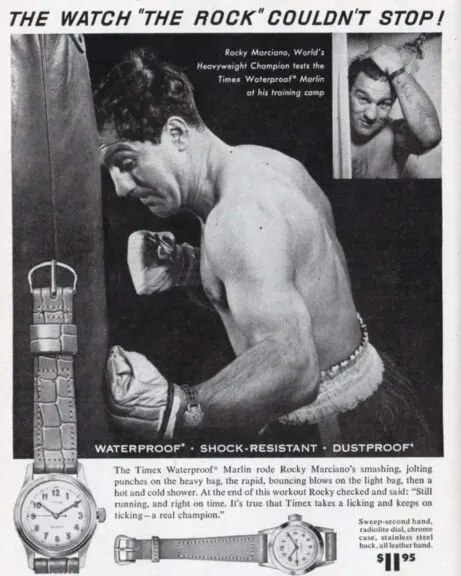
Timex ran ads that promised their watches would “take a licking and keep on ticking.”
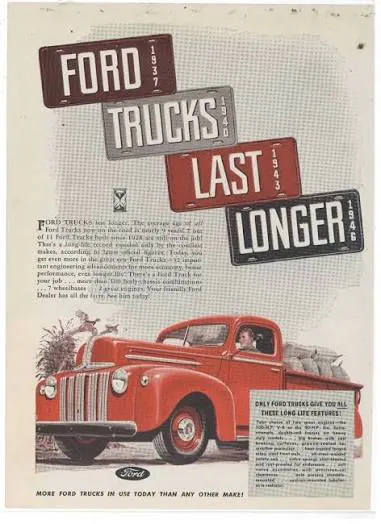
Ford promised that “Ford trucks last longer.” Again, customers expected that products would last a very long time. And most corporations had not yet mastered the art of planned obsolescence, or maximizing shareholder value, so they gave customers what they wanted.
Fast forward a few decades, and ads look more like this one from GE:
I’ll admit that, in certain situations, having a WiFi-connected appliance can be a good idea. It can be useful to remotely control your thermostat with your phone, for example. Or hypothetically, you could even use your iPhone to access the camera on your Roomba, spot a home invasion in progress, race home, and shoot the burglars. These are all completely reasonable scenarios that are made possible by the wonders of online-enabled “smart appliances.”
But when your dishwasher claims it’s using “machine learning,” it’s time to draw the line. There is no universe in which “machine learning” and “a dishwasher” should appear within the same sentence. It’s totally absurd. No sane person wants to get dishwasher notifications on their phone. This is one of the most self-defeating things about all of these “smart” appliances.
The whole point of a household appliance is that it’s supposed to do a job for you and take it off of your plate. But now with “smart” appliances, all routed through your wifi and connected to your phone, your appliances are constantly nagging you. They take up more space in your mind and your life, not less. Admittedly, I’ve never connected any of my appliances to my phone, because I don’t really like receiving text messages from most humans I know, let alone receiving them from my oven or my ice maker. But I know plenty of people who are fully connected and integrated with their appliances. They receive real-time updates and push notifications from their refrigerators, washers and dryers, and crockpots. It’s like being in a never-ending group chat with every inanimate object in your house. You might as well bring your sofa and your coffee table into the conversation at this point.
And as you’d expect, all of this comes with a very big catch.
Watch:
So in addition to being more inconvenient, the intelligent “machine learning/WiFi enabled dishwasher” also has access to your personal information. Once you install their app on your phone, you’re giving them your name, your email address, maybe even your phone number. They’re learning how often you wash the dishes when you’re at home. And presumably, they’re either selling this information or planning to monetize it in some way.
If you asked a random customer, which would you prefer: A dishwasher that lasts 50 years, or a dishwasher that connects to your WiFi and floods your entire kitchen in three years, every single one of them would choose the 50-year option. But none of these companies are even trying to market a product like that. Collectively, they’ve all decided to create worse products in tandem to improve their margins and ensure planned obsolescence. It’s probably not some antitrust conspiracy, but it doesn’t have to be. It’s a happy medium for these corporations. And we’re all paying for it.
A big part of the problem is that, all across the appliance industry, plastic housing is increasingly used for critical components — in a dishwasher, that includes the pump or the spray arms. Very often, this is presented as a safety measure, rather than an attempt to cut costs (or to force the machines to fail, so that they need to be replaced). But the truth is usually a lot more complicated.
Take mixers, for example. If you buy a KitchenAid mixer today — even an expensive one — the machine is almost certainly going to have a single nylon gear inside, called a “worm gear.” The primary role of the worm gear is to transfer rotational power from the motor to the gears, which then allow the mixing attachment to work. But the worm gear also functions as a mechanical fuse. It’s designed to strip and shed if the mixer ever encounters too much resistance, which in turn will immediately stop the mixer from working — protecting the motor and the gears from any further damage.
But as many people have pointed out, this “safety feature” does not simply kick in during a rare emergency. Instead, after a few years, the worm gear seems to inevitably fall apart, regardless of how you’re using the mixer. And, according to many different reports you’ll find online, this failure mode is very new, because back in the day, the worm gear was made of metal instead of plastic. Supposedly, these mixers were much more reliable when a company called Hobart was making the mixers, before Whirlpool took over in 1986. Here’s just one example of a video making this claim.
Watch:
There are aspects of this claim that are true, and some that are made up. The important point — which most people don’t realize — is that KitchenAid does indeed include nylon worm gears in most of their models, and these gears are very prone to failure over time. And if you don’t use your mixer in accordance with the manual, then you’re going to accelerate this timeline drastically. If you read all the documentation that came with your mixer, you’ll learn that you need to use low speeds when you’re mixing yeast dough, for example.
On the other hand, professional-grade mixers — including some sold by KitchenAid — use all-metal gear assemblies. And even ordinary mixers from the 80s had much better construction than what you’ll find today. Take a look at this shot, which I pulled from the website “Mixerology,” along with all of my knowledge on the topic.
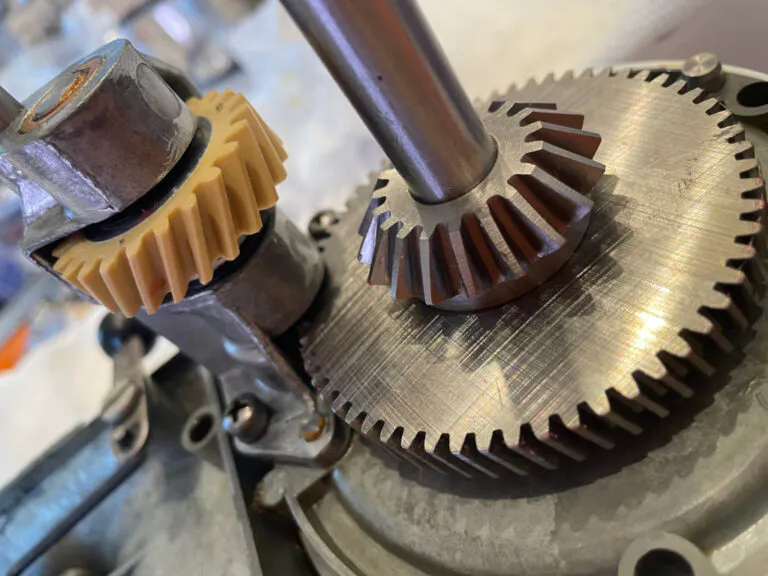
This is what the kids would call a “gear mogging.” I’m not going to pretend to be an expert on the topic, but I can say with a high degree of certainty that, if I had the option, I’d rather have the mixer that doesn’t look like a child’s toy. But today, you don’t get that option — at least, unless you spring for a much more expensive “professional mixer.”
Evidently, these professional mixers come with fully metal transmissions, and the worm gear follower is made of bronze, not nylon. This is reportedly the case for the “Professional HD” and “Professional 600” model types, among others. And while the bronze gear can theoretically still fail, of course, it’s much more resilient. You can also find professional mixers (mostly used in high-volume cafeterias) that don’t have a “mechanical fuse” at all. They use an integrated motor and transmission assembly. And as you’d expect, they have a much, much lower failure rate than your mixer at home.
What’s misleading about the KitchenAid content you’ll find online — and yes, it’s an entire genre — is the suggestion that older household mixers didn’t have the nylon gear. They did. This wasn’t a modern change to suddenly force your mixer to fail. Wirecutter recently tore down an old KitchenAid mixer and found very similar components in an old mixer compared to one you can buy today. That said, as I just mentioned, the quality of the construction in those old mixers was still visibly superior to anything you can buy off a shelf right now, for a reasonable price.
As it stands, if your KitchenAid mixer becomes disabled, you have a couple of options. You can buy a new mixer — which is obviously what KitchenAid wants you to do. It’s also the most common option. Alternatively, you can pay a technician $100 to fix it, or you can replace the part yourself. Here’s what that looks like — it’s a fairly involved process that will take about 30 minutes out of your day.
Watch:
If you’re the kind of person who’s willing to deal with this hassle, repairing the gear is cheap. But if you’re like the vast majority of KitchenAid customers, and your machine dies on you after a few years, you become frustrated and buy a new one. That’s the whole point.
But again, I don’t want to imply that all executives invented all these problems to wring as much money as possible out of you. The government has also played a very big role, across a variety of industries. When Wirecutter spoke to some repairmen, they immediately pointed to federal regulations concerning water and energy efficiency as the root cause of many problems that people deal with:
The main culprit is the set of efficiency standards for water and energy use for all cooking, refrigeration, and cleaning appliances. Those standards have been managed by the Department of Energy since 1987 and frequently updated; the rules are evaluated at least once every six years after each amendment. … Most of the significant changes arrived in the early 2000s, and they have been updated several times since. Before those updates, appliances were road-tested for decades. … Brand representatives would even ride along with his technicians as they worked on appliances “and monitor the failures, and what goes on inside.” … Now, the models change a lot more often. More importantly, to meet any new standard, appliances often move from analog parts to digital components, such as computer circuit boards.
So the constant changes prevent long-term testing from taking place, while also introducing many more components that can fail. And by the way, just in case you think this was a partisan issue, the National Appliance Energy Conservation Act of 1987 passed the Senate with 89 votes. The House approved it with a voice vote. We’re talking about overwhelming support from both political parties to empower the Department of Energy to ruin as many household appliances as possible.
The law was signed by Reagan, who supported it because appliance manufacturers (who lobbied hard for the bill) were frustrated by the patchwork of state laws that were regulating their products. They wanted a uniform federal standard, and they got one. Mechanical timers were replaced by circuit boards. Plastics replaced metal, as we discussed. Motors became smaller and used less water.
This was a theme of Reagan’s presidency — he created a framework that in the following decades would become a disaster. He did it with immigration and his “amnesty.” And he did it again with this legislation. Under George W. Bush, the Department of Energy gained more power. And then under Obama, the regulations intensified even further.
We’ll close with one more practical example of the effects of these regulations, specifically the regulations governing water use. Again, I’m not an expert on the topic, but it’s fascinating to see exactly how the government can manage to cause problems with your washing machine. So I found a “ServiCenter” in San Diego that pointed out many of the issues caused by eco-related regulations that conserve water. And here’s what they had to say:
The logic is simple: washing machines need sufficient water to create effective agitation and detergent distribution. When water levels are reduced, clothes do not move as freely, and detergent may not dissolve fully. The result is uneven cleaning and an accumulation of grime inside the drum, hoses, and filters. This hidden buildup can cause malfunctions, unpleasant odors, and even accelerate wear on critical components such as pumps and seals. High-efficiency machines are designed to use less water, but their sensors and cycles rely on careful balance. If a machine’s sensors misread the load size or detergent amount, it may use even less water than intended. Over weeks and months, small compromises in water usage can lead to a steady decline in performance. Users often notice that clothes look cleaner but feel stiff, smell faintly musty, or require extra cycles for stubborn stains.
Reduced water levels also “strain the appliance,” causing pumps to work harder, along with uneven wear on the drums. Detergent residue, since it’s not fully rinsed, can corrode components. And on and on.
How do you benefit from any of this? Maybe your utility bills will be a little lower. That’s about it. In exchange, you get an expensive washing machine that’s doomed to fail in a few years. Oh, and all of your other appliances got worse too, courtesy of the federal government.
If there’s any silver lining here, it’s that in 2024, the Supreme Court overturned the Chevron doctrine. We talked about this case at the time. The ruling basically means that Congress can’t delegate everything to federal agencies like the Department of Energy.
In other words, every once in a while, Congress needs to pass a law using the constitutional process, rather than allowing bureaucrats at the Department of Energy to effectively pass laws by themselves. Agencies are no longer entitled to the benefit of the doubt in every case.
And that’s good news if someone decides to sue the Department of Energy to roll back some of these inane regulations that are making our everyday life much worse, in many respects. There’s a real opportunity to do something about these regulations for the first time in decades.
And once that happens, who knows — maybe we’ll usher in a new era of human progress. Maybe we’ll colonize Mars in a few years. You see, when we’re not drowning ourselves in regulations, there’s actually a lot we can achieve. All we have to do is admit, once again, that Reagan made a mistake.
We have to make it clear that people are entitled to demand functional products even if that means paying more upfront and even if that means we’re using a little more water in the process.
And if you doubt that it’s possible, remember: We once landed on the moon. We also, once upon a time, created a toaster that doesn’t burn the bread. And we can easily return to that era of American excellence if we’re willing to do so.
This is a far more worthy cause than all of the BLM riots combined. So the next time your WiFi-enabled washing machine destroys your entire kitchen, or the next time your KitchenAid mixer spontaneously combusts, remember the words of the civil rights heroes of old, and get yourself into some “good trouble.”
Take to the streets and seek the justice you and your dirty dishes so rightly deserve. Future generations — and future customers of household appliances in particular — will thank you for your sacrifice.
And the next time there’s a Labor Day appliance sale, for the first time in recorded history, people will actually be excited about it. And with apologies to George Floyd and John Lewis, it’s hard to imagine a more meaningful legacy than that.
.png)
.png)