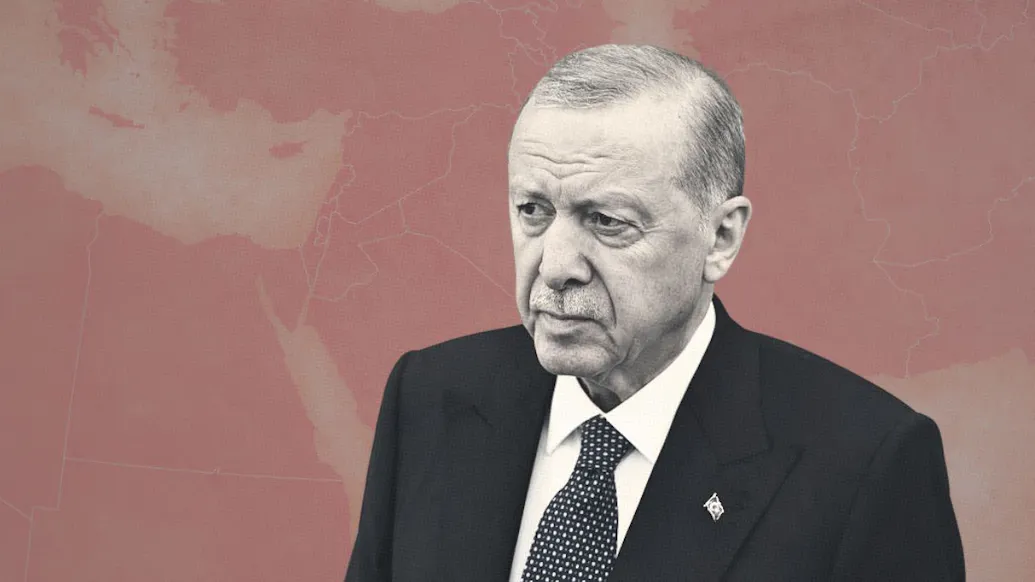
Turkey’s mutual defense pact with Saudi Arabia and Pakistan is a step toward the ultimate ambition of Turkish President Recep Tayyip Erdogan: to make Ankara a powerhouse across the entire territory of the old Ottoman Empire.
The Mecca Joint Defence Agreement, signed in Mecca on August 7 by Erdogan, Saudi Crown Prince Mohammed bin Salman, and Pakistani Prime Minister Shehbaz Sharif, commits the three countries to a NATO-type alliance among Sunni states that would treat an attack on any one of them as an attack on all.
The agreement gives Turkey access to assets it could not easily replicate on its own: Pakistan’s implicit nuclear deterrent and military capabilities, Saudi Arabia’s vast financial resources and influence across the Arab and Muslim worlds. Egypt has also been floated as a possible new member.
The pact will help counterbalance Iranian regional power, but it will also position Turkey as the military and political leader of a “Sunni ring of fire,” advancing the Turkish president’s vision of a modern Ottoman sphere of influence, according to Chaim Silberstein, the chairman of the Jerusalem Center for Applied Policy (JCAP).
“All these goals help him to progress and cement his position as the hegemon in the Middle East,” he said, arguing that the agreement helps resolve two significant obstacles to claiming leadership of the Muslim world, including not being a descendant of the Prophet Muhammad or an Arab.
Ankara is seeking to expand its own military capabilities. At the NATO summit in Ankara last month, President Donald Trump said he would consider allowing Turkey to purchase F-35 stealth fighters, potentially reversing a ban imposed after Erdogan’s government bought Russia’s S-400 missile defense system. Turkey was removed from the F-35 program in 2019 over concerns that operating the Russian system alongside the American stealth fighter could expose sensitive information about the aircraft to Moscow.
Congress subsequently prohibited the transfer of F-35s to Turkey unless Ankara no longer possessed the S-400, leaving any potential sale dependent on resolving the dispute over the Russian system. U.S. and Turkish officials have been exploring options, including making the S-400 inoperable or moving it to a U.S.-controlled facility.
Trump has also embraced the new alliance itself. In a post on Sunday, he praised the leaders of Saudi Arabia, Turkey, and Pakistan for signing the Mecca agreement, calling it a “BIG, BOLD, AND IMPORTANT FIRST STEP” and saying it showed the Middle East was coming together and becoming better able to defend itself.
While Ankara contributes its own NATO-backed military and sophisticated defense industry, the pact could ultimately benefit Turkey most by giving Erdogan a broader security and political network through which to project Turkish power across the former Ottoman sphere, says Silberstein.
In Silberstein’s view, the alliance also gives Erdogan a way to unite otherwise divided Sunni states around a common adversary: Israel.
He sees Jerusalem as particularly powerful in that regard, arguing that the city can serve as a shared cause among countries with otherwise competing interests — and one with deep historical resonance for Turkey, whose Ottoman predecessors ruled Jerusalem for roughly 400 years.
“The pathway to consolidate his leadership and dominance is through a broad Sunni alliance,” Silberstein said. “Its main dynamic route runs through Jerusalem, which he perceives to be the best unifying factor among Sunni countries that continually fight with each other.”
Silberstein has made that argument the focus of a broader assessment of Turkey’s regional ambitions, warning that Erdogan’s strategy extends beyond conventional diplomacy and military alliances.
In the recent report, “Exposing Erdogan’s Plan for Palestine,” his organization examined a 758-page document published by Erdogan’s communications directorate covering the Gaza war from Oct. 7, 2023, through April 20, 2024. The organization argues that the document provides insight into how Ankara views Israel, the Palestinian issue, and Jerusalem as part of a longer-term Turkish strategy.
According to JCAP, the Turkish publication portrays Ankara’s involvement in Jerusalem not as foreign intervention but as a continuation of Turkey’s historic role. It emphasizes that the Ottomans ruled Jerusalem for more than four centuries and goes further, describing Gaza as an “integral part of our homeland.”
JCAP argues that this Ottoman narrative allows Turkey to present itself as a “civilization heir with a unique, inherited claim to Jerusalem — one that no Arab state, and certainly no Western power, can contest on equal terms.” The report says this framing “converts a geopolitical ambition into an inheritance.”
Erdogan has called Jerusalem “our city,” while Turkish Foreign Minister Hakan Fidan has said the Islamic world would do “whatever it takes” to defend the Islamic identity of the Al-Aqsa Mosque.
The Palestinian cause, in JCAP’s assessment, therefore gives Erdogan a platform to present Turkey as the defender of Jerusalem and the Palestinians — and, more broadly, as a leader of the Muslim world. The publication repeatedly invokes Jerusalem, Saladin, and Muslim responsibility, reinforcing what JCAP describes as Ankara’s effort to turn its historical connection to the city into a modern political claim.
In JCAP’s “Turkey’s Phased Plan to Conquer Jerusalem” report, it describes the series of steps Turkey could take to establish itself as the patron of Jerusalem and its holy sites. These include reconciliation between Hamas and the Palestinian Authority, a political and military foothold in Gaza, a Turkish foothold in Syria, the establishment of a Palestinian state with Jerusalem as its capital, and, eventually, an invitation for Turkey to help stabilize the new Palestinian government.
The report says the common thread running through Erdogan’s regional moves is the goal of eventually entering Jerusalem as its “patron and overlord.” It points to a network of Turkish organizations, charities, and cultural institutions already operating in Jerusalem as part of what it describes as an effort to establish a Turkish presence before any formal political role emerges.
That network includes the Turkish Consulate, Turkey’s intelligence service MIT, the Yunus Emre cultural center, and organizations promoting Turkish and Ottoman heritage. JCAP says Ankara has used economic assistance, education, scholarships, Turkish-language programs, and heritage initiatives to expand its influence among Arab residents of Jerusalem.
Turkey’s approach to Gaza follows a similar pattern, according to the reports.
The official Turkish publication calls for a Turkish role in the postwar security structure while describing Ankara as prepared to participate as a guarantor with a military presence. JCAP identifies the guarantor mechanism as one of the report’s central strategic objectives, alongside a reconstruction fund.
Trump was initially open to deploying Turkish troops to Gaza as part of the plan to remove Hamas from power and rebuild the Strip, but Israeli Prime Minister Benjamin Netanyahu forcefully rejected the inclusion of Turkish troops.
Turkey has also stepped up its rhetoric against Israel. On July 3, the Turkish foreign minister declared that Israel had become a “burden that humanity can no longer bear.” Erdogan has compared Netanyahu to Adolf Hitler, and his administration has called for Israeli leaders to face trials like those of Nazi officials.
As Iran’s regional influence has waned, Turkey is moving to fill the vacuum left by Tehran, particularly in Syria, where Ankara is expanding its presence.
JCAP describes Syria as a crucial piece of Turkey’s broader strategy. It estimates that roughly 20,000 Turkish troops are deployed across nearly 100 outposts and bases in Syria and argues that Ankara is seeking to deepen its political and military hold over the country. The report describes a potential Turkish strategy of creating political structures in northern Syria subordinate to Ankara while providing military and political assistance to the government in Damascus.
In doing so, Turkey is beginning to adopt the same regional playbook that Iran used to build its influence. Iran spent years building its regional network through military deployments, local allies, and political influence, using Syria as a critical bridge to Lebanon and Hezbollah. With Bashar al-Assad gone and Tehran’s position weakened, Ankara has an opportunity to establish its own foothold.
Syria is particularly valuable because it sits between Turkey and much of the former Ottoman Middle East. A durable Turkish presence there would give Ankara a military foothold directly south of its border while positioning it to project influence toward Iraq, Lebanon, and the Palestinian territories.
But the prospect of a more powerful Turkey also comes with concerns about the man directing it. Erdogan has a long record of human rights abuses, Islamist politics, and hostility toward the West. His government has cracked down on journalists, political opponents, and Kurdish politicians, while Erdogan has increasingly embraced an Islamist vision for Turkey and cultivated relationships with U.S. adversaries, including Russia and Iran.
He has also used anti-Americanism as a political tool, with his government promoting claims that the West was behind the 2016 coup attempt. In 2017, members of Erdogan’s security detail were accused of violently attacking protesters outside the Turkish ambassador’s residence in Washington D.C. — an assault that prompted a unanimous condemnation from the U.S. House of Representatives.
For Erdogan, the objective is not necessarily to recreate the Ottoman Empire on a map, but to restore the power and influence it once exercised — putting Turkey at the center of the Middle East and increasingly independent of the West.
.png)
.png)

