 Daniel Payne
Like many Americans, I no longer go to the movies as often as I used to. And on the relatively rare occasions I go, I find myself rather haunted by the movie theaters themselves, which are no longer the fun, energy-filled, boisterous communal places they once were but increasingly feel like weird, dark, ghostly husks, hulking and empty and unsettling in a way that feels sort of eldritch, almost Lovecraftian.
The more I dwell on this disquieting feeling, the more likely I won’t be going back.
Actually, many of the reasons I’ve stopped going to the movies are probably similar to most people. For one, popular movies these days are mostly pretty lame. Half seem to be superhero movies, perhaps the most detestable mainstream genre in cinematic history. And if they aren’t the ninth spinoff of some obscure comic book hero, the marquee blasts another remake or reboot nobody asked for, and nobody cares about (they’re remaking “The Bodyguard,” if you were interested, which of course you weren’t). And virtually every movie these days, like 99% of them, all look the same: Either garishly overlit and oversaturated, or else dull and listless and grayed out. It’s awful to look at. None of it looks normal. It all looks like junk. It all looks like Netflix.
And who wants to spend what seems like a mortgage payment for a listless, gray, unoriginal moviegoing experience? To put it mildly, movies are extremely expensive. It may seem incredible, but as recently as 2016 it was possible to get an evening ticket for a first-run premiere movie for around $8. Today a similar ticket costs about $16, nearly double the price. Throw in a $15 bag of popcorn and a $13 soda, and a date night can cost more than $60 (that’s not even including dinner!). Take your kids to the movies, and it might be over $100.
Bad movies and bad prices are a strong deterrent to moviegoing. Throw in the utter ubiquity of streaming and the resultant media oversaturation, and it’s not surprising that attendance at movie theaters is at historic lows. The result is, increasingly, empty movie theaters.
It is true that theaters can at times seem full the way they used to. In 2026, for instance, we’ve seen multiple big-budget movies draw huge crowds to theaters: “The Odyssey,” “Toy Story 5,” and the latest “Spider-Man” release. Big-budget spectacle movies can still command huge box-office turnout. And even some lower-budget surprise hits can still draw a crowd, as did “Obsession” and “Backrooms.”
Yet ticket sales are ultimately a fraction of what they used to be. For example, Box Office Mojo reports that in 1986 the domestic box office topped $3 billion; that’s about $9.3 billion in 2025 dollars, or about $1 billion more than the domestic box office in the latter year. And note that there were considerably fewer major film releases in 1986 compared to 2025, meaning theaters back then did more sales with much less. Big-budget movies and sleeper hits can drive brief surges in attendance, but otherwise people increasingly just aren’t going to the theater.
And there is something deeply haunting and discombobulating about an empty cineplex. It’s like being inside an empty airport, or a disused hospital wing, or an elementary school in July. Your brain kind of skips a beat in these situations, as if it’s trying to manually fill in the throngs of people it knows should be there.
A packed movie theater is full of electric charge; it’s a kinetic experience, active and dynamic and animated in a way that affirms your own essential humanness and your place in a human community: We’re all here having fun doing the same thing. An empty theater is one long, endless hallway, abandoned and forgotten, as if you yourself have been left behind and excluded from some vital inclusion. It’s like a memento mori with wall sconces.
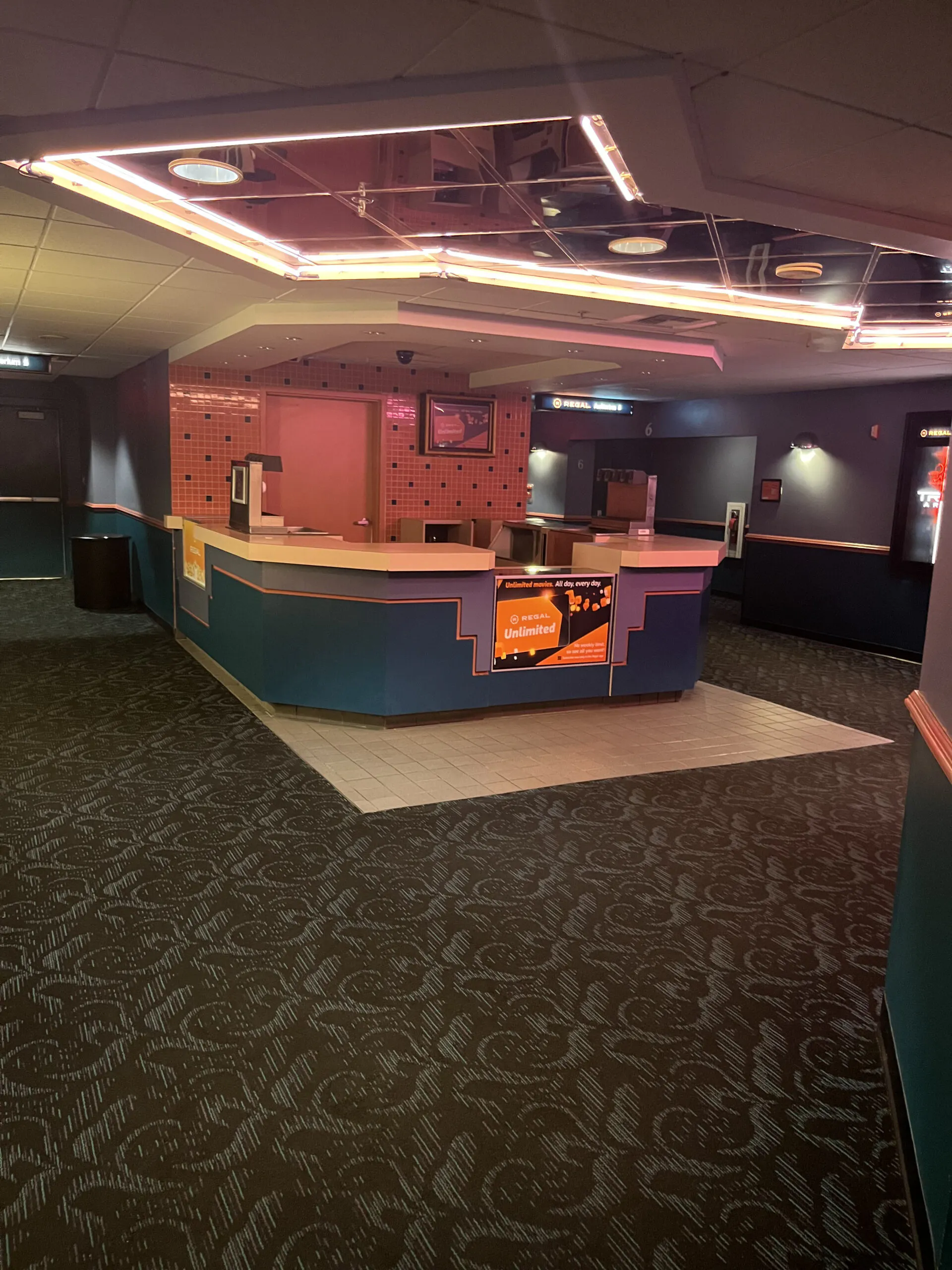
Perhaps the most unnerving part of the empty theater is the auxiliary concession stands you find deep in the hallways of many theaters built in the 1980s and 1990s. These little islands were obviously built during a much more generous moviegoing heyday, when the crowds were so large that it made sense to have overflow capacity for the snack lines. These days they exist as nothing more than silent, empty shells, what some commentators refer to as “ghost concession stands.” The candy display cases are empty. The soda taps are all dry and have been for years. There aren’t even any napkins or straws.
Credit: Daniel Payne
Being in these theaters is an eerie, sad reminder of how degraded the theater economy has become. And in that, it’s a reminder of something larger and more important — how much better and stronger our social fabric used to be. An empty shell of a movie theater is much more what is signified than a signifier; it shows us not something that is coming to pass but something that has already come. It is not a harbinger but a harbinged.
The abandoned movie theater is a sign of our times — a sign of how deeply and fundamentally our social fabric has been ripped and torn over the last 20 years or so, and how the happy communal experiences we used to enjoy as a matter of course have largely ceased to exist. Yes, we no longer go see movies en masse. But something else has happened, too, something worse: The very notion of communal life itself has radically degraded.
Go out in any public place — literally anywhere there are lots of people, a restaurant, a music venue, a public park, a bookstore — and it is a pretty safe bet that very many, if not most, people there will be looking at their phones. This is not an idle directive: I urge you to really look the next time you’re out in a crowded public space. Once you really see it, you’ll never be able to unsee it: People are on their phones constantly, ceaselessly. Everywhere you go, it’s what nearly everybody is doing. The smartphone has become the universal experience for everyone, everywhere, pretty much all of the time.
The consequences for movie theaters are obvious: Presented with an endless glut of on-demand digital content, most people aren’t likely to drive to the suburbs and shell out $45 to take a risk on a movie they’ve never seen. Hence the haunting hallways and ghost concession stands. The consequences for the broader social infrastructure are more complex but no less ruinous: For millions and millions of us, life is increasingly a delivery mechanism for phone usage. Data indicate that most people spend more than five hours on their phones every day, or about 30% of their waking hours. About a third of our lives is given over to looking at these devices every day.
Everywhere we go, everything we do, the phone is a constant, endless, relentless presence — a never-ending loop of scrolling, tapping, scrolling, scrolling, tapping. It crowds out other, funner things, like movie theaters. It also crowds out better, more vital things, like human connection, communal awareness, a sense of place, a sense of belonging in one’s own neighborhood or city.
It has eroded manners and decorum in a way that would be shocking to people even a dozen years ago: It is now considered completely unremarkable to whip out one’s phone and devote one’s entire attention to it even when in the middle of a conversation. Everything is subordinate to the phone. It has become the dominant feature of nearly every part of our lives.
It is unsurprising that movie theaters are dying a slow death in this environment. It is less surprising still that the very basis of a rich social fabric — shared experiences, communal spaces, mutual attention — has degraded so sharply. Think about this the next time you pull out your phone, or the next time you see one of those ghost concession stands sitting dusty and empty and forgotten.
***
Daniel Payne is a senior editor at EWTN News. He lives in Virginia with his family.
.png)
.png)

