
Iran-backed Houthi terrorists have rapidly expanded their foothold along Yemen’s Red Sea coast, seizing strategic territory that has put the once-ragtag militia within roughly 20 miles of a major American military base.
The Houthis captured the Red Sea port of Mokha and the strategically located Mayun, or Perim, Island last week before seizing the Greater and Lesser Hanish islands on Monday, according to the Associated Press. The latest gains have strengthened the group’s position around the Bab el-Mandeb Strait, a critical maritime chokepoint connecting the Red Sea with the Gulf of Aden.
The advances have brought the group’s fighters to within approximately 20 miles of Camp Lemonnier in Djibouti, the largest U.S. military base in Africa and a key hub for American operations in the region, which sits on the opposite side of the Bab el-Mandeb Strait from the new Houthi-held territory.
The Houthi gains come as the group intensifies attacks on Saudi Arabia, raising the risk of further disruptions to global oil supplies as the war with Iran threatens shipping through the Strait of Hormuz and sends crude prices higher. It also puts the terror group in a strategic position to follow through on a threat made by Iran to close the Bab el-Mandeb Strait.
Saudi Arabia’s East-West oil pipeline was forced to shut down last week following a drone attack launched from Iraq, according to Saudi and Iraqi officials. The pipeline, which can transport up to 7 million barrels of crude per day from the Persian Gulf to the Red Sea, has provided the kingdom a way to bypass the Strait of Hormuz since Iran threatened commercial shipping at the start of the Iran war in February.
Satellite images show extensive damage to a pumping station. The pipeline is expected to remain out of service for weeks, according to the Associated Press.
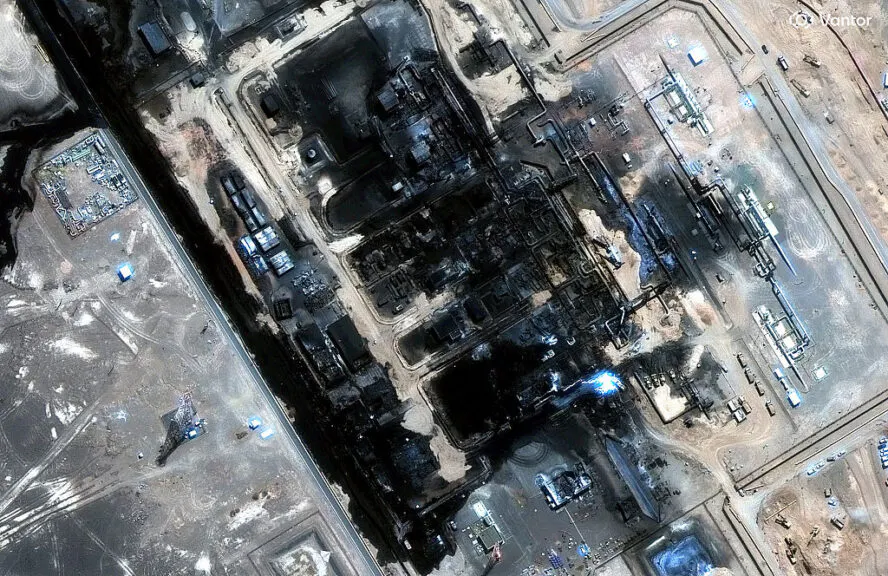
A closer view of fire-damaged structures and blackened ground at the East-West pipeline pumping station in Saudi Arabia following the September 11, 2026 drone attack and resulting fires. (Satellite image 2026 Vantor/Getty Images)
Brent crude prices climbed to roughly $109 per barrel Monday following the attack.
The Houthis have also targeted Saudi oil infrastructure and shipping in and around the Red Sea for more than a month.
The group has also made clear that its campaign against Saudi Arabia is not over. Nasr al-Din Amer, head of the Houthi-run Saba news agency, told CNN that the Houthis would continue “pressuring” Saudi Arabia until Riyadh ends what the group describes as a “siege” of northern Yemen.
The Houthis and Saudi Arabia have been in conflict for more than a decade since the Iran-backed group seized Yemen’s capital, Sanaa, in 2014 and drove the internationally recognized government into exile. Saudi Arabia launched a military intervention the following year to push the Houthis back.
The group, known for its bizarre propaganda music videos, emerged from one of the world’s poorest countries, where the adult literacy rate is just 54% in the latest World Bank data available. Yet over the years, the Houthis have built a capable arsenal with Iranian support, including ballistic and cruise missiles, drones, and other weapons. The group has used them to attack commercial ships in the Red Sea and Gulf of Aden, as well as targets in Israel and Saudi Arabia.
The conflict killed tens of thousands of people and contributed to one of the world’s worst humanitarian crises before a 2022 truce significantly reduced the fighting. The Houthis declared the ceasefire over in July, amid the wider regional conflict.
Saudi Arabia has avoided launching a major military response to the latest Houthi advances and instead reportedly asked the Trump administration for assistance. President Trump has declined to commit U.S. forces directly to the fighting.
On Saturday, Trump said the Houthis had contacted his administration and indicated that they did not want the United States to become directly involved.
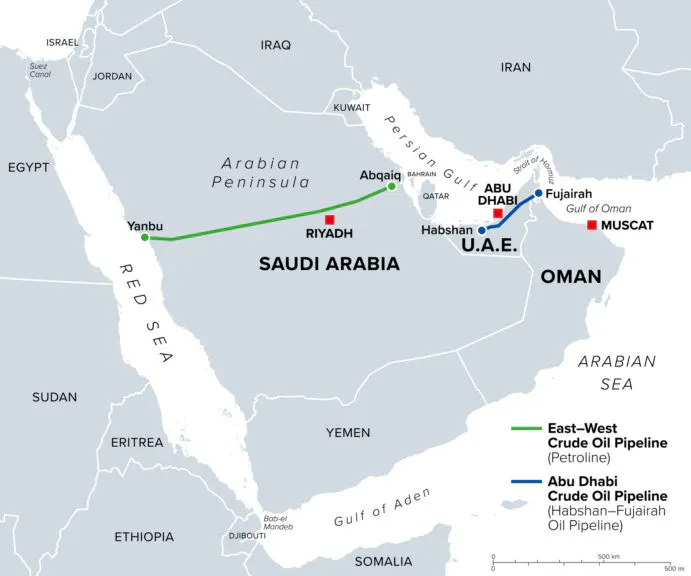
Map of East-West Pipeline or Petroline in Saudi Arabia, from Abqaiq across Arabian Peninsula to Yanbu at Red Sea, and Abu Dhabi Crude Oil Pipeline, from Habshan, in the UAE to Fujairah. (Getty Images)
“They would much prefer not having us involved,” Trump said. “They’re letting most ships go through. There’s just one country that they’re not too happy with, and we’ll get that straightened out.”
Instead, the United States sent more than 100 military personnel to Saudi Arabia to provide intelligence and targeting assistance for its campaign against the Houthis, CNN reported.
The Houthis previously came under direct U.S. attack in March 2025 when Trump ordered a major bombing campaign against Houthi targets after the group resumed attacks on commercial and military vessels in the Red Sea.
U.S. Central Command said the campaign, dubbed Operation Rough Rider, struck more than 800 targets by late April, including Houthi leadership, command-and-control facilities, and weapons storage sites. After 52 days of U.S. strikes, Trump announced a ceasefire with the Houthis on May 6, 2025.
The Yemeni military has also attempted to halt the Houthi advance by reportedly launching airstrikes against Houthi positions in Mokha, the coastal town of Dhubab, and elsewhere in Taiz province on Sunday, according to the Associated Press. The Houthis reported attacks by Saudi-backed forces in Taiz as well as artillery fire in Saada, a Houthi stronghold near the Saudi border.
The National Resistance, a government-allied force that previously controlled parts of Yemen’s western coast, said more than 500 government fighters had been killed along the coast during the past four weeks. The group also claimed that more than 1,000 Houthis had been killed in Hodeida and Taiz provinces.
Nearly 94,000 people have been displaced by the fighting since the beginning of September, according to the United Nations.
.png)
.png)

