Iran-backed Houthi terrorists are escalating deadly attacks on Saudi Arabia, striking airports, and hitting key oil infrastructure, and the kingdom looks to President Donald Trump for help.
At least 20 people were killed and 356 injured in Houthi attacks on Saudi airports between October 6 and October 11, according to the Saudi General Authority of Civil Aviation. The deadliest attack struck King Khalid International Airport in Riyadh on October 10, killing at least 12 people, including an American citizen, and injuring more than 300.
The attacks have disrupted air travel and raised questions about Saudi Arabia’s ability to defend its territory as the conflict threatens critical shipping routes and global energy supplies.
President Donald Trump said the United States was considering joining Saudi Arabia’s strikes against the Houthis, telling reporters Sunday, “We may. We’re gonna look at it.”
Trump accused the Houthis of acting at Iran’s behest and deliberately driving up oil prices in a lengthy Truth Social post Tuesday, warning the group that he “will never forget” its latest attacks on Saudi Arabia. He also recalled last year’s U.S. bombing campaign against the Houthis, which cost more than $1 billion and ended with an agreement for the group to stop attacking American ships in the Red Sea.
“I thought they learned their lesson a year ago when we bombed the HELL out of them and, at their request, stopped. They’ve been silent for a long time, but now they’ve emerged again, probably at the behest of Iran,” Trump wrote.
Houthi official Mohammed al-Bukhaiti warned that U.S. involvement would trigger a “swift and painful response” targeting American interests across the region, reported AFP.
Here’s what you need to know about the Houthis’ war against Saudi Arabia and what it could mean for the United States.
Why Are The Houthis Attacking Saudi Arabia?
The Houthis’ conflict with Saudi Arabia dates back to the early 2000s, when Houthi leaders accused Riyadh of pressuring then-Yemeni President Ali Abdullah Saleh to crack down on their Shia community and providing financial support for the government. Saleh denied the allegations, and Saudi Arabia has not confirmed them.
Tensions boiled over in 2014, when the group seized Yemen’s capital, Sanaa, and drove the internationally recognized government into exile. Saudi Arabia launched a military intervention in 2015 to restore the government and push the rebels back, beginning a war that killed tens of thousands of people and contributed to one of the world’s worst humanitarian crises.
A 2022 truce significantly reduced the fighting, but the Houthis declared the ceasefire over in July amid the U.S.-Iran war, resuming attacks on vessels in the Red Sea and eventually striking Saudi Arabia directly. The group demanded an end to the kingdom’s military operations in Yemen and what they describe as a siege of northern Yemen. The Houthis have also demanded billions of dollars in compensation for damage caused by the Saudi-led intervention.
The group, known for its bizarre propaganda music videos, emerged from Yemen, one of the world’s poorest countries, where the adult literacy rate is just 54%. Yet over the years, with Iran’s backing, the Houthis have built a capable arsenal, including ballistic and cruise missiles, drones, and other weapons. The group has used them to attack commercial ships in the Red Sea and Gulf of Aden, as well as targets in Israel and Saudi Arabia.
Houthi political bureau member Mohammed al-Bukhaiti said that this month, the group rejected proposed two-week and one-month truces, warning that continued fighting would deepen losses and make a settlement more difficult.
How Can The Houthis Pose A Significant Challenge To Saudi Arabia?
Saudi Arabia spent approximately $83 billion on defense in 2025, according to the Stockholm International Peace Research Institute. Its military has advanced American-made Patriot and THAAD air defense systems, fighter jets, and other weapons purchased from the United States and European countries.
Yet the kingdom has struggled to intercept every incoming missile and drone, including the ones that hit the airport in Riyadh. Saudi authorities have launched an investigation into how the attack penetrated the kingdom’s air defenses.
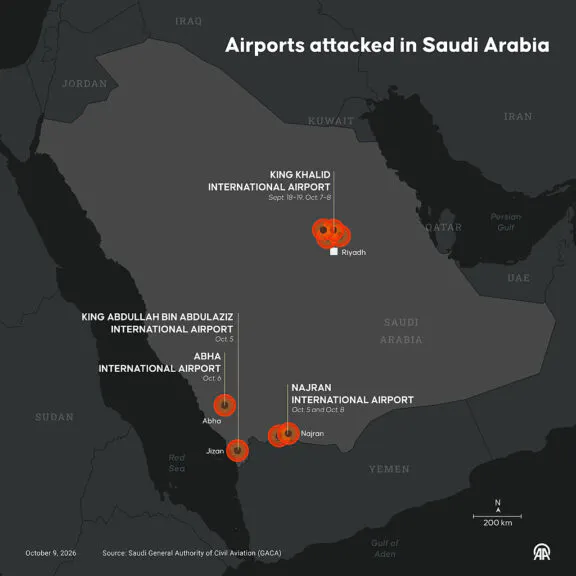
(Photo by Kadri Suat Celik/Anadolu via Getty Images)
One challenge is Saudi Arabia’s size. Covering roughly 830,000 square miles — about one-fifth the size of the United States — the kingdom must defend airports, military bases, cities, oil facilities, and other critical infrastructure spread across a vast territory.
Saudi Arabia is also facing threats beyond Yemen. The kingdom has come under attack from Iran and Iran-backed militias operating in Iraq, leaving it to defend against threats coming from multiple directions.
Even advanced air defenses cannot intercept every projectile, especially when the Houthis launch waves of missiles and drones to overwhelm radar systems and force defenders to track multiple threats at once. Not to mention that the Houthis’ Hatem-2 and Palestine-2 missiles are considered surprisingly accurate.
Saudi Arabia is facing one of the biggest challenges in modern warfare: fighting a guerrilla group with a conventional military, while spending millions of dollars to intercept relatively cheap drones and missiles. The Houthis can operate from dispersed positions in Yemen’s rugged terrain and continue launching attacks on assets worth billions even after taking losses.
A major Saudi ground offensive could be costly, with no guarantee of eliminating the Houthi threat, and could drag the kingdom into a prolonged war that threatens Saudi interests.
For Saudi Arabia, total victory means eliminating the threat to the kingdom, not simply weakening the Houthis on the battlefield. Crown Prince Mohammed bin Salman is pursuing an ambitious plan to turn Saudi Arabia into a world-class hub for tourism, technology, and business, but continued Houthi attacks threaten those ambitions by scaring off investors and visitors.
The impact is already reaching the business community. Saudi Arabia is working to offer virtual attendance and alternative travel routes for its October 26-29 Future Investment Initiative in Riyadh, known as “Davos in the Desert,” diplomatic sources told AFP. The conference typically draws major foreign leaders and business executives.
Saudi Arabia has also faced criticism over its handling of public warnings, with Reuters reporting that Saudi Arabia stopped issuing alerts about imminent missile and drone attacks days before the deadly strikes on Riyadh’s airport. The government had not publicly explained the interruption, but alerts have reportedly resumed.
How Is Saudi Arabia Responding?
Saudi Arabia has stepped up its military campaign, targeting Houthi fuel and oil infrastructure in Yemen in an effort to weaken the group’s ability to sustain its attacks. On Tuesday, the Saudi-led coalition struck fuel storage and transportation facilities in Sanaa, Hodeidah, and Dhamar, including the Al-Sabaha central fuel station outside the Yemeni capital. Coalition officials said the Houthis were using the facilities to support their missile and drone operations.
The Houthis responded by threatening further attacks on Saudi oil facilities and airports. On Tuesday, a missile struck an administrative building at Saudi Aramco’s headquarters in Dhahran, causing a fire but no reported casualties, according to Saudi officials. The group also threatened to target Aramco facilities and Riyadh’s King Khalid International Airport if Saudi Arabia continued striking Sanaa.
Riyadh is also seeking military support from regional allies as part of a broader coalition. So far, Pakistan has sent thousands of troops to help defend the kingdom, while Egypt has offered assistance.
Yemeni government-aligned forces backed by Saudi Arabia have launched their own offensive against the Houthis, seeking to reclaim territory along Yemen’s Red Sea coast and push the group away from the strategic Bab el-Mandeb Strait. Earlier this month, the government-aligned forces reported advances in Marib and along the coast.
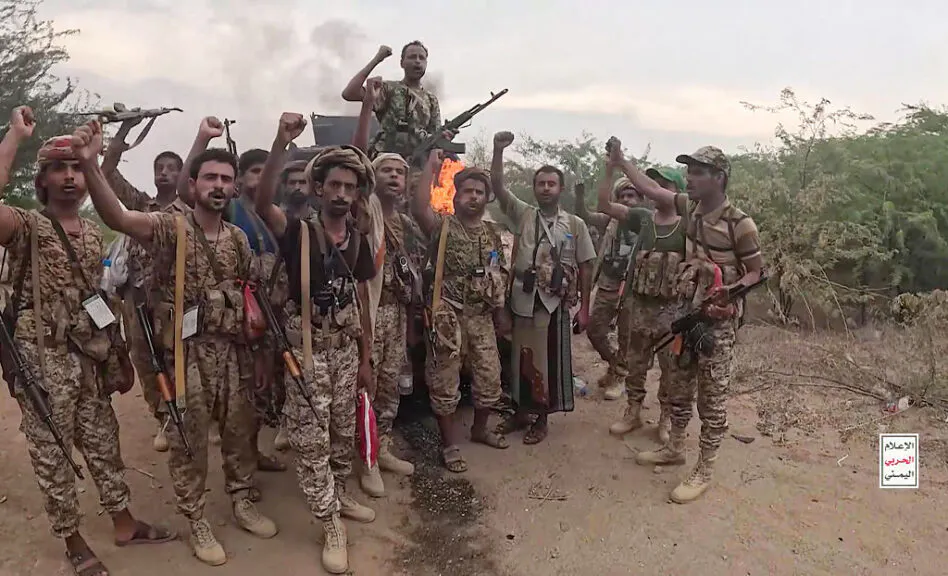
TAIZ, YEMEN – SEPTEMBER 9:(EDITOR’S NOTE: This Handout photo was provided by a third-party organization and may not adhere to Getty Images’ editorial policy.) In this handout photo provided by Houthi Media Center, fighters of Yemen’s Houthi group shout slogans as they fight against the Saudi-backed forces on September 09, 2026 in Taiz, Yemen. The renewed fighting between Yemen’s Houthis and Saudi Arabia came after a breakdown of the ceasefire when Saudi warplanes launched airstrikes on the Sana’a International Airport to prevent an Iranian plane from landing. The escalation between the two sides has led the group to capture much of Yemen’s Red Sea coast from Saudi-backed forces. (Photo handout by Houthi Media Center via Getty Images)
The Houthis, who have an estimated 350,000 fighters, according to a United Nations assessment cited by Reuters, are pressing their offensive around Taiz, Yemen’s third-largest city, which remains under government control. Their fighters have battled the government-aligned forces near the city’s southwestern outskirts and sought to seize a key checkpoint on the main road into Taiz. Control of the checkpoint remains contested, according to the Institute for the Study of War.
But the Houthi attacks have continued, forcing Saudi Arabia to close Riyadh’s international airport until October 17, causing disruptions at other airports, and forcing international carriers to suspend service.
What Does The Conflict Mean For The United States?
President Trump is weighing whether to join Saudi Arabia’s military campaign against the Houthis after a series of deadly attacks on the kingdom. On Tuesday, Trump told reporters he might ask Turkish President Recep Tayyip Erdoğan to help Saudi Arabia fight the Iran-backed group.
“I might do it. He’s a great friend of mine, as you know,” Trump told reporters. “And I might do that. I have a lot of respect for the president of Turkey. President Erdoğan, I think, would do as I ask.”
The Houthis have warned that American intervention would make the United States a direct target. In an interview with AFP, Houthi political bureau member Mohammed al-Bukhaiti said that if the U.S. became involved in the campaign against Yemen, there would be a “swift and painful response targeting the U.S. and all its interests in the region.”
Win McNamee/Getty Images
The Houthis’ advances along Yemen’s Red Sea coast and around the Bab el-Mandeb Strait put the terror group within 20 miles of Camp Lemonnier in Djibouti, the largest U.S. military base in Africa and a key hub for American operations in the region.
The United States sent about 100 military personnel to Saudi Arabia to provide intelligence and targeting assistance for its campaign against the Houthis, CNN reported.
A new U.S. campaign would also stretch American military resources as U.S. forces continue confronting Iranian attacks on commercial vessels in the Strait of Hormuz.
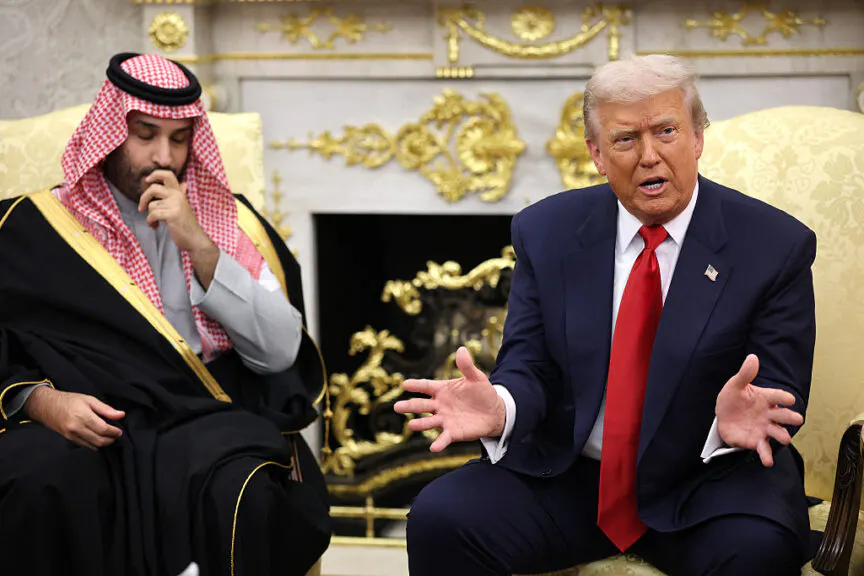
But Saudi Arabia is a major American ally, and the relationship goes beyond the current conflict. During his May 2025 visit to Riyadh, President Trump secured a $600 billion Saudi investment commitment and announced a $142 billion defense agreement.
Walking away as the kingdom faces repeated attacks could damage that relationship and raise questions among other U.S. allies about whether Washington will stand by them when they come under fire. Trump now faces a balancing act: deciding how far to go to help Saudi Arabia without pulling the U.S. into another prolonged military campaign in the Middle East.
.png)
.png)

