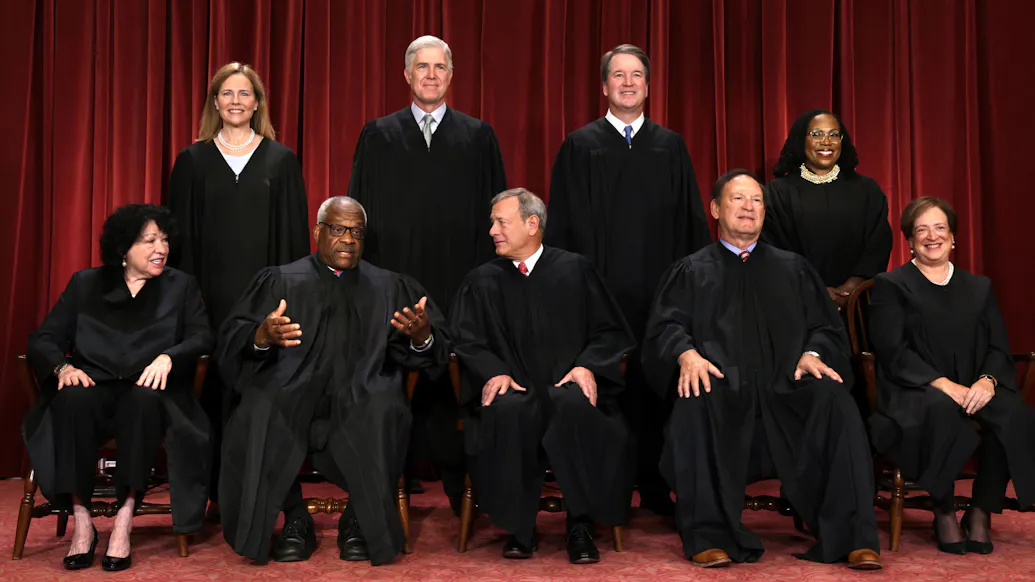
The U.S. Supreme Court is racing to issue rulings on some of the country’s most consequential legal disputes, with decisions that could reshape elections, gun rights, the transgender movement, and President Donald Trump’s second-term agenda.
Traditionally, the nine justices finish their work at the end of June and leave Washington for the summer. With two weeks still remaining in the month, some of the term’s most significant cases have yet to be decided.
The blockbuster cases remaining on the Supreme Court’s loaded docket are expected to be decided in the coming weeks, capping an already landmark term that invalidated the president’s sweeping tariffs and effectively ended race-based redistricting.
Arguably, the most significant case of this term involves President Trump’s executive order restricting birthright citizenship. The order, which was signed on his first day back in office, faced immediate legal challenges and was never implemented. Last term, the conservative majority struck down nationwide injunctions but left the merits of the case for another day. During oral arguments in April, a majority of the justices appeared skeptical of the administration’s arguments that would redefine who qualifies to be a citizen of the United States.
“The United States of America cannot live with the shackles of Birthright Citizenship. It is not economically, or otherwise, sustainable, and no other Country in the World, of consequence, does it,” Trump said in a June 11 Truth Social post.
It’s not the only Trump-related dispute before the high court. Justices will also decide whether Trump — or any future president — can fire the heads of independent agencies within the executive branch. In another test of executive power, the court is also weighing Trump’s attempt to remove Federal Reserve Board Governor Lisa Cook over allegations of mortgage fraud. Cook has denied any wrongdoing.
On immigration, the Supreme Court is set to decide whether the White House has the authority to revoke Temporary Protected Status (TPS) for migrants. The administration has suffered a series of legal setbacks in lower courts after moving to end protections for Venezuelan, Haitian, and other migrants.
Justices will also decide the legality of late-arriving mail-in ballots, a top target of the Trump administration and an increasingly contentious issue following California’s recent primary. Leftist Los Angeles City Councilmember Nithya Raman advanced to the November mayoral election after nearly a week of counting late-arriving ballots, locking Republican Spencer Pratt out of the race. Late vote drops gave Raman more than a three-point lead over Pratt, a stunning turnaround for the leftist who had trailed by more than nine points on election night.
The case challenges a Mississippi law that allows a grace period for mail-in ballots, but a ruling in favor of the Republican National Committee could upend voting rules in as many as 14 states.
Turning to social issues, the power of states to restrict transgender athletes from competing in women’s sports is also on the chopping block. More than half the country has enacted laws aimed at protecting female sports and locker rooms. Transgender athletes and liberal activists have taken the fight to the Supreme Court, arguing that Idaho and West Virginia’s policies discriminate based on sex and transgender status.
Upholding the state bans on transgender athletes would deal another blow to the LGBT agenda. Last year, the conservative majority upheld Tennessee’s ban on gender procedures for minors.
A closely watched Second Amendment dispute is also before the Supreme Court. Justices will determine whether a Hawaii gun law limiting the carrying of firearms onto private property infringes on the right to bear arms. The regulation — known as the “vampire rule” — requires concealed-carry permit holders to obtain permission before entering private property open to the public.
“You are just relegating the Second Amendment to second-class status,” conservative Justice Samuel Alito told Hawaii’s lawyer, Neal Katyal, during oral arguments.
The Supreme Court is expected to hand down more opinions on Thursday.
.png)
.png)