When a scholar presented evidence that British professor Jason Arday committed plagiarism, Cambridge University called the accusation “vile.” England’s most prestigious university declared the plagiarism impossible, leaning on an investigation by his previous employer, Liverpool John Moores University, that cleared him.
Of course, Arday was a plagiarist. After it was demonstrated beyond doubt that Arday was a flagrant fabulist, Cambridge called the situation an “aberration.” It promised a “thorough and transparent” investigation into how he got hired and how his lies were missed.
Cambridge has now, following Arday’s death, announced that it will no longer investigate any of it. It will instead examine whether it supported Arday enough after he was exposed as a fraud, the New York Times reports.
In reality, what happened at Cambridge was not an aberration.
A Daily Wire series years ago uncovered three egregious examples of plagiarism by American scholars, and alerted relevant universities. It’s now been long enough for any reasonable internal processes to have concluded, so we circled back to see what happened. The Jason Arday problem, it turns out, is much bigger than one man.
We found vicious retaliation against those who exposed academic misconduct, including siccing police and lawyers on those who did speak out. We also found official investigations that gave a clean bill of health despite obvious misconduct, cult-like secrecy by taxpayer-funded universities, and professors willing to burn their own credibility to defend a total lack of standards.
The findings raise questions about whether academia has outright abandoned policing itself, and whether a degree from these institutions is any assurance of quality.
University of Maryland Eastern Shore
More than a year ago, the vice president for research at the University of Maryland-Eastern Shore, a former Rhodes scholar named Sandeep Gopalan, filed a report with the state as part of his job policing research integrity.
The culprit, this time, was not a professor or student. It was the president of the historically black university, Heidi Anderson. The report presented evidence of large-scale plagiarism in the doctoral dissertation upon which Anderson’s career rests.
Anderson kept her job. Gopalan was stripped of his government grants and demoted to professor.
Just as Jason Arday infamously delayed his exposure by having a law firm threaten a news publication and the British police investigate an academic who questioned his research, Maryland officials have enacted a campaign of vengeance against those who raised ethical concerns.
Shortly after Gopalan and professor Donna Satterlee filed academic misconduct reports with state Chancellor Jay Perman, I checked Anderson’s dissertation myself and found that the problems went beyond the lengthy copy-pasted passages they identified.
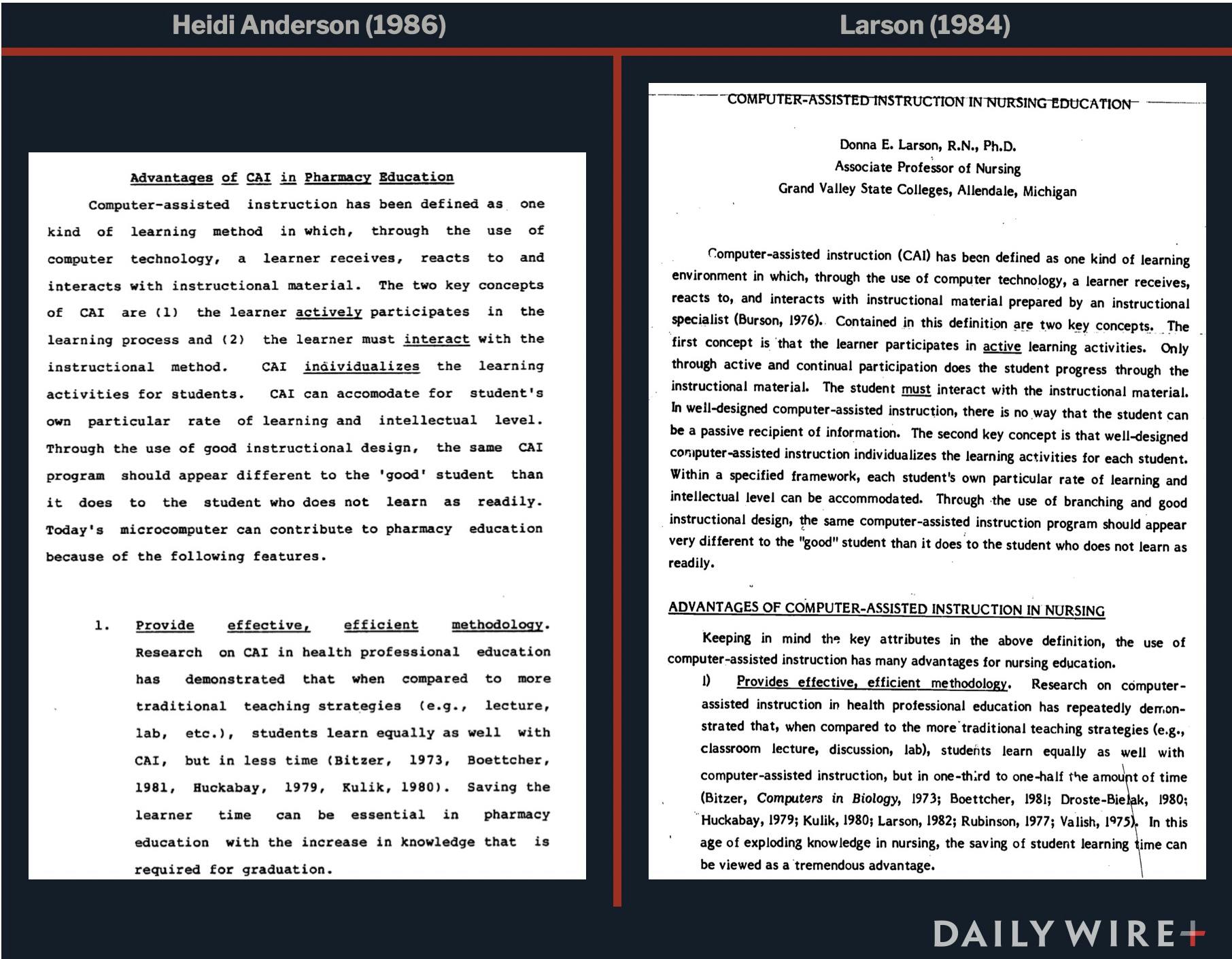
A major portion of her dissertation, written in 1986 about how computers could be used in pharmacy education, took a paper by Donna Larson about how computers could be used in nursing education and simply changed the name of the field. There were indications that this was deliberate deception, not sloppiness: The dissertation copied over the citations Larson included but removed one in which Larson cited her own prior work. With Larson’s name nowhere in the dissertation, reviewers were less likely to stumble upon the near-identical content.
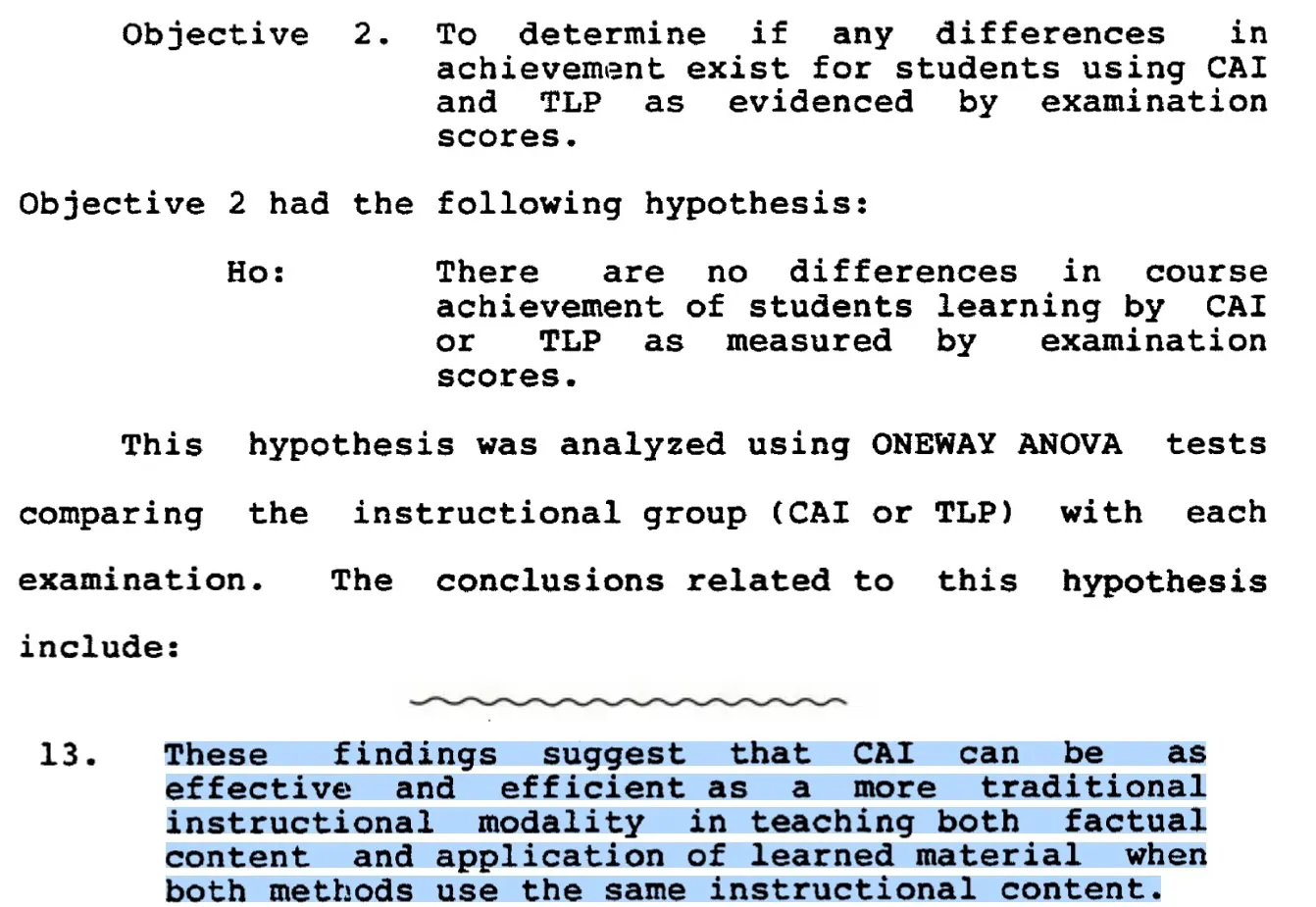
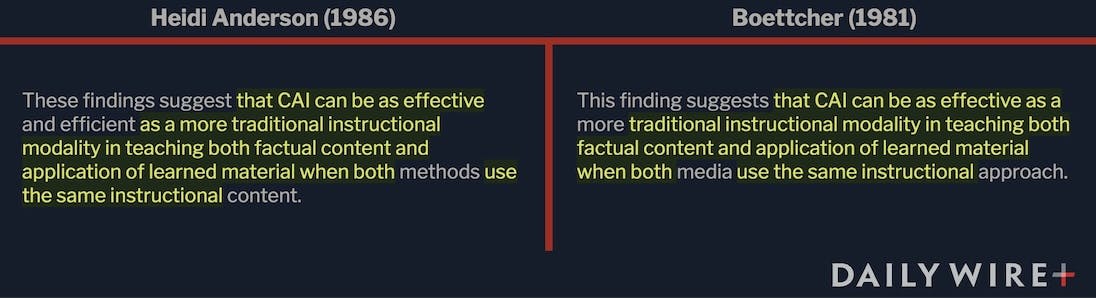
The misconduct may have extended to research fraud. Anderson’s contribution to original knowledge was an experiment to determine whether lessons on a computer could help students learn. She had someone create a computer program, then had 118 Purdue students use it and analyzed data about whether their knowledge improved. But her conclusion from this original data was, word for word, from another academic’s paper five years prior:
After we published last year, Anderson said publicly that “integrity, accountability, and trust are the foundations of my leadership and I take these concerns with the utmost seriousness.” But behind the scenes, she hired a lawyer to demand that The Daily Wire scrub the story from the internet. Our attorneys brushed aside the defamation accusation as baseless: the story presented evidence for all of its claims.
Anderson then moved on to suing Satterlee, who was quoted in the story. Anderson had pushed Satterlee out of her job, and as an unemployed 70-year-old, she would have a harder time putting up a defense against the university president, who hired the lawyer using personal funds from her $439,000 salary.
Gopalan, who holds a law license in addition to being the school’s former vice president, agreed to represent Satterlee for free. But three days after he informed Anderson’s lawyers of his intent, Anderson added Gopalan as a defendant – a move that, they explained, meant he was no longer permitted to represent Satterlee. Gopalan said his only act was to file an internal report and he was added to the suit solely to deprive Satterlee of a lawyer.
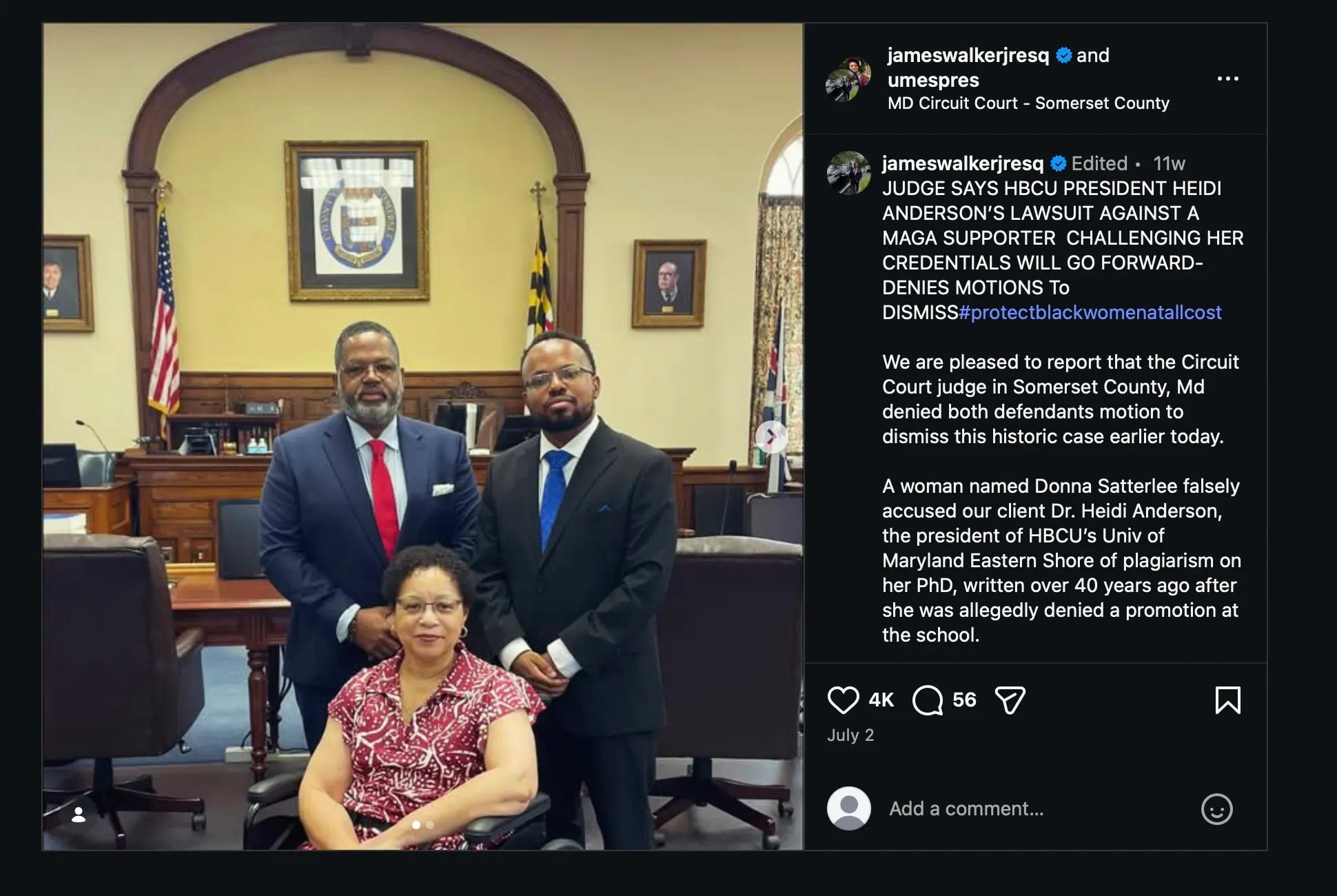
Anderson’s attorney, James Walker Jr., made the case about race and politics, saying he would “protect black women at all cost [sic].” He called Satterlee, a registered Democrat, a “MAGA supporter.” Walker’s firm didn’t respond to my email.
In July, Maryland Judge W. Newtown Jackson III denied Satterlee’s motion to dismiss, ensuring that she would have to go into debt to be dragged through a lengthy process.
Gopalan said the lawsuit accused him of nothing more than doing his job.
“The conduct complained of — reporting a public university president’s plagiarism to the State body that oversees her” is a “recognized professional duty,” his rebuttal said, adding that he “served as the institution’s Vice President for Research — the office charged with research and academic integrity—until Anderson removed him.” He counter-sued for retaliation, seeking $2 million.
He said in a separate suit that as part of her retaliation, Anderson terminated $4.6 million in grants he won from the federal government. That led to his Ph.D. candidates carrying out work to cure cancer being fired. The students were made to believe it was because Donald Trump had rescinded funding from the black college, the lawsuit said.
Plagiarism was not the only misconduct Gopalan allegedly found, according to the Daily Record. He said in a sealed whistleblower suit that Anderson oversaw a “criminal enterprise” that defrauded the federal government of nearly $200 million by inflating enrollment numbers. Reported enrollment rose from 1,800 to 2,700 between 2021 and 2025.
But when the police got involved, it was against whistleblower Satterlee, not Anderson.
In August, Satterlee, who is white, filed a racial discrimination lawsuit against Anderson, who is black, and the school in state court (a judge dismissed an earlier case in federal court over Satterlee’s separation agreement). Maryland’s attorney general is defending Anderson at taxpayer expense, while Satterlee has resorted to representing herself. When she accompanied a friend to serve the court papers on her former supervisor, Anderson ally Grace Wasike Namwamba, last month, Namwamba secured criminal trespassing charges against her for being on her front porch. (She testified that she called the police on advice of the school’s lawyer.)
Satterlee had been driven out of her job on the pretense that she was “bullying” Namwamba by correcting mistakes in her department-wide communications; Satterlee said she was just doing her job and trying to help the department avoid embarrassment. I looked at Namwamba’s dissertation and found support for this; the passage below, for example, copies and pastes from another paper (which is cited elsewhere in the paper, but not quoted) and inserts a linguistic error as one of the only changes:
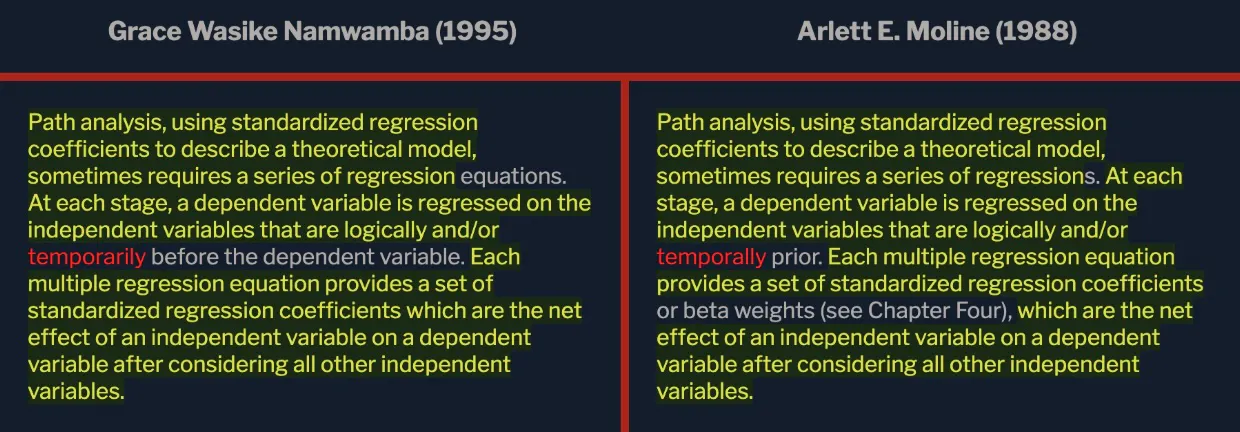
In academia, debates should be a battle of ideas. Professors presented portions of Anderson’s dissertation and explained why they believed it was a problem. A defamation lawsuit is the opposite. It seeks to bar one side of an argument from even being made with the threat of personal financial ruin.
To successfully sue for defamation, a public figure — such as a university president — must show that the speaker made a knowingly false statement. That means Anderson had to prove not only that she didn’t plagiarize, but that no reasonable academic could have believed she did. Given the sheer volume of duplicated language, that would require a world in which college faculty universally accept that doctorate programs have standards lower than the average grade school — and create one, through precedent, in which people aren’t permitted to use their own critical thinking to render judgment on the academic work of powerful people.
Anderson’s defamation argument rests on an appeal to authority: That Purdue University, where she was granted the doctorate in 1986, has not called it plagiarism — therefore no one may.
The suit said Satterlee must have known Anderson didn’t plagiarize, because she used software (the same program professors use against students) to detect duplicated text rather than asking Purdue. The difference, as far as I can tell, is that software will try to find plagiarism by professors, while universities like Purdue won’t.
“Plaintiff’s dissertation advisor and university officials have affirmatively supported her,” Anderson’s suit said. Its key exhibit is an affidavit from Holly L. Mason, a Purdue professor emeritus and former pharmacy college dean, which says, “In my professional judgment, Dr. Heidi M. Anderson conducted herself with integrity and adhered fully to the standards of academic honesty expected at Purdue University.”
Gopalan said that Mason’s affidavit should be barred from court because it swears Anderson did nothing wrong while tacitly admitting that he did not even check. Mason’s affidavit is “based on my recollection of the process, my direct involvement, and my recent review” of her paper, but not the list of passages identical to other papers, or those papers themselves.
The Purdue professor’s proclamation relies on hypotheticals (“Any section lacking appropriate attribution… would have been flagged and corrected”) and speculation (“If any omissions in citation exist, they are exceedingly minor and clearly unintentional”).
I wondered how Mason could file such an affidavit, knowing it would be used to try to bankrupt professors who had studied the issue more closely than he did. Not only did it seemingly rely on his elite credentials to willfully mislead (it was a conclusory declaration based on his “professional judgment” as a “professor emeritus of pharmacy administration at Purdue University”), but it was willing to spend Purdue’s credibility to protect shoddy scholarship.
Anyone can see the side-by-side graphics. Stanford University professor David G. Stork told me based on his “experience on the editorial boards of eight international journals” that “there is a persuasive case that plagiarism was committed.”
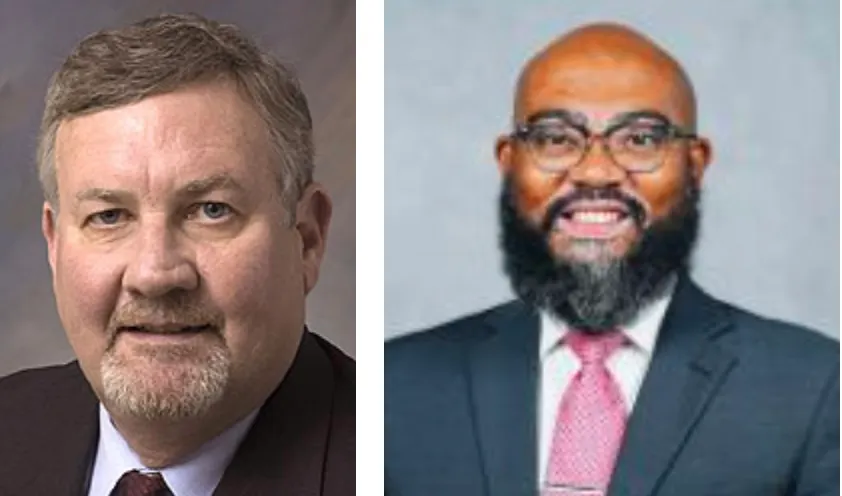
Purdue University College of Pharmacy officials Holly Mason and John Allen (Purdue)
Anderson’s other theory is that the “dissertation complied with the APA citation standards in effect at that time (1980–1984).” The Washington Post in its report on the scandal said that a plagiarism expert, Jonathan Bailey, “said that Anderson’s claims — that citation norms were different in 1986 and she was just following the rules of the time — weren’t true. He said the standards and principle of citing large sections of text have remained unchanged for centuries.”
I asked Purdue’s Mason to make his argument about all of this, since the affidavit merely declares it without explanation. He did not reply. Anderson’s lawsuit says that not only Mason, but also “university officials have supported Plaintiff and confirmed that any minor textual issues were unintentional and non-substantive.” John Allen, the head of Purdue’s pharmacy department, also failed to respond to our inquiry.
Anderson’s lawsuit suggested that Satterlee would have known she was innocent of plagiarism if she had contacted Purdue. But she did. She sent her evidence to Purdue’s research integrity officer, Jamie Mohler, who confirmed receipt. Mohler ignored my questions about what happened next, even though Anderson was giving the impression that Purdue backed her work, and Gopalan, Mohler’s counterpart at Maryland, was facing a lawsuit as a result. Did Purdue actually find her innocent? Did it find her guilty?
The secrecy has put Satterlee in a catch-22. Anderson suggests it’s defamatory to call someone a plagiarist unless an official panel of their university says so. But a year after Purdue received credible information about high-profile plagiarism allegations, there is no evidence that it even checked.
Indeed, a year after the University of Maryland-Eastern Shore’s vice president for research told the state college system that Anderson plagiarized and defrauded the government, and was promptly sacked by Anderson, there is no concrete evidence that Jay Perman, who is chancellor of the entire University of Maryland system, has even placed the president under investigation.
At the time, Perman’s spokesman Michael Sandler told me that the university was “aware of the allegations raised against President Anderson and are reviewing them with our policies.” The university would “determine the next steps once that process is complete,” he said.
He wouldn’t commit to sharing the additional evidence I’d found with reviewers. This month, he ignored my inquiry about whether “next steps” wound up including an investigation, and if so, what the status of it was.
University of Maryland-College Park and Duke
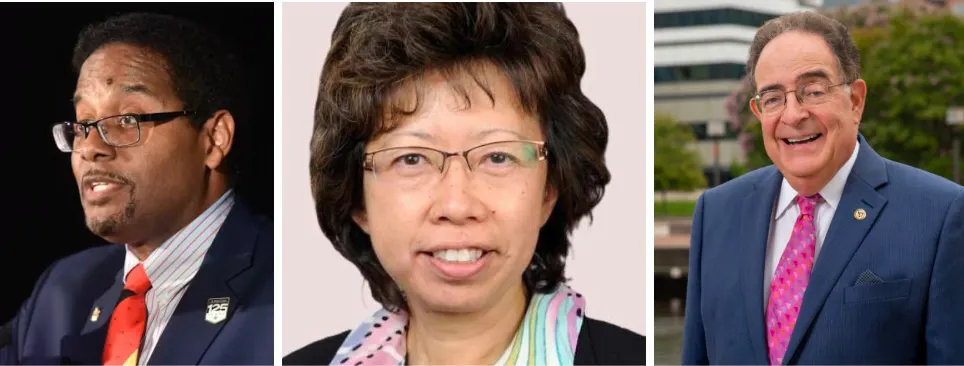
The University of Maryland’s Darryll Pines and Jay Perman (left, right) and Duke’s Liming Salvino (center). (UMD/Duke)
Perman’s passivity is remarkable because I found plagiarism in the papers of not one University of Maryland campus president, but two. In September 2024, I revealed that one-third of a paper by Darryll Pines, president of the University of Maryland’s flagship campus in College Park, was copied and pasted from an introductory website by an Australian student, who was not credited.
Again, there was evidence that it was deliberate theft, not sloppiness: No American author could have seen British spellings in his document and mistaken them for something he had written. Those British spellings were systematically changed in Pines’ published paper.
A spokeswoman for Pines indicated that Pines saw no issue with it, saying “It is not uncommon for historical and technical reviews to use recurrent language to provide a framework for past work.” She said, “The use of customary or common language in introductory material does not speak to the integrity of the data or the veracity of the findings.” But this was not “customary or common language.” It was 1,500 consecutive words from an obscure and totally uncited student.
The state university system said it hired a law firm to conduct a review. Fifteen months later, it emailed students and staff a terse statement saying it cleared Pines. He remains in the position.
Yet there can be little dispute that the paper contained plagiarism. Since my story came out, the journal that published the paper issued a “corrigendum” saying it “copied a substantial amount of descriptive text from a webpage without citation.”
The conclusory email, the only public information about the review’s findings, said the law firm “did determine that the two works highlighted last year contained select portions of text previously published by another author,” but that Pines “was not found responsible for the inclusion of such text.”
Pines was the lead author, but the paper had a secondary author, Liming Salvino, who is now at Duke University. There is only one way to read Maryland’s conclusion: Pines was innocent because it was Salvino who was guilty. Yet Maryland made sure to obscure that.
I asked Salvino whether the investigative committee had contacted her, and whether she told them she was responsible for the portion of the paper containing plagiarism. I also asked a spokesman for the University of Maryland system whether it had made an academic honesty referral to Duke. And I asked a Duke spokesman if the school had taken any action. None responded.
Without any public statement by Salvino, the pair were able to have their cake and eat it too: Pines was cleared on the basis that, behind closed doors, it was pinned on Salvino. But Salvino never had to actually bear the consequences of taking the fall.
The University of Maryland system paid the law firm $600,000 to undertake the investigation, but refused to release the report. Maryland claimed it was kept private because it was a personnel record, but experts said this was an unusual interpretation, and that even then, Pines could waive the privilege.
“To announce the results of the process without really revealing any of the details does not communicate transparency,” Steven McGuire, a fellow at the American Council of Trustees and Alumni, told The Baltimore Banner. “They owe it to alumni, and really to the public in general, to the Maryland taxpayers, to make very publicly clear why he is not guilty of these allegations.”
Stork, the Stanford professor, told The Daily Wire that it was some of the most blatant plagiarism he’s ever seen, and that he’s shocked nobody has faced repercussions for it.
“I have NEVER seen such extensive plagiarism as in the Pines case,” Stork said. Whether that was due to Pines or his co-author, SOMEBODY should suffer the consequences. There is definitely more going on than a sporadic Jason Arday here, Claudine Gay there.”
UCLA DEI czar and the University of Virginia’s honor code
Natalie J. Perry (UCLA/Icon Sportswire)
Lastly, there was Natalie Perry, the “North Star cultural lead,” a sort of DEI czar, at UCLA’s Geffen School of Medicine. Perry’s position exists specifically as a moral guidepost for the medical school, with the motto “do what’s right.”
Her Ph.D. dissertation was plagiarized to a shocking extent, Chris Rufo and I found in April 2024. It was lazily cobbled together from 10 different sources, with entire pages copied and pasted verbatim. On the basis of that paper, Perry was awarded a doctorate in 2014 from the University of Virginia.
Two and a half years later, Perry is still listed in her role, and her staff bio still boasts a Ph.D. credential from UVA. UCLA has gone to great lengths to show that it doesn’t mind plagiarism: a litany of top officials ignored emails on the topic over the period of years, including this month.
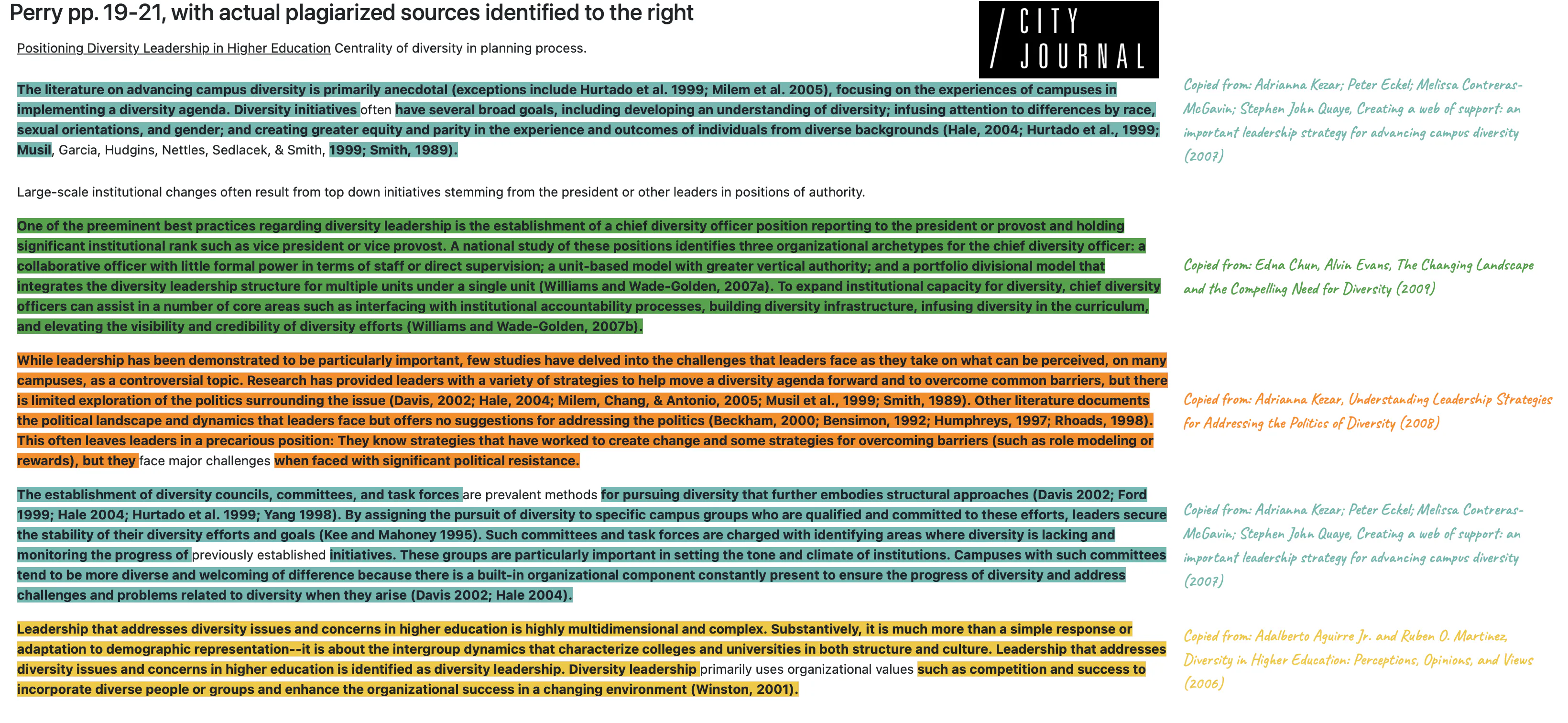
The University of Virginia is best known for its “honor code,” a strict academic honesty policy passed down by founder Thomas Jefferson. If UVA doesn’t take a hard line against plagiarism, no university does. At the time, it said, “We are initiating an investigation according to our process. While federal student privacy laws prohibit us from commenting on any specific case, the University does have the ability to revoke degrees in cases where plagiarism or other qualifying forms of misconduct are identified and proven.”
Any such investigation would have now concluded. Yet UVA spokesman Brian Coy ignored my emails last month asking what happened. If UVA contends it is prohibited from saying that it revoked a degree or that a paper was plagiarized, I asked what the legal basis for that is, and what’s to stop someone from continuing to claim a degree if it was revoked only in secret.
He had no response when I noted that Perry still advertises her UVA doctorate; it seems most likely that’s because they never did anything. If colleges still cared about ensuring that a degree actually holds value as an assurance of quality, a UVA alumni council said, they’d act like detectives instead of defense attorneys.
That would include proactively probing, the Jefferson Council wrote: “How many other advanced dissertations offered by the Education School were marred by plagiarism of this sort? Who signed off on the dissertation? How did it slip? Did others with the same mentors also plagiarize?”
.png)
.png)