
 Gideon Askowitz
Tuesday night, I partied with students, influencers, organizers, union workers, and the wealthy elite at New York City’s Harlem Tavern. It was the vibe wave that hit the socials and swallowed Gotham, and here I was riding it at its peak on election night, 2026. I was chanting with the Democratic Socialists of America on an undercover assignment for The Daily Wire. I was surrounded by the very crowd who helped elect one of the most radical candidates in our country: Darializa Avila Chevalier of New York’s 13th District. Thanks in part to my fellow partygoers, she is now Congresswoman-elect Avila Chevalier. While she is without a doubt one of the most radical people I have observed or met in American political life, blowing straight past AOC and Ilhan Omar, at least in vibes (isn’t that all that counts these days?), she and her friends are also the perfect reference from which the GOP, and the conservative movement more broadly, need to learn some lessons.
Republicans puff cigars (and some of us sell them) and talk in extreme abstractions. Trump is sui generis, and the lexicon is built around him. The DSA is built around radical ideas that, within their own framework, compel and move people across spaces to build a radical movement. The circle regularly traffics in emotionally resonant terminology, appeals directly to a singular political issue, and calls people to turn those feelings and policies into political action. Republicans might talk the talk, but the DSA, as I was witnessing at the Harlem Tavern, was all about feeling the feels.
This is not exactly a new observation here at The Daily Wire, and it lies at the heart of a constant debate between Daily Wire host Ben Shapiro’s “Facts don’t care about your feelings” and hosts Michael Knowles’s and Matt Walsh’s sentiment that voters do care about their feelings. What is missing from the discussion, however, is how that gap actually plays out in the political realm.
This party was fun; the energy was electric, and everyone was friendly (of course, they didn’t know where I worked). The venue was decked out in a Mao-hued red and emotional slogans from the campaign: “Tax the Rich,” “When We Organize, We Win,” “We Will Beat Billionaires,” “Protect Our Neighbors” (written in Spanish, Chinese, Russian, Yiddish, and English), “Free Palestine,” and “Babies Not Bombs.” Each of these phrases sits perfectly within a Marxist framework. The language is built around class warfare; it is anti-Western, and even the choice of Spanish, Chinese, Russian, and Yiddish (Yiddish was the language of the Jewish Labor Bund, the socialist, anti-Zionist movement of the Russian Empire, while Hebrew is the language of the Bible and modern Israel) resonates perfectly with those familiar with the intellectual and practical history of socialist movements throughout the world.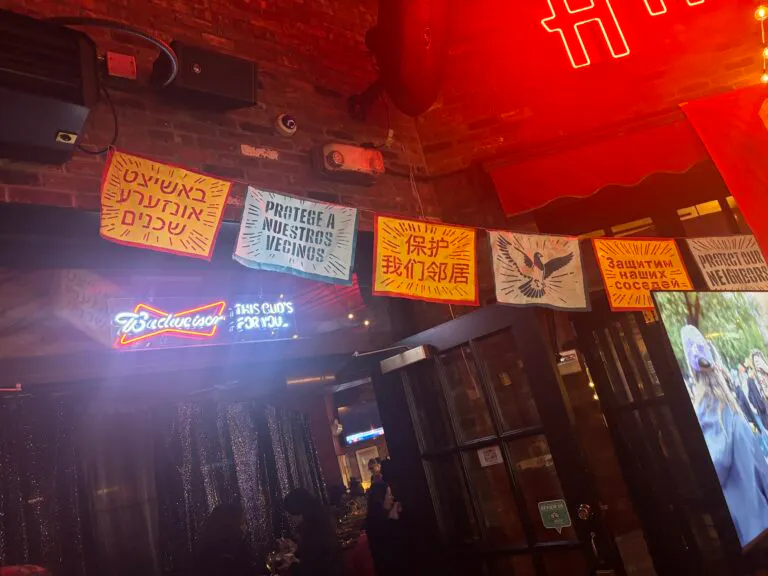
At a normal political event, speakers and politicians speak of love of country, of the state, or of the people in the community generally. But again, this is where the vibes really kicked in. Here, the speakers, the campaign staff, and ultimately Avila Chevalier herself made no reference to patriotism or to gratitude for the country, its promises, culture, or heritage; they spoke only of racial groups and classes.
As various people associated with Avila Chevalier’s campaign rose to speak, chants of “D-S-A, D-S-A, D-S-A” broke out with the same fervor and zeal as “U-S-A” chants at any regular American sports event. Except here, the cause itself was antithetical to the country, and the people involved know that. Much has been written on the grievance culture of the DSA and critical theorists, and how they dwell on, expand, and imagine injuries suffered by their group identity at the hands of the U.S. government, its institutions, and its society. That’s all true.
When Avila Chevalier’s campaign manager and now chief of staff, Ilona Duverge, who served as former Congressman Jamal Bowman’s field director, rose to speak, she, like all the other speakers, spoke in a Marxist tone, touting each person’s contribution toward organizing, knocking on doors, making calls, and donating, all in the name of the movement.
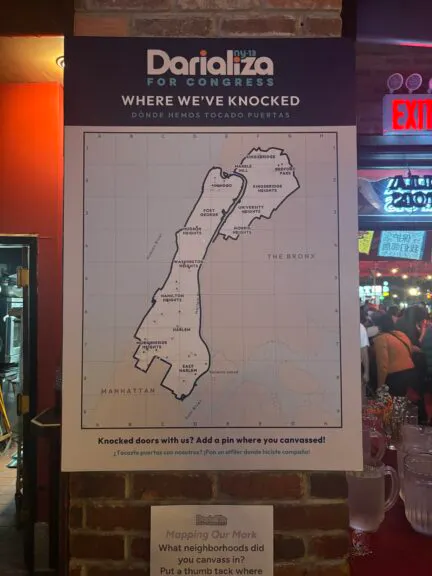
And while some conservatives would imagine the experience as disgusting, unappealing, and perhaps scary, I will admit it felt like a shared experience, and that is what makes this movement so powerful – and troubling. With every turn and with every campaign slogan, the DSA and its affiliated groups amplify and double down on their language, enabling their ideas to grow in emotional resonance and take on a life of their own.
The comrades erupted when Avila Chevalier came out. She delivered her remarks in impassioned Spanish, and then in English. In each speech, she led the group in chants reflecting the slogans of many of the campaign’s stickers and signs. Chevalier and each speaker invited spirited passion to the audience, reinforcing the vibe-collective. “It’s your victory,” Chevalier proclaimed, adding several times over that this is “our movement” and that she was merely the conduit to Washington.

Republican strategists have not drummed up a single rallying cry that replicates this vibe. Admittedly, Trump’s revamping of the slogan “America First” plausibly could do this, but it largely falls short because it is not specific to a voter’s material needs in each instance. Contrast this with “Housing for All” or “Healthcare for All.” These are simple, concise phrases that appeal on an emotional level. What does the phrase “America First” mean in a housing discussion? How does it tell a young person how they will buy a home? The Republican tactic up until now has been a discursive lecture on why “Housing for All” would not materially improve the housing market, an abstract, boring discussion. The same could not be said for many of the DSA slogans.
No Republican that I have seen (excluding Trump) is able to work a crowd this well, and no Republican campaign has the ability to use self-reinforcing language in this way. The lexicon of Marxists focuses on class organization, mobilization, and basic needs. Combine that with a passionate leader charting the way for the rest of the class, mixing in music, chanting, signs, and stickers, each reinforcing the political causes and methods of the group, and you have a very powerful movement. The energy is unmistakable and hypnotic.
Republican pollster Frank Luntz built a career on the idea that “it’s not what you say, it’s what people hear.” His work helped the GOP reframe entire policy debates: the estate tax became the “death tax,” and drilling became “energy exploration.” But Luntz’s method is about nouns. Using focus groups, he tests synonyms for a policy and picks the one that resonates most. The DSA’s lexicon is built on verbs: “organize,” “do the work,” “speak to your fellow workers.” Even its nouns carry connotations of political action. “Worker” is not a description of a policy; it names a class of people with shared interests and a shared fight. That vocabulary also lives in ordinary life in a way Luntz’s never could. We’re not talking static abstractions or labels. The DSA is about progress and change.
Two electricians or two steelworkers already know they are both workers at the same company. The DSA seizes on that reality and casts them as a group locked in struggle against another group. Republicans, by contrast, show up and explain the policy implications that people like them should care about: trade, wages, tariffs, the future of American steel. The substance may be better, but the conversation lacks psychological immediacy. The GOP presents a policy problem first and its solution. The DSA helps voters reframe their own identity, and then that identity impels them to pursue Marxist political objectives through Marxist methods.
What would a candidate who could meld personality, slogans, and sound policy and political judgment look like for the conservative movement? What would it look like to find a candidate who could rebuild the conservative lexicon so that, whenever its members speak about their own identities, politics, and the issues they care about, their language propels them toward concrete actions that deliver election results for the broader conservative movement, not just one candidate?
Today we don’t have that lexicon; there are no words like “organize,” “do the work,” or “speak to your fellow workers.” Instead, Republicans have “free market,” “get government out of your way,” “limited government,” and “don’t talk to your colleagues about politics.” Our words are aloof; they don’t inspire camaraderie, and they certainly don’t elevate and empower local organizing. To us, some of these words feel dirty, commie-colored, and gross. That’s true, but we also need to find our own language, or we’ll keep losing elections.



