
 Matt Walsh
After four years of overt persecution by the Biden administration — where elderly pro-lifers were rounded up and thrown in prison for non-violent protests outside abortion clinics, where the FBI explicitly wrote about a crackdown on “Radical Catholic violent extremists,” and where peaceful demonstrators were hunted down by SWAT teams at their homes, at gunpoint, in front of their children — it’s hard to overstate how much has changed for Christians in this country.
The federal government no longer uses the force of law to compel Christians (particularly Christian schools) to violate central tenets of their faith, for example, by facilitating abortion or transgender insanity. Parents have more options to send their children to Christian schools.
Instead of importing millions of Muslims from failed states like Somalia who spend every waking moment finding new ways to defraud us, we’re taking in Christian refugees from places like South Africa, where they’ve been persecuted because of their faith (and their skin color).
All of this is happening because, for the first time in memory, the federal government is willing to affirm — in explicit and unambiguous terms — that America is a Christian nation with an obligation to spread the faith and advance the interests of Christians. This is a post featuring Marco Rubio that went up on the State Department’s official social media accounts this week. It’s a video that has led to meltdowns from every depraved, demonic corner of the Left. And for that reason, naturally, we’re going to play it in full:
America, more than any other nation in world history, was shaped by the Christian tradition of spreading the gospel unto all nations.
Join us in celebrating International Religious Freedom Day. https://t.co/6Mfz9jLjUy
— Department of State (@StateDept) October 27, 2026
All the “Pride Month” depravity, which the previous State Department tried to export to every corner of the Earth, was really, of course, a direct assault on the Christian history and the lineage that Marco Rubio just outlined.
As we know, the goal of Leftist ideology is not to create anything coherent or functional. They don’t want to produce a new set of rules for governing an orderly society or ensuring human flourishing. They want to destroy the rules and sources of human flourishing already established.

Their followers, in addition to being profane and nihilistic, are obsessed with grievance, weakness, narcissism, and shame. They complain endlessly. They melt down at even the slightest criticism. They try to ruin people’s lives when they step out of line. They give themselves the powers of gods, but at some level, they understand it’s all fraudulent — an act, and not a very convincing one. That’s why, for all their talk about “Pride,” they’re clearly miserable people.
On the other hand, the message of Christianity is very different. It’s a religion that teaches not only mercy but justice and virtue, and preaches the promise of salvation. At its core, this is obviously a hopeful message. Any sinner can be saved. Every great man of American history, without exception, understood this. Our government leaders should not be shy about saying this. And historically, they have not been.
“International Religious Freedom Day” was created in 1998 through a law passed during the Clinton administration. And although it progressed through Congress because of Christian persecution all over the world, Clinton himself — of course — insisted that the law had nothing to do with Christianity in particular. He stated that the goal was “to promote the religious freedom of people of all backgrounds, whether Muslim, Christian, Jewish, Buddhist, Hindu, Taoist, or any other faith.”
This is the kind of leadership we’ve been used to for some time. Our politicians balk at the idea of promoting Christianity in any way. It’s just another “faith” along with dozens of others, they say — sending the message, of course, that Christianity has no particular relevance for America. We’re supposed to take seriously the fantasy that Taoism and Sikhism are somehow just as crucial to the American identity as the religion — Christianity — that quite literally built the country.
This is totally false, as we’ll discuss in a moment. But it’s also ironic in this case, given that the whole idea of “International Religious Freedom Day” is to celebrate “religious freedom” — which exists because of Christianity.
In fact, the first person in Western history to use the words “freedom of religion” was a Christian apologist in North Africa named Tertullian, circa 197 AD. The following quote is from the Russell Kirk Center in Michigan:
Tertullian, the second-century North African convert, [is] most famous today for his observation about the blood of the martyrs being the seed of the church. … At a time of harsh, if sporadic, persecution, Tertullian argued that Rome should allow Christians to exercise their faith because religious freedom was an essential component of human nature. “It is only just and a privilege inherent in human nature,” he wrote in his Apology, “that every person should be able to worship according to his own convictions. For one person’s religion neither harms nor hurts another.” Sixteen centuries later, Jefferson would write something remarkably similar in “Notes on the State of Virginia”: ‘[I]t does me no injury for my neighbor to say that there are twenty gods, or no God.” … [Historian Robert Louis Wilken notes that] Jefferson had a copy of the “Apology” in his personal library, and marked the passage about religious freedom.
So for many reasons, it was appropriate for Rubio’s State Department to release this video for “International Religious Freedom Day.” Even if you’re a godless communist, you should be able to admit that Christians deserve credit as pioneers in the field of religious freedom — and every other kind of freedom. Our entire conception of human rights, as we understand it today, is inextricably tied to Christian teaching. Human rights are certainly without question a religious doctrine.
The idea of “inalienable rights” somehow spiritually endowed in us from the moment of our creation cannot be understood or made sense of at all except through a religious framework. And the religious framework that makes the most sense of them, and that formed “human rights” as we know them today, is Christianity. That is just a truth of history. There’s no way around it. And yet, one after the other, all of the most perverse and unhinged Leftists in the country came out to condemn this video, right on cue. Leading the charge was Scott Wiener — who’s about to take Nancy Pelosi’s seat in Congress:

Image courtesy of the New York Post
This is the model Democrat Party politician at the moment — it’s everything they stand for. I guess Hakeem Jeffries might be in contention too, as he’s an illiterate black Obama impersonator who’s been promoted far beyond his level of competence. But Scott Wiener is up there. If these people had been in power when Mount Rushmore was built, it would look like that classic SNL Chippendales sketch with Chris Farley:

Image courtesy of Getty Images via SNL.
There it is. Just picture their faces on mountains in South Dakota, and you get the idea. This is what tourists would be subjected to if the demented gay perverts had been running things back in the early 20th century (Or at least, if they had been out of the closet).
In any event, Wiener is perhaps most famous for leading the campaign to decriminalize the intentional spreading of HIV. He’s also known for making it more difficult for prosecutors to incarcerate gay men who prey on children. It’s quite a resume.
As you’d expect, given that he’s a genuinely repulsive individual who shouldn’t be allowed anywhere near a school zone, Wiener was shocked and appalled by Rubio’s video. He was positively aghast at the whole thing. So he wrote simply with maximum indignation:
This is an official United States government account promoting the Christian gospel.
When I saw this, I hadn’t actually seen Rubio’s video yet. So I was genuinely thankful that Wiener pointed it out. He performed an actual public service, for once in his life, by helping to spread this fantastic video around the internet. If I didn’t know any better, based on the caption, I would think he was celebrating the video. Indeed, the official US government account is promoting the Christian gospel. And that’s a wonderful thing.
It’s impossible for the promotion of the Christian gospel to be anything but a wonderful thing. Promoting a false gospel is bad. But if you are promoting the actual Christian gospel, then it is a good thing, always and everywhere. This goes to show how the two sides of the ideological divide live not just in different countries but in a different universe.
To weird Wiener and his weird followers, a phrase like “promoting the Christian gospel” has the exact opposite connotation. They see it as inherently bad, in all contexts. So much so that he doesn’t even need to explain why it’s bad, or include any other commentary. To him, saying “they’re promoting the Christian gospel” is akin to saying “they’re drowning puppies in the river.” You don’t feel the need to explain why you oppose it.
Christianity to Scott Wiener is like garlic to a vampire. But you have to wonder if this guy knows anything about American history because he seems shocked by the idea that the government would ever promote Christianity in any way. Meanwhile, for most of American history, especially at the founding, the government was expressly in the business of promoting, defending, and promulgating Christianity. This is not up for debate. Again, it’s an historical fact.
No matter how you feel about it. For example, in April, 1776 — just a few months before the Declaration of Independence was signed — the Continental Congress hired a Christian missionary for the express purpose of converting the Indians:
Resolved, That the commissioners for Indian Affairs in the middle department, employ a minister of the gospel, to reside among the Delaware Indians, and instruct them in the Christian religion; a school master to teach their youth reading, writing, and arithmetic; and also, a blacksmith to do the work of the Indians in the middle department.
So that’s an interesting little detail. Then just a few years later, as the war for independence raged on, Congress went out of its way to explicitly endorse the Bible. This is from The Daily Signal:
On Sept. 12, 1782, Congress, under the Articles of Confederation, officially endorsed the “Aitken Bible,” or “The Bible of the Revolution,” as the first complete English-language Bible in America. That Bible was named after its printer, Robert Aitken. … [The endorsement] was supported by the chaplains of Congress at the time.
Shockingly enough, at the time, there were no gay shirtless men (wearing leather pants and black ties for some reason) who objected to this resolution. It’s almost as if the scrawny gay HIV fanatic is not, in fact, representative of America, its traditions, or its history. He likes to pretend that Rubio’s State Department just violated some ancient norm. But in reality, it’s Scott Wiener who has made a career out of mocking this country and its Christian traditions.
If you’re ignorant of our history, then you might be inclined to believe what he’s saying — you might buy into the idea that this country’s government somehow never endorsed Christianity. You might buy into the lie about the “separation of church and state,” which is a mostly fabricated concept that only became fashionable in the 1960s.
Never mind the fact that, in the early 19th century, the federal government financed a Catholic church (under Jefferson’s administration no less — even though Jefferson is closely associated with the idea of separating church and state). Also forget about how, in 1819, Congress, through the Civilization Fund Act, provided a significant amount of money for schools that converted Indians to Christianity. And pay no attention to the fact that in 1869, the president — Ulysses S. Grant — spent a paragraph of his inaugural address promoting the idea that the so-called Native Americans should be Christian.
If you pull up some transcripts of Grant’s speech, you’ll find that many of them actually omit this line, or edit it out. But here’s what he said in full:
The proper treatment of the original occupants of this land — the Indians — is one deserving of careful study. I will favor any course toward them which tends to their civilization, Christianization, and ultimate citizenship.
Notice how, for Grant, a necessary precursor of citizenship was Christianization. Basically, every prominent leader of this country from its first century, and beyond, felt exactly the same way. But what’s remarkable is that, if you look up this speech on most websites, including Yale University, the quote will say the following:
The proper treatment of the original occupants of this land — the Indians — is one deserving of careful study. I will favor any course toward them which tends to their civilization and ultimate citizenship.
So they just flat-out censor it. They’re relying on a compilation of Grant’s speeches that was created decades later, which omits the word “Christianization.” Meanwhile, the contemporary versions of the speech — the ones where stenographers wrote down what Grant was saying — include the word “Christianization.” So there’s no reasonable question about what Grant said. But various historians would like to pretend he didn’t say this, even though in his State of the Union address one year later, Grant doubled down. Specifically, Grant said:
Indian agencies being civil offices, I determined to give all the agencies to such religious denominations as had heretofore established missionaries among the Indians, and perhaps to some other denominations who would undertake the work on the same terms — i.e., as a missionary work. The societies selected are allowed to name their own agents, subject to the approval of the Executive, and are expected to watch over them and aid them as missionaries, to Christianize and civilize the Indian, and to train him in the arts of peace. The Government watches over the official acts of these agents, and requires of them as strict an accountability as if they were appointed in any other manner.
So basically, Grant gave control of around 70 federal Indian agencies — agencies headquartered on Native American reservations — over to Christian missionaries and church leaders. This was his so-called “Peace Policy.” Amazingly enough, there was no outrage whatsoever that Grant was violating the “separation of church and state.” No one claimed Grant had violated the First Amendment or done something shockingly unconstitutional. The thought never crossed anyone’s mind, actually.
At the time, and for most of this country’s history, right up until the civil rights era — no one thought the church should be separate from the state. Instead, we understood that the First Amendment prohibited the government from establishing a national religion or barring the practice of other religions. That’s it.
If Grant had given control over these agencies to one particular Protestant denomination as part of a plan to make that one denomination into a national religion, people would’ve been upset. But because he gave control to many different Christian groups, no one had a problem with it.
There was no expectation that the government, because of the First Amendment, could not promote Christianity. The whole idea would’ve been absurd to the typical American. When it comes to “the separation of church and state,” the only thing the First Amendment was meant to prohibit was the government mandating that its citizens follow one particular faith. But as for promoting, preaching it, passing laws based on its teachings and precepts — there was no such prohibition, and nobody ever thought there was any such prohibition, until modern times.
To the extent that anyone opposed Grant’s “peace policy,” it was coming from the corrupt senators who wanted to retain their control over these agencies. It was also coming from people who wanted to eliminate the Indians entirely, instead of negotiating with them and managing them. But it was not a First Amendment issue.
Admittedly, it’s true that, thanks to unrestricted mass migration, we now have far fewer Christians in this country than ever before. The overwhelming majority of people living in the United States are Christian, but the percentage has been declining. That’s accurate. Major cities like New York, Los Angeles, and Minneapolis are now unrecognizable as a result. Since 9/11, Muslims in particular have conquered large portions of the United States.
But that doesn’t mean we’re no longer a Christian nation. That would be like saying Iraq became a Christian nation after we invaded it. The presence of hostile foreign hordes does not somehow negate this country’s Christian heritage. Christianity is embedded in our traditions, our laws, and our Constitution (There’s even something called “The Sundays Excepted” Clause in the Constitution, which states that the President has ten days to veto a bill, excepting Sundays — because Sunday is the Christian Sabbath).
These are things you’re never told in school. Therefore, Leftists don’t know any of this. Along those lines, here’s how a guy named Jacob — who apparently has a hockey podcast — responded to Rubio’s video. He’s specifically referring to the idea that America was “shaped by the Christian tradition.” He writes:
No the actual f*ck it wasn’t, holy sh*t. In fact, the exact opposite is true. It should be terrifying to everyone that a nation founded on religious freedom and the separation of church and state is touting this ideology.
First of all, as we’ve discussed before, the term “separation of church and state” is nowhere in the Constitution. It comes from an 1802 letter that Thomas Jefferson privately wrote to some Baptists in Connecticut. He was trying to convey the idea that “religion is a matter which lies solely between Man & his God” — which is not remotely controversial. He wasn’t establishing any kind of bar on the government promoting religion. And he was far more concerned about the government’s toxic effect on religion than religion’s effect on the government. So his point in many ways was the opposite of what midwits like Jacob here will say.
As you might remember from our Real History episode on the Indians, the term “Trail of Tears” only became popular in the 1960s — long after the “Trail of Tears” supposedly occurred. It was largely an invention of activists in the civil rights era, who wanted to use the alleged plight of Indians to demand concessions from the Nixon administration.
In the same vein, here’s the use of the term “separation of church and state” over the years:
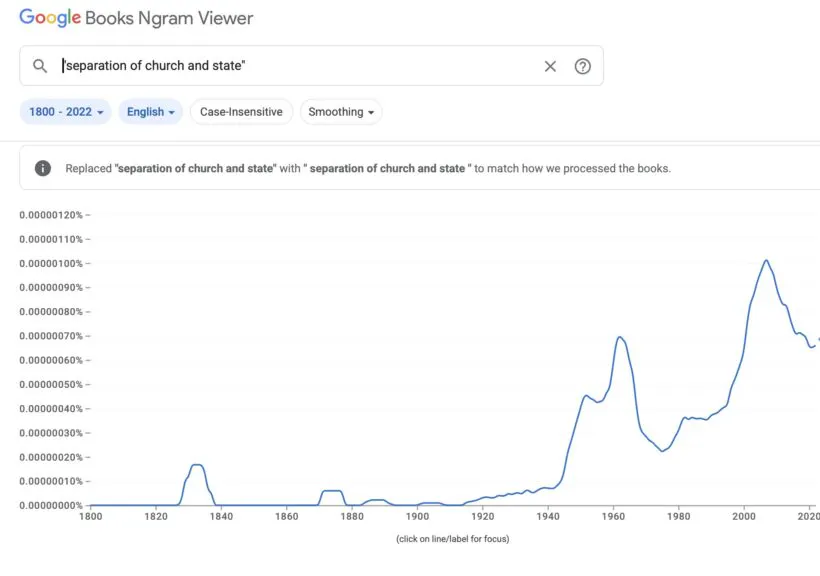
As you can see, it was basically non-existent until the late 1950s and 1960s. Now it’s everywhere. People became convinced that “separation of church and state” was a real idea that our Founders came up with largely because of a series of very dumb Left-wing Supreme Court decisions. But there was never any historical basis for believing this. It’s yet another modern fiction, invented during the hysteria of the 1960s.
We’ll read one more reaction to Rubio’s video, just to illustrate how desperately unhinged and wrong these people are. This post comes from a nonprofit called “The Freedom From Religion Foundation.”
Christianity’s global spread was marked by colonialism, forced conversions, destruction of Indigenous cultures and religious persecution. International Religious Freedom Day should celebrate the freedom to believe or not believe, not the spread of Christianity.
Putting aside the fact that the spread of pretty much every major religion has been marked by “colonialism” and the “destruction of cultures” — and also putting aside the fact that Christians were the first people to advocate for religious freedom in the West — it’s necessary to respond head-on to this objection by affirming that colonialism and the destruction of Indigenous cultures were good, actually. And if you don’t understand why, we have several Real History episodes that go into great detail on the topic.
These so-called “cultures” were barbaric. They were unsustainable. They led, in every single case, to widespread death and horrors beyond human comprehension. To the extent that Christians intervened forcefully to put an end to this misery, they created the conditions necessary for civilization to flourish today. They created the conditions that allow religious freedom in the modern era. Without colonization, these primitive people would either be dead, or they’d still be ripping each other’s hearts out to appease the Sun god (As the saying goes, the Aztecs were famously good at open-heart surgery; they just couldn’t figure out how to put the heart back in).
Every single person who complains today about the Christian colonialists is much, much happier, and freer, and more comfortable, than they would be had the Christian colonialists never existed. Without Christianity — and without Christian colonialism and imperialism in particular — your life would be significantly worse. That is a fact.
Really, though, the idea of “International Religious Freedom Day” is not the main issue here. This is a fake holiday that was created by Clinton in 1998 — who cares? The main issue is that more Americans need to understand that we are, in fact, a Christian nation. And we should devote more government resources towards spreading Christianity and benefiting Christians in particular.
We have an upcoming Real History episode on colonization that goes into great detail on this point. One of the main sources we use is Samuel Huntington’s book “Who Are We.” It’s one of the strongest arguments you’ll find in support of the idea that America is a Christian nation. There are plenty of amazing details in there, which we’ll cover in the documentary.
One of his more interesting insights is that the Founders were interested in prohibiting state religions not because they wanted to live in a Reddit-style atheist dystopia, but because they wanted to create the conditions for religion to grow, expand, and ultimately dominate American cultural and political life. This is from Huntington’s book:
“A Republic can only be supported by pure religion or austere morals,” John Adams said. The Bible offers “the only system that ever did or ever will preserve a Republic. in the world. … Our Constitution was made only for a moral and religious people.” Washington agreed: “Reason and experience both forbid us to expect that national morality can prevail in exclusion of religious principles.” … Fifty years after the Constitution was adopted, Tocqueville reported that all Americans held religion “to be indispensable to the maintenance of republican institutions. This opinion is not peculiar to a class of citizens or to a party, but it belongs to the whole nation and to every rank of society. … The words ‘separation of church and state do not appear in the Constitution, and as Sidney Mead pointed out, Madison spoke not of church and state — European concepts with little relevance to America — but of ‘sects’ and ‘civil authority,’ and the ‘line’ not the ‘wall between them. … The prohibition of an established national religion and the gradual disestablishment of state religions promoted the growth of religion in society. ‘As the state’s authority in religion faded,’ Jon Butler notes, ‘denominational authority expanded,’ leading to ‘the single most important institutional development of post-revolutionary Christianity: the shift of religious authority away from the state toward the ‘voluntary’ institutional bodies. Out of this shift came an extraordinary expansion of denominational institutions.
This is a thesis that’s the exact opposite of what everyone is taught in school. You’re told that the founders were skeptical of religious influence in government, when the truth is that they wanted more religious influence in every aspect of American life. Huntington continues by pointing out that, to European observers, America was unquestionably a religious state — far more so than any country on the planet:
At the end of the eighteenth century, religious establishments existed throughout European countries and in several American states. State control of the church was a key element of state power, and the established church, in turn, provided legitimacy to the state. The framers of the American Constitution prohibited an established national church in order to limit the power of government and to protect and strengthen religion. … In the absence of a state religion, Americans … were free to create whatever religious communities and organizations they wished. … When substantial numbers of Catholic immigrants arrived, it was eventually possible to accept Catholicism as one more denomination within the broad framework of Christianity. The proportion of the population who were religious adherents, that is church members, increased fairly steadily throughout most of American history. European observers repeatedly commented on the high levels of religious commitment of Americans compared to that of their own peoples. Tocqueville said, quote, “On my arrival in the United States, the religious aspect of the country was the first thing that struck my attention. … In France, religion and liberty opposed each other. The Americans, in contrast, ‘have succeeded combining admirably the spirit of religion and the spirit of liberty. Religion in America ‘must be regarded as the first of their political institutions.’
This is why, at every opportunity, our government must not simply tolerate Christianity, but promote it. That doesn’t mean establishing a national church, which would be counterproductive — as the founders recognized. But it does mean we should identify new ways to enable Christianity to flourish.
For starters, we should do exactly what the Trump administration is doing — which is to work to end the persecution of Christians (both in the U.S. and places like Africa), and also to affirm (as Marco Rubio just did) that we are a Christian nation, and always will be.
Contrast Huntington’s thesis with this report from the Left-wing outlet “The Intercept,” which was published just a few months ago. The Intercept was panicking over Instagram posts on the State Department’s official account. Here’s what they wrote:
THE STATE DEPARTMENT has shifted its public image in favor of explicit Christian messaging and iconography and away from secular and multicultural causes, an analysis by The Intercept of the department’s Instagram posts has found. Posts marking Passover, Good Friday, and Easter in 2026 included explicitly religious messaging, including imagery of Christian crosses and references to “Christ’s sacrifice” and the Resurrection. The Intercept’s analysis, which catalogued the department’s Instagram posts from 2020 through early 2026, found these posts show a clear change in messaging not only from the Biden years, but also from President Donald Trump’s first term.
So they’re really proud of their deep-dive investigative reporting here. They relentlessly catalogued Instagram posts on the State Department website and found, to their shock and horror, that the State Department is talking less about gay deviants and more about Christianity. It’s cutting-edge journalism, to say the least. And the best part is that at the top of the page, they have a gigantic banner where they beg for donations so you can fund even more articles about the State Department’s Instagram account.
The point is — look at the contrast between the wailing of modern-day Leftists compared to what the Europeans and Americans were saying about the United States in its earliest days, continuing through the 19th century. They’re talking about constitutional principles and history they don’t remotely understand.
Their goal, as always, is to rewrite history. They want to dismantle and undermine Christianity — not because they want a wall between church and state, but because they want total control over both.



