
I kept hearing that sex in movies was dead, but I’ve spent the summer watching a surprising amount of sex in the theater. It hasn’t been actual, physical sex on screen — not porn, and not drama, either. The movies continue to lack costume-drama ravishing. “The Odyssey” was surprisingly sex-free, given the source material. But that old standby, the sex comedy, is legitimately back, and this time, it has a conservative twist.
Classic 1980s sex comedies featured horny teenagers and hot female objects of desire who not only lacked agency, but sometimes even lacked names. The woke backlash to these movies produced joints like “Blockers,” “Booksmart,” and “Bottoms” (apparently studios required “B” titles), where our horny female heroines were either lesbians or just as prone to objectification as their male counterparts.
But this summer’s sex-coms are as smart, knowing, and skeptical as their classic late ’60s-early ’70s numbers like “Bob and Carol” and “Ted and Alice,” and “Carnal Knowledge,” which revealed the sexual revolution in all its farcical absurdity. Now that revolution is long in the past, and we live in the crater of its aftermath. The sexual revolution won so completely that movies no longer find sexual availability inherently liberating or even particularly interesting. The new comic problem is what to do once everybody is theoretically allowed to get with everybody else. Four summer movies, in particular, examined the dilemma of what it means to be horny (or not), in a post-revolutionary age.
The most obvious choice is the arthouse hit “The Invite,” directed by Olivia Wilde (who also directed “Booksmart”), from a knowing, funny screenplay by Rashida Jones and Will McCormack. Wilde and Seth Rogen play married San Francisco bohemian parents who live in a state of severe artistic and sexual repression. Enter their nonmonogamous upstairs neighbors, played by Edward Norton, and, in a delicious parody of intimacy therapist Esther Perel, Penelope Cruz, who has rarely been hotter on screen, which is saying a lot.
The movie doesn’t really judge Cruz and Norton’s lifestyle. In fact, it presents it as somewhat appealing, if also somewhat easy to mock. The surprising twist isn’t that Wilde and Rogen try swinging and don’t like it. The movie makes it pretty clear that if Rogen hadn’t thrown out his back, they might have liked it just fine. Instead, it ends up reaffirming or rebooting their commitment to each other. That’s a radical statement for a movie, playing mostly to Blue State crowds, to make.
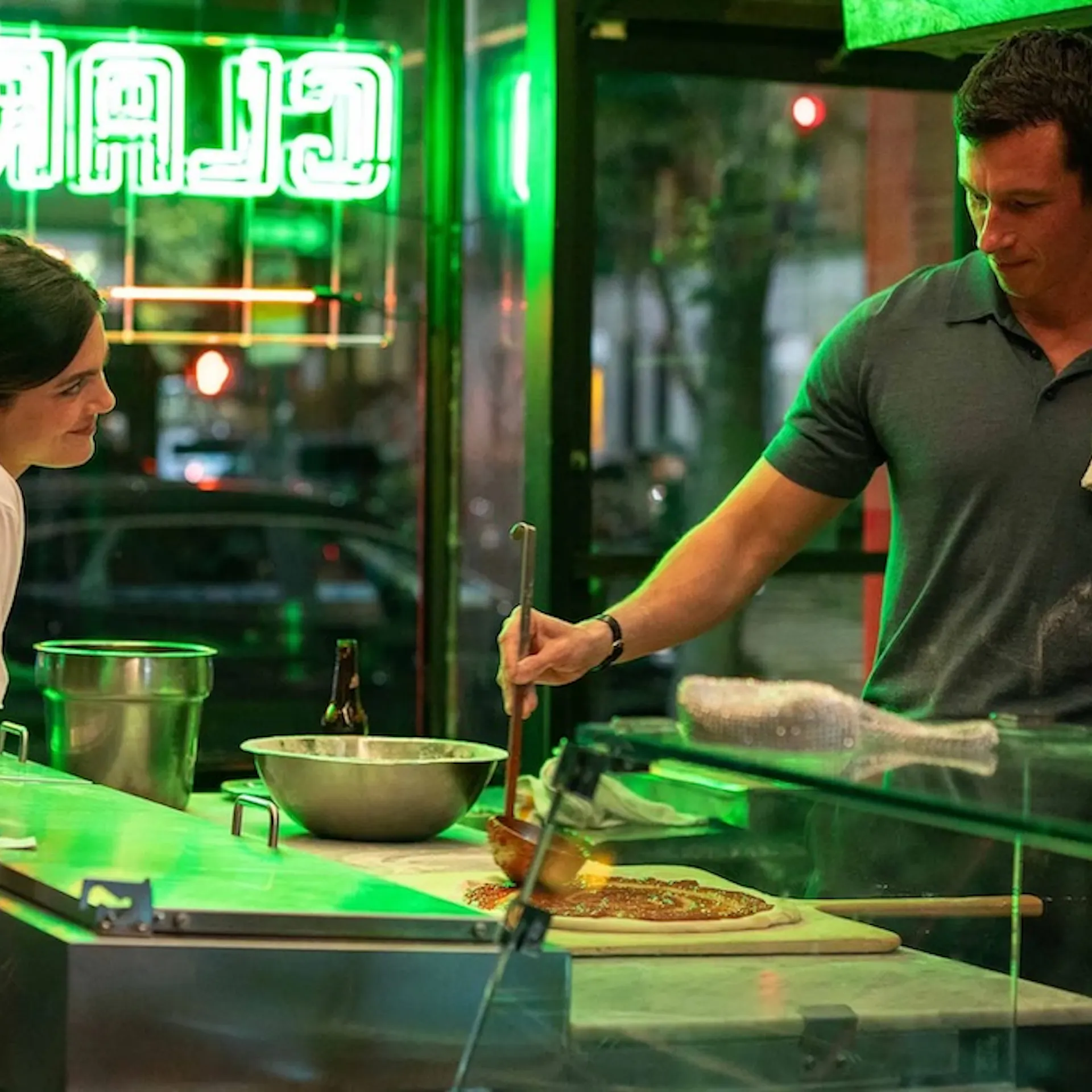
Less subtle, less interesting, and more pop-culture forward is the bizarre dystopia romcom “One Night Only,” which released in August to mass confusion. The bizarre premise either turned people off or turned them away. In a nightmare for libertarians, a putatively Republican government has banned premarital sex except for one 12-hour period every summer, a mandate it enforces through biometric branding. Set in New York City — because One Night in, say, Des Moines wouldn’t be nearly as multicultural or full of pizza and subways — the movie plays out as a kind of Logan’s Booty Call.
Apparently, the original cut of “One Night Only” contained a lot more sex, but Gen Z audiences rejected it. Yet I saw much more sex in this movie than I have in any other movie this year. Every scene and frame is full of people making out frantically in public and half-naked people orgiastically hanging out of windows. We even see Molly Ringwald and LeVar Burton doing kink in bubble wrap, which wasn’t something I had on my 2026 pop culture bingo card.
Even our gorgeous leads, Monica Barbaro and Callum Turner, obviously destined to be together, come very close to getting fully naked, and not with each other. Barbaro, wearing a green spangled dress that leaves nothing to the imagination, nearly gets laid twice, spoiled once by the fact that her hookup is an art thief, and later because another hookup is an arrogant rock star who falls off a piano. Turner himself has a series of near-misses. The movie goes out of its way to get his shirt off as often as possible.
Though the movie’s characters don’t seem to like the sex mandate, they also seem oddly resigned to it. Barbaro and Turner are softly apolitical. And in the end, they make the sweet, and ultimately conservative, choice to spend a year getting to know each other before hopping in the sack.
“Gail Daughtry and the Celebrity Sex Pass,” on the other hand, features an act of wanton infidelity as its inciting incident. Directed by David Wain and written by Wain and Ken Marino, this is the most lib-coded sex movie of the summer. It’s also the funniest. Zoey Deutch plays a perky Midwest hairdresser whose fiancé hooks up with Jennifer Aniston, the actual Jennifer Aniston, who’s in town to sign a cookbook that she wrote. This sends our heroine to Hollywood so she can take revenge by hooking up with Jon Hamm.
The premise is stupid, but the execution is stupider than you could possibly imagine, and contains more laughs per scene than any movie I’ve seen this year. “Gail Daughtry “uses its infidelity scaffolding as a way to make fun of action movies, and also to present a lightly parodic, mostly affectionate, and occasionally blood-soaked modern take on The Wizard of Oz. It’s not fantasy or wish fulfillment. It’s just dumb fun, like a rare improv performance that actually entertains.
“Tony,” the wonderful new Anthony Bourdain coming-of-age biopic from director Matt Johnson, acts as a surprising corrective to the Horny Young Man narrative that has dominated sex movies for so long. It’s a necessary one as well, given that we all know the tragic circumstances surrounding Bourdain’s death, and realize he probably could have benefited from some treatment for relentless pursuit of sexually charged romance.
Young Tony, played with accurate intensity by Dominic Sessa (“The Holdovers”), pursues a lovely Manic Pixie Dream Girl (Emilia Jones) to Cape Cod for the summer. Broke and delusional, Bourdain stumbles into working in a kitchen run by Antonio Banderas. His coworker, Leo Woodall, is a drug addict, a bad boy whom women find irresistible. He collects door notches as signs of sexual conquest, and he has no problem banging a bride out back of the restaurant on her wedding night.
Woodall’s behavior is appealing in a down-and-out kind of way, but the movie doesn’t glamorize it either or portray it as a lifestyle worth pursuing. When Bourdain finally finds himself in a position to make it with the girl of his dreams, he instead breaks down and reveals an uncomfortable truth about himself. In the end, honesty and respect are more important qualities than bedpost-notching. It’s a surprisingly conservative conclusion to come to for a movie about a bohemian liberal icon. But it wrapped up the summer of the conservative sex movie in a nice little bow of integrity.
***
Neal Pollack, “the greatest living American writer,” is the author of 12 semi-bestselling books of fiction and nonfiction and is a three-time “Jeopardy!” champion.
This article is part of Upstream, The Daily Wire’s new home for culture and lifestyle. Real human insight and human stories — from our featured writers to you.


.png)
.png)