If you’ve spent any time on social media in the past decade, you’ve seen posts about Iran before the Islamic Revolution.
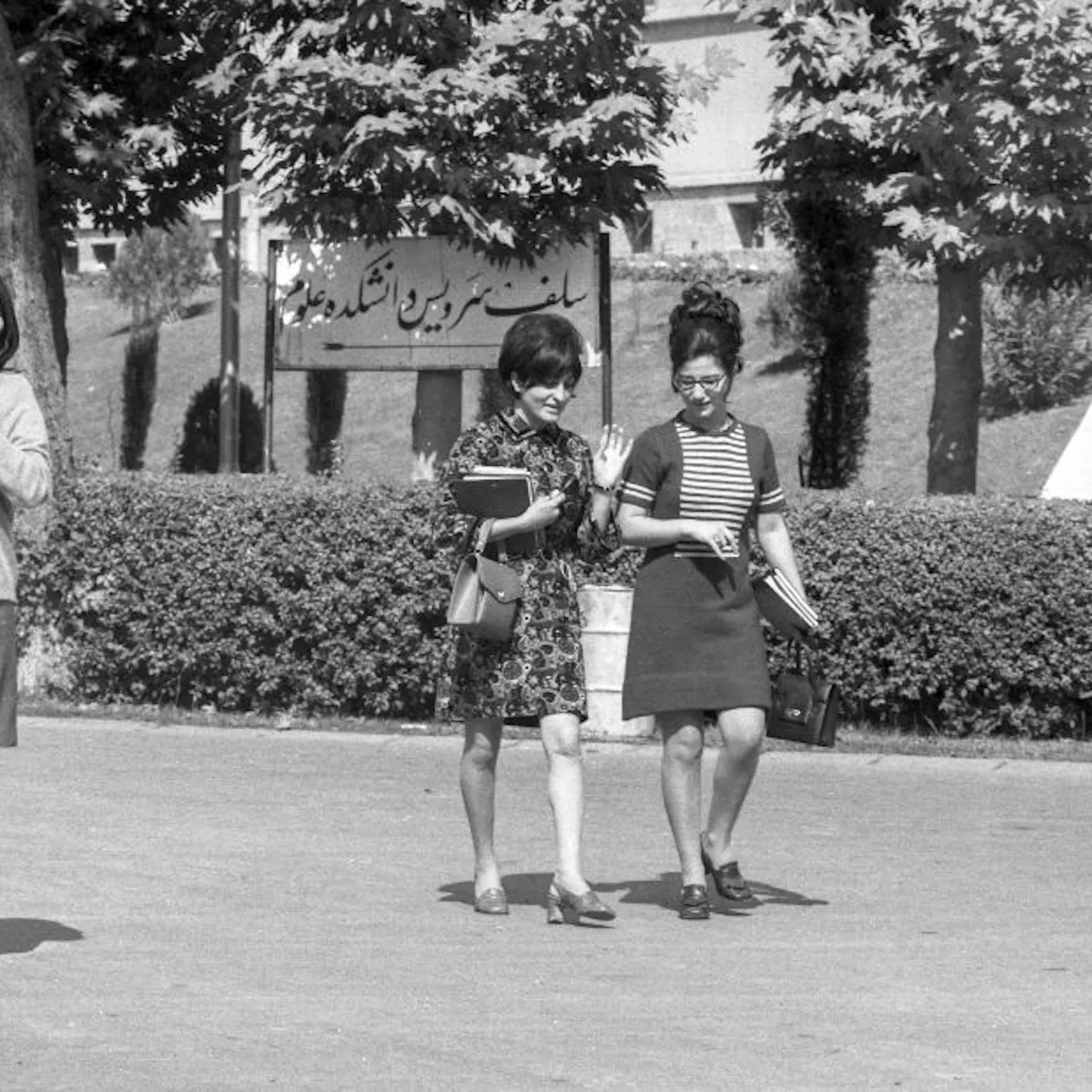
The posts are usually just that — the phrase “Iran before the Islamic Revolution” above photos of mod women in miniskirts and sunglasses carrying books and Western records or rollerskating down the streets of Tehran. The photos offer a stark contrast, of course, to the dour and veiled faces we now associate with the Islamic Republic.
This type of post reached a fever pitch at the onset of the current Iran war, back when it was still proximally a people’s revolution and hope remained for a return to pre-revolutionary Iran. But the war dragged on, and the internet, being what it is, turned the posts into a joke. If today you see the phrase “Iran before the Islamic Revolution,” it’s almost certainly going to accompany a picture of the cast of The Sopranos or Ryan Gosling.
Iran before the 1979 revolution. 💔 pic.twitter.com/8e9Zk8vaTc
— Flappr (@flapprdotnet) March 4, 2026
Iran before the Islamic Revolution pic.twitter.com/8dY7qcas1W
— Pericles (@PerryALPHA) June 28, 2022
A friend asked me recently if I’d ever seen pictures of Iran before the Islamic Revolution; I laughed to myself, the phrase immediately conjuring an image of the Kardashian sisters. “One day people will be posting like that about Tysons Corner,” my friend said, referencing the affluent Northern Virginia suburb that has become increasingly populated by traditional Muslims.
I think my friend was kidding, but his quip really stuck with me. Not because I think that an Islamic takeover of the United States is imminent (I don’t) nor because I think Muslims are ruining Tysons Corner (they may be, but there’s still a great mall).
Still, my friend’s comment made me really stop and take stock of how radical Islam has crept into our society. I thought I appreciated the severity of the problem, but I realize now I’ve been too optimistic. And I’m not the only one.
There’s a lot of space between regime change and cultural defeat. The latter is much more common and considerably less noisy, which is why it so often goes unnoticed until too much has changed.
It’s popular among a certain sort to point out that Islam has always been a fact of American life — Thomas Jefferson owned a Koran, don’t you know — but that’s not really true. Before 9/11, Islam was only tangentially relevant in American life. As recently as 1993, the journalist Robert Kaplan was still using the term “Moslems,” which feels like “Boer” or “Hottentot” or something else we left in the 19th century.
But on September 11, 2001, Islam and America collided, and the former has been on a speedrun in our country ever since.
It’s fascinating but not entirely surprising that an Islamic terror attack on the United States somehow led to the rapid mainstreaming of radical Islam in this country. Countries tend to import bits of former enemies’ cultures, like how we all drive Hondas and the Japanese love baseball. But the acceptance of even the most vile and un-American forms of Islam was hastened by the liberal obsession with fighting “Islamophobia” during the War on Terror, an arguably good intention that paved the road down which folks like Abdul El-Sayed now trod.
Our problem is not a lack of awareness necessarily — consumers of conservative media at least are familiar with things like the footwashing station in the Dallas-Fort Worth airport and the semi-autonomous Muslim town in Texas. The problem is that even those of us paying attention don’t appreciate how quickly we got here.
As we approach the 25th anniversary of 9/11, consider the scandal that rocked the 10th: the planned construction of an Islamic community center blocks away from the site of the terrorist attack. Dubbed the “Ground Zero Mosque,” the project was almost universally derided. Howard Dean said the project was “a real affront to people who lost their lives” on 9/11, while then-Senate Majority Leader Harry Reid called for the builders to pick a different site.
It’s hard to imagine Democrats reacting that way now, and that’s a problem. But even in 2011, things had gotten away from us. Reid and Dean broke with President Barack Obama, who defended the project. Obama may not be a secret Kenyan Muslim, but he sure did his best to make criticizing Islam socially unacceptable.
Michel Houellebecq’s 2015 novel “Submission,” which imagines an Islamist party taking over France, was controversial because it was largely misunderstood. Critics accused Houellebecq of Islamophobia, of saying that a country governed by Muslims was some kind of dystopia.
That’s not the point of the book. The point is how the takeover happens — slowly at first, then all at once — and how no one wants to fight back. To torture an analogy, Houellebecq’s protagonists are like frogs being slowly boiled alive who simply decide the water’s nice and decide to kick back.
The rise of Abdul El-Sayed and other Hamas-loving, America-hating radical Muslim leftists has shaken us out of a similar amphibian stupor. But what comes next will depend entirely on how serious we are about this threat. Will we get serious about what we want this country to be, and the threat posed by certain ideologies? Or will we let the moment pass, ease back into the status quo, and one day find ourselves reminiscing about how good we used to have it?


.png)
.png)