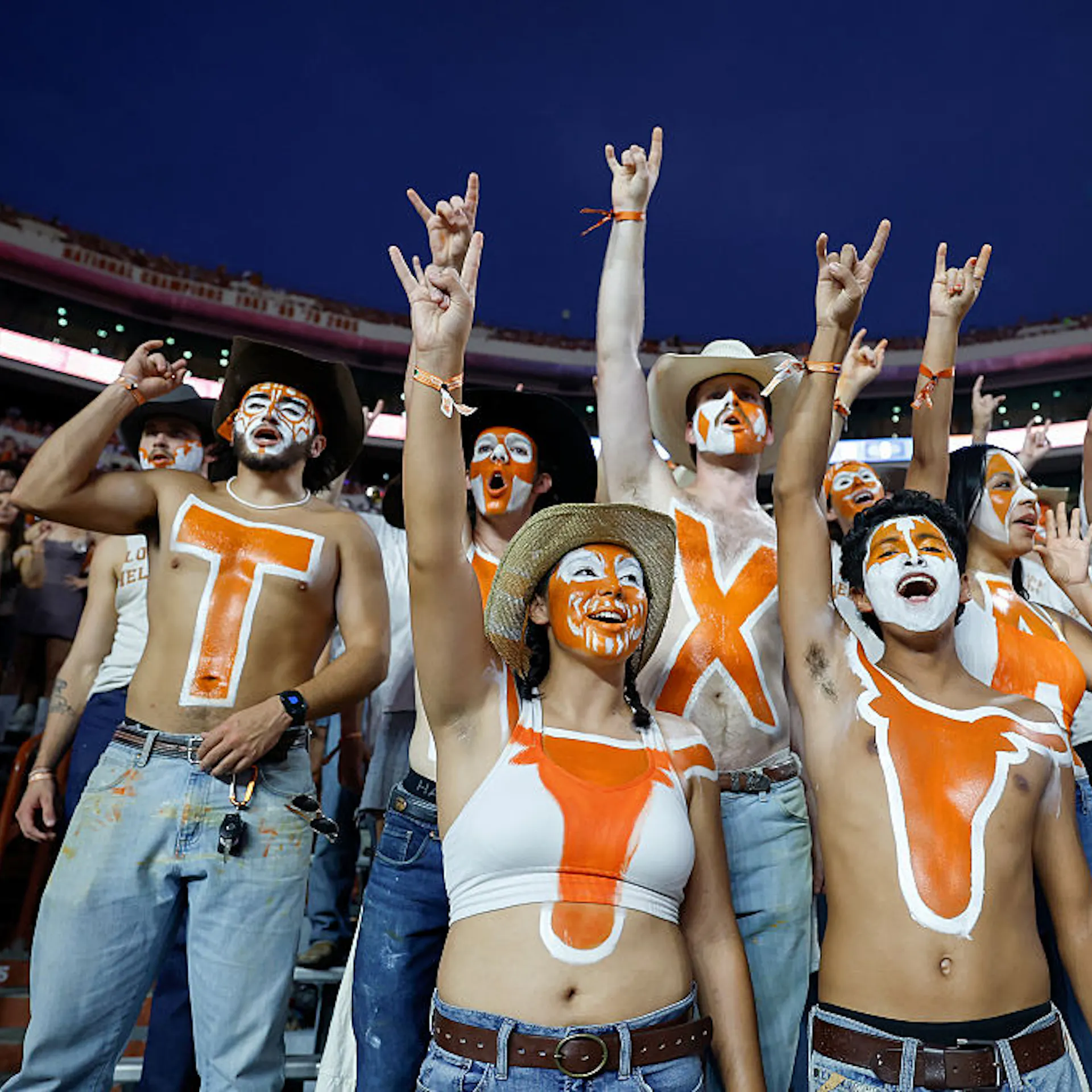

On Saturday, September 12, the University of Texas completed a twenty-point fourth-quarter comeback against Ohio State. A few seconds of the celebration appeared on the Longhorns’ social media account: students in orange celebrating and tossing the “Hook ’em Horns” sign into the air after Texas scored in the final minute. Bo French, the Republican nominee for Texas Railroad Commissioner, posted a screenshot of students of Indian descent and wrote, “The problem is now obviously far worse than anyone imagined.” He later described the picture as evidence that Americans were being “displaced by foreigners.” French had no way of knowing their citizenship, but their skin color was enough for him to call them outsiders. Two of the students pictured identified themselves as American citizens.
Senator John Cornyn called on Republicans to condemn French’s “intolerance and racism.” Texas House Speaker Dustin Burrows wrote that conservatives can oppose immigration policies without demeaning people because of their race. State Representative Lacey Hull said she “saw Texans” in the photo, and that French should delete his post. French and his defenders have doubled down, claiming that the “establishment” conservatives criticizing his comments are bowing down to the far Left.
The controversy has laid bare a question beneath the immigration debate: is race a barrier to becoming an American?
American nationalism was civic, voluntary, and universal in aspiration, if not always in practice. Being American means holding dear the principles of individual liberty, equality before the law, constitutional government, and republican self-rule. Civic nationalism is the only framework that can sustain a diverse republic. A nation can restrict immigration and still promote the idea that citizenship and assimilation confer equal membership on a newcomer. The debate over immigration has no connection to singling out non-white students at a football game as “foreigners.”
Civic nationalism asks newcomers to accept responsibility for the country they now share. Much of that responsibility is learned through institutions rather than abstract principles. Football is one of them: people acquire loyalties to a school, a team, or a city by showing up, sharing rituals and passing them on. Immigrants do this when they build institutions of their own. Catholics built parish schools and charities; Jewish congregations organized lay boards and federations; Hindu Americans incorporated temples as nonprofits, established schools and organized acts of charity. Faith remains distinct, but their institutions operate according to American customs of voluntary association and self-government. Assimilation is not erasure. It means translating one’s culture into the civic framework of the country one has joined.
The Anglo-American culture newcomers assimilate into is itself a composite. In “Albion’s Seed,” David Hackett Fischer traces regional traditions that crossed the Atlantic: Puritans to Massachusetts, Quakers to the Delaware Valley, Royalists and indentured servants to Virginia and British border peoples to Appalachia. They shared a language and British legal traditions, but differed over religion, social rank, and the meaning of freedom. Later immigrants, Fischer argues, adopted the customs of the regions where they settled while retaining their own ethnic identities. He encountered the combination among his own Brandeis students, including “backslapping Texas Jews in cowboy boots and ten-gallon hats.” As Fischer puts it, “in a cultural sense most Americans are Albion’s seed, no matter who their own forebears may have been.”
Today’s far-right nativists claim to defend American identity, but they’re importing the European blood-and-soil politics that America has rejected. When they speak of “heritage Americans” defined by ancestry, they’re channeling the Know-Nothings of the 1850s and the immigration restrictionists of the 1920s. An 1854 Know-Nothing document required members to support only native-born officeholders and exclude Roman Catholics. For the nativists, naturalization could not overcome a foreign birthplace, and American birth could not overcome being Catholic.
A May 1, 1939, Life profile of Joe DiMaggio praised the Yankees player’s adaptation to American habits: “He never reeks of garlic and prefers chicken chow mein to spaghetti.” The article assured the American public that the Italian-American player was Americanized, with his preference for chow mein as reassuring evidence. Much of what we recognize as ordinary American life was once seen as a failure of assimilation. Today an Italian surname or a dish of spaghetti hardly needs a defense. Later generations have little reason to remember how fiercely their ancestors’ membership was disputed.
A nation demands extraordinary commitments from total strangers. Citizens pay taxes for people they will never meet, obey laws written by people they did not elect, and defend the rights of people they vehemently disagree with. A passport alone cannot produce that kind of allegiance. It has to be learned in families, schools, churches, neighborhoods, and other institutions that teach people to regard strangers as members of the same political community. Every generation has to shoulder and renew this responsibility.
That kind of civic formation is harder in an age of extraordinary personal autonomy and isolation. You can work from home, order food from an app, watch movies alone, argue about immigration, and develop beliefs about places without meeting the people who live there. Politics becomes entertainment. The fewer occasions we have to encounter fellow citizens directly, the easier it becomes to view them only in political categories: immigrants, activists, socialists, “heritage Americans.” The technology that creates unfettered autonomy also leaves us dependent on intermediaries to explain our country.
Members of Congress have become some of those intermediaries. Having worked in the House and Senate, I’m painfully aware of how little control an individual member has over the legislative process. Speaker Mike Johnson holds one of Washington’s most powerful offices, yet he spends an astonishing amount of time managing rival power centers whose members can reach voters and donors without his help. A member who cannot move legislation can still create a hearing-room confrontation or fire off an inflammatory post that reaches millions of people.
That dysfunction matters most on issues where public anger is genuine, and Congress has repeatedly failed. Immigration is one of them. The Bipartisan Policy Center examined 309 bipartisan immigration-related bill introductions from 2015 through 2024 and found that fewer than one in 20 were actually passed. The issue remains unresolved, voters remain angry, and politicians are rewarded for demonstrating the intensity of that anger rather than for resolving it. They can announce radical solutions, denounce enemies, and demand action without producing legislation that would force them to compromise. In that environment, immigration becomes valuable political content. French is running for an office that regulates Texas’s oil and gas industry, yet a racially charged post about college football made him nationally famous.
Many on the Right have argued that liberalism weakened inherited institutions and left people free but unmoored. That is exactly why one should care about institutions that still give young people a sense of belonging. The students in the UT celebration video were sharing in a football tradition. They stood in line in the Texas heat. They wore cowboy hats and the university’s colors and celebrated victory like generations who came before them. What could be more American than that? French asked Texans to look at people celebrating alongside them and decide, from their faces alone, which fellow fans they should regard as Americans. Nothing in the photograph suggests a refusal to assimilate. He created the accusation by judging their skin color.
This is an extraordinary position for people who complain that Americans no longer share a common culture. They dismiss the traditions that do exist because those traditions include people they consider outsiders. The country needs institutions capable of bringing people together, yet even when those institutions succeed, the nativist wants to reject the result. He may gain an online following by persuading Americans to distrust their friends and neighbors, but he does so at the expense of the culture he claims to defend. The racial divisions he encourages make national cohesion harder.
“Americans were not born free and democratic in any modern sense; they became so,” Gordon Wood wrote in “The Radicalism of the American Revolution.” He places the destruction of inherited rank at the center of America’s transformation. Because we lack a hereditary ruling class, the obligation to treat citizens equally belongs to the descendant of the Mayflower Compact as much as to the newcomer.
Yet the nativist seeks to resurrect inherited rank. They claim a permanent right to judge: learn our language, respect our institutions, share our loyalties, but never suppose that doing so gives you an equal claim to the country. Follow that premise to its unstated conclusion. The Gulf’s kafala system makes the migrant worker forever dependent on a native sponsor, and Malaysia’s Bumiputera system gives preferential standing to a native population. They illustrate the political destination of permanent guesthood: the creation of an unbridgeable caste system.
Assimilation demands work from everyone. Newcomers must learn American history, embrace constitutional principles, and participate in civic life. But a nation that demands this commitment must teach it — and fully embrace those who fulfill it.
Citizenship cannot be a ceremony followed by permanent probation, with suspicion passed on to American-born children. Americans should not have to prove they belong because someone questions the color of their skin. To claim a hereditary privilege above one’s fellow citizens is anti-American.
***
Anang Mittal is a Washington, D.C. based public affairs professional. He was a staffer for Speaker Mike Johnson and former Senate Majority Leader Mitch McConnell.
.png)
.png)

