
 Matt Walsh
Hot on the heels of the Boston Globe’s viral exposé on the lesbian bar in Massachusetts that descended into chaos over a COVID mask mandate in the year 2026, WIRED Magazine has just published its own contender for “most entertaining news article of the year.”
It’s a genre that is really heating up lately, even though the formula is actually pretty simple. All you have to do is document the day-to-day activities of Leftists who are attempting to navigate life on this Earth, and hilarity inevitably ensues.
For reasons that are not entirely clear, Left-wing outlets like the Boston Globe and WIRED Magazine are the ones publishing these stories — probably because their desperation for clicks outweighs any political considerations. It’s a brutal industry, so if you have to make fun of your own side, I guess that’s a step they’re willing to take.
Whatever the case, here’s the headline that WIRED Magazine has graced us with. Behold, what could be the single greatest news headline of the year: “They Fled Trump’s America. Now They Regret It.” Followed by, “The internet told them Europe was a social paradise. Turns out the trains are awful, the health care isn’t free, and people can be really mean.”
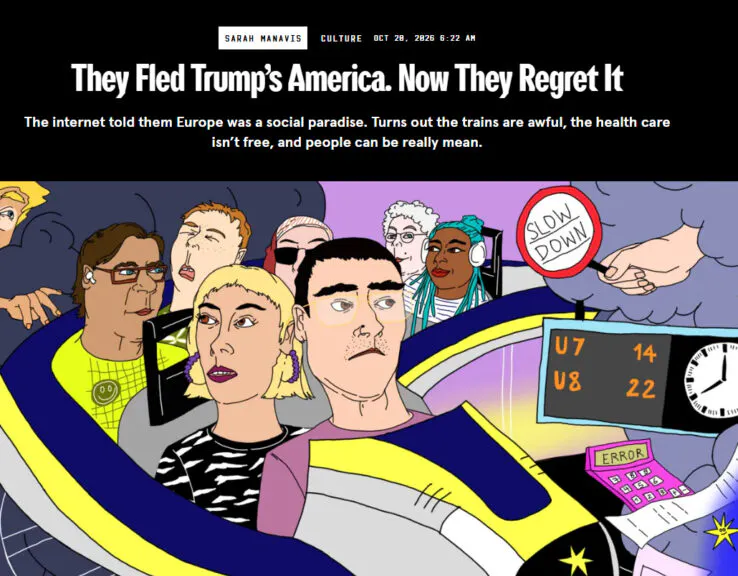
Image courtesy of WIRED Magazine
Yes, you heard that correctly. People actually fled the United States because Donald Trump was elected president. It wasn’t just a handful of celebrities who bought timeshares in Greece or something. This was not a fake TikTok phenomenon. Real, everyday Americans actually left the United States when Kamala Harris lost the election.
By one estimate, in the first quarter of 2025 — when Trump took office for his second term — the number of U.S. migrants increased by 100% year-over-year. The UK saw more residency applications from the United States in early 2025 than it had ever recorded, since it first started keeping track in 2004. So there was a real (if statistically insignificant) exodus here, totalling thousands of people. Some Democrat voters actually went through with this.

And now, sort of like a child who realizes that Candy Land is actually a pretty horrible place (because a candy-only diet would actually kill you faster than eating nothing at all, for reasons that are beyond the scope of this writing), these Leftists are melting down in large numbers.
They haven’t been gone for very long, but they’re already making their way back to the United States, with their tails between their legs. Of course, we shouldn’t let these people come back. They effectively renounced their citizenship, and we should act accordingly. But according to WIRED Magazine, as of right now, many of these Leftists are planning a return to the United States. Here’s how the article begins:
In the autumn of 2024, Annie was ready for something new. She was living in the southern United States when her husband received an unexpected job offer that would move them to a town just outside London. They were in their twenties with no kids. “We wanted to take a risk,” she says. While researching their new destination on Reddit, TikTok, and Instagram, Annie found Americans eager to explain how enchanting life in the British suburbs could be — all the benefits of a small town, just a short train ride away from one of the biggest cities in the world. The more she read, the sunnier her expectations about the UK’s health care system, social culture, and European transportation systems became. They moved before the end of the year. But the reality of life in the UK was dramatically different to what she’d imagined. “There are huge misconceptions about access to quality health care, standard of living … the quality of life is significantly lower than in the US,” she says, citing the challenges she experienced with the National Health Service’s maternity care — having moved while pregnant with her first child — as well as the lack of disposable income in Britain, thanks to lower salaries. “Things in the UK that are considered luxury items are very common” in America, like a dishwasher and dryer, she adds. Annie says she experienced a high amount of anti-American sentiment straight away. “I found it particularly surprising how people feel so comfortable mocking my accent and culture, even in a workplace environment,” she says. “The UK is very much a place of ‘it is what it is,’ but as Americans we are taught to always improve and strive for better things.” Annie and her husband now have an exit plan for summer next year.
She mentions that a dishwasher and dryer are considered luxuries in the UK, which is true. Only around half of British households have a tumble dryer, while roughly two-thirds have a dishwasher — and they mostly go unused, because the owners can’t afford the electricity to run them very often. But the bigger luxury, by far, is air conditioning (or “air con” as they call it in the UK). I had to look up the statistics on this and double-check them, because it’s truly hard to believe. But in the UK, according to most surveys, only around 2% to 8% of homes have some form of air conditioning. Yes, 2% to 8%.
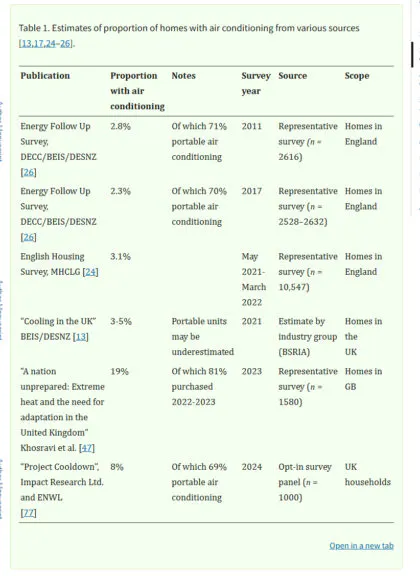
You can see the figures there, which are from a paper that was published by researchers at University College London earlier this year. So this data is up-to-date. They cite seven different surveys — and all of them show AC ownership between 2% and 8%, with one outlier at 19%.
This is despite the fact that this past summer, half of all homes in Europe were exposed to extremely high temperatures. And by some estimates, more than a third of typical homes in the UK are prone to overheating. This is from an article published in Politico earlier this year:
Cash-strapped Europeans are struggling to keep their homes cool as the continent’s summers get hotter, a major new survey has found. More than 38 percent of the 27,000 respondents to a continent-wide poll published Wednesday said they couldn’t afford to keep their house cool enough in the summer. … while nearly 40 percent of well-off households invested in AC or fans, just over 20 percent of cash-strapped Europeans did the same. … Nearly half of renters said they were unable to afford to keep their home cool, compared to 29 percent of homeowners. … As a result, some 60 percent of tenants said they had felt too hot at home at least once over the past five years, versus just over 40 percent of owners.
This is a level of poverty truly foreign to most Americans. And if you listen to how they talk about air conditioning on the BBC, it’s like stepping into another dimension. There’s a lot of denial. There’s a lot of commiserating. And a lot of the conversation, frankly, is very bizarre:
Yes, we Americans are “addicted to really cold indoor spaces in the summer.” That’s an actual sentence that was uttered in that BBC clip. For whatever reason, Americans have this bizarre obsession with not sweating profusely (or suffering heat strokes) during the summer. It’s really hard to explain, but that’s just the way we are.
Other things Americans are “addicted to” include running water, having money in our bank accounts, and being able to see the doctor without waiting 50 months for an appointment. Maybe one day we’ll break the habit, and become just like Europe, where everyone’s too poor to be addicted to anything except, I guess, alcohol and perpetual resentment.
By the way, the other amusing thing about that clip is that it’s filmed inside an air-conditioned studio. So they’re sitting there and telling everyone that the UK is “addicted” to air conditioning, as a way of making these poor Europeans feel better about their lot in life. They want to make air conditioning seem like some bizarre luxury that serves no purpose. And meanwhile, the BBC is definitely paying to cool that studio in the summer. You see, if you’re wealthy, or you work for the government, you get AC. But if you’re poor, you’re told that, if you want AC, then you probably suffer from some kind of mental illness.
Actually, towards the end of this segment — which went on for around 20 minutes for some reason — some reality did begin to creep in, when they realized how utterly pathetic their status quo really is.
Of all those heat-related deaths, believe it or not, Europe accounts for a significant percentage of the total — more than 175,000 people. The United Nations reports that “A staggering 175,000 people die from heat-related causes every year in Europe.” So a huge number of people are dying in Europe every year because of heat-related causes — far more than the United States, which barely has any of these deaths. And yet these people are lecturing us about being “addicted to cold.” It’s impossible to parody.
To put this in context, vastly more Europeans die from heat-related causes in a typical year than Americans die from all gun-related causes put together. Less than 50,000 Americans die because of guns every year. Meanwhile, Europe is losing 175,000 to heat. So for all their pontificating about “gun violence” and “school shootings,” they’re losing far more people to warm weather. It’s staggering.
These are not abstract figures. The stories coming out of Europe are truly disturbing. On Monday we discussed how France is rioting because no one can afford anything. But if anything, I undersold how terrible the living conditions are. This is from an article in the Guardian this summer:
Living in a sweltering, seventh-floor flat on a concrete housing estate south of Paris, Samira said she was feeling desperate as France experienced its highest temperatures on record this week. “Yesterday I sat down and cried, I thought I’m going to die,” said the 35-year-old single parent and former building caretaker. Her flat in Ris-Orangis in Essonne is, like millions of apartments in France, poorly insulated and lacking in outside window shutters.
And of course, her apartment is lacking in air conditioning as well. This is just how these people live, day after day. It’s not a choice. All of them would prefer to have air conditioning. But they can’t afford it. There are very few jobs — and the jobs that do exist simply don’t pay anywhere near what they do in the United States. To give just one example, the national median pay for a nurse in the United States is $97,000 gross. In France, it converts to around $40,000. So you take a massive pay cut in terms of your salary.
Meanwhile, residential electricity costs are much higher in France — 65% higher than low-cost states like Texas or Louisiana. Gas prices are much higher too — around double what you’d pay at the pump in the U.S. There are a lot of reasons for this discrepancy — taxes and energy policy are the big ones — but the point is, they simply can’t afford to power AC units, so they don’t buy them.
This is what life is like in Europe, to the horror of the people who spoke to WIRED Magazine for the article. But let’s continue with the piece, because it keeps getting better:
Sarah Wood González, a journalist and consultant, recently returned to New York after three years in Spain and Edinburgh. She says she had few expectations of her life in Scotland and wasn’t glossy-eyed about Europe but was “surprised and delighted” by how “educated and intellectually curious” everyone was. However, when it came to work, she found the slowness to be a drawback.“Something I had taken for granted is the American outgoingness and default to action, where the question is ‘how can we collaborate?’” she explains. “Generally speaking, I also found that the American work style, for better or for worse, moves much faster and can get to a yes or no in less time.” This was a similar reality for Josh, another American immigrant who asked to remain completely anonymous, citing concerns about backlash. He moved to Berlin in 2023, in part anticipating what might happen at the 2024 election. … He had even lived in Germany before, spoke German, and had friends in Berlin. But his expectations, particularly when it came to his career, didn’t align with reality. “Finding work was so hard, and the endless bureaucracy had grown worse since I’d left,” he tells WIRED. “I missed the friendlier people, freedom of speech, and ease of daily life” in the US. … “I thought that ‘British politeness’ existed as it does in movies,” Annie says, “but unfortunately, the reality is that present-day British culture is very individualistic, as well as without the sense of charity and helpfulness that many parts of American culture value.” She says she had negative experiences with the NHS maternal care, compared to the smooth experience of her private health insurance in the US, and didn’t expect it to cost her anything: “I pay huge amounts of taxes and an immigration surcharge to access the NHS services—so no, the health care is not free here.” She also expected train travel to be low cost, based on what she’d read about Europe (despite the extortionate train prices and terrible service quality being one of the biggest political conversations in the UK).
What’s especially funny about this passage is that, in all likelihood, this woman was reading about Europe’s cool trains in WIRED Magazine. Back in 2020, WIRED published an article claiming that “Europe is ushering in a new golden era of train travel.” The article claimed that “2020 will be the year that we fall in love with train travel again,” and stated, “Train fever is gripping the country [of Sweden].” The article also claimed that the train craze would soon “spread across Europe” and that it would be “increasingly easy to book rail tickets across borders — a key barrier for many travellers.” WIRED concluded by comparing train travel to flying on a plane, and declared, “train travel is a clear winner.”
Fast forward six years, and now WIRED is publishing articles about these Left-wing Americans who got the idea that train travel would be viable in Europe. Where could they have possibly gotten that idea? It’s a mystery. We’ll never know the answer.
Meanwhile, all of these poor saps who were conned into moving to Europe — by outlets like WIRED — are desperately trying to undo their mistake. They’re realizing why, in European countries, it takes something like 13 months to approve construction on every new factory — and to be clear, that’s not construction time; it’s time to approve construction. In the United States, it takes around 80 days. We are simply a much better-run, more motivated, and more competent country. No country in Europe can compare.
This is why, whenever you go online and try to say any of this, you get dogpiled by unemployed Europeans who spend all day on Reddit. This is again from the WIRED article:
On subreddits dedicated to these kinds of discussions, like r/expats, r/GoingToSpain, r/AmericanExpatsUK, r/AmerExit, you can now find a number of stories about difficulties building a new community, trouble finding work, icier cultural norms compared to the open friendliness of America, and sometimes a higher-than-expected European cost of living. Many posts now feature people asking for a new kind of advice: Is it okay for me to miss, or even to want to move, back home? These posts are usually met with a huge amount of backlash. Commenters are quick to imply that the poster must be right-wing and privileged. … Ironically, many times, they parrot the right-wing notion that they probably aren’t trying hard enough to assimilate into their new country. When one person recently said they badly missed their community of friends in a “blue city in a blue state” and were considering moving back, the majority of top comments agreed the user was “insane.”
I went looking for this thread on Reddit and, sure enough, it’s exactly the cesspool that WIRED described.
Here’s a sampling of the replies this guy received, simply for asking if he should move back to the United States:
Sadly, it really depends on how well you score on the ‘family guy’ color chart card test.
Honestly, right now with Trump and everything, yes that is insane.
Yes. You are insane.
Yes that is insane to move willingly into a budding fascist dictatorship.
There’s a handful of people who tried to offer a more nuanced take, but in general, this is what you get on Reddit. People are looking for ways to rationalize their disastrous decision to live in Europe, so they’ll berate anyone who even suggests moving back to the United States. You’ll also see tons of posts where these Europeans will say something like “salary isn’t everything,” as a way of arguing that their allegedly “free healthcare” (and other perks) make up for it. But the thing is, the salaries in Europe are so low, and the taxes are so high, that actually it’s not even a close call.
There’s actually a statistic called “Household Net Adjusted Disposable Income” that measures this. It looks at your household income after taxes, adjusted for cost of living, and adds in the cash value of things like “free healthcare.” Even under this metric — with the UK getting full cash credit for their healthcare — the typical American citizen has around 50% more purchasing power than someone living in Britain. That’s why, if the UK were a state, it would rank dead last in the country in terms of living standards. By the way, the healthcare in the UK is obviously much worse than our healthcare in the United States — it’s slower, the doctors are less competent, there are fewer doctors and diagnostic machines, etc. So they’re paying more — much more — for less.
So no matter how you slice it, Europe is a catastrophe of a continent. So you have to ask: what kind of person would delude himself into thinking otherwise? The WIRED article concludes on this note, with an anecdote about a guy named Nick. This paragraph belongs in a museum:
What is happening in the US is also happening everywhere now, to the point I’m even a little hesitant in what I say to you, or anywhere online,” says Nick, an art director from New York who relocated to Poland in part because of right-wing populism in the US. He moved with his Polish wife to Krakow, where they have a young child, but despite these personal ties has found it difficult to adjust to the culture and bureaucracy. Now Nick feels trapped in Europe where he says the politics aren’t much better — conceding that Poland both politically and culturally has strong right-wing popularity. … As of a few months ago, Josh is back living in the US, where he says he feels happier, and finally “accepted and at home.” In retrospect, he wonders if he got caught up in the frenzy of discourse when he chose to leave in the first place. “Once I was in Germany and had some distance from the situation in the US,” he says, “I felt perhaps I had overreacted.”
So the art director is trying to escape right-wing politics, and he ends up in … Poland. This is like moving to Seattle because you don’t like rain. Did he board the wrong plane somehow, like the kid from Home Alone? How does this happen? Unfortunately, the article doesn’t explain. And that’s too bad, because we really need a feature-length documentary about this guy’s life. We need to study his decision-making process in great detail, so that future generations can learn to do the exact opposite of everything he’s ever done. But we’ll probably never get this documentary, because as of right now, he’s trapped in Poland — presumably without air conditioning, electricity, or running water.
But at least Nick (and Josh, the other guy they mention) appear to have realized that they “overreacted” by uprooting their lives (and their families) to flee to a foreign country, simply because Donald Trump was elected president. That’s something, at least. And indeed, that’s the message that WIRED is clearly sending with this article. They’re doing something that almost no Left-wing outlet ever does, which is to expose the hysteria and the paranoia on the Left, and the ridiculous results that this paranoia often causes.
As you’d expect, WIRED’s subscribers (who actually pay money for this content) were not happy with the article. They were frothing at the mouth — sort of like New York Times readers, whenever James Rosen publishes an op-ed exposing the truth about Watergate. Here’s the top comment on the WIRED article, to give you an idea. It’s from an American living in Italy who wanted to provide a counter-example to demonstrate that things are actually going great over there. Here’s what he says. Again, this is the most-upvoted comment on the article, from WIRED’s left-wing audience:
Two years plus in Italy here. From Southern California. Best decision ever. I rarely find Americans wanting to return to the US. This article seems to focus on jobs and work. Jobs are hard to come by in Italy, so I can imagine it would be hard if you were moving here and looking for work. I do not fall into that category.
It really is art. “Everything’s great here — as long as you don’t focus on jobs and work, which I don’t have to do, because I got wealthy in America before I even came here.” What a riveting endorsement of life in Europe. They have no jobs or air conditioning, but if you’re an American who’s independently wealthy, you can have a lot of fun living like a full-time tourist. And isn’t that what matters?
I saw a conversation along these lines that I’ll close with, from a lawyer named Alison Somin. Here’s what she wrote on X:
I worry that tourism/ travel serves people ill here. Yes, it’s good to go to Paris or London and see civilizational masterpieces. On the other hand, Americans staying in Europe often stay in the most beautiful and richest section of a city, eating in lovely restaurants and living a life that’s not at all representative of how even relatively well-off Europeans actually live. Seeing how actual middle class people live abroad was eye opening for me.
This is an important point, because it’s extremely easy for Americans to fall into this trap. They might go on a vacation or study abroad or whatever, and never see what the reality of life in these European hellholes is really like. A professor named Tim Hamilton responded to Somin with the following:
Yes, that’s like visiting my wife’s family in Romania. Her dad’s an engineer, and they live in an apartment with a tiny portable washing machine that has to be hooked up to the sink. No A/C, no dryer, although they’re in a dry climate so a “drying room” works.
Somin then recounted her experience in Europe more than two decades ago:
Did a Dartmouth study abroad program in France in spring 2002. My host family’s father had a good job in something involving computer engineering; mom stayed at home with their then three young kids. The washing machine and dryer they had was shockingly primitive, such that I wound up basically hanging up most of my clothes to dry. They also had difficulty affording proteins like fresh meats or fish, such that I dropped from 5’0/about 100 lbs to about 85 by the end of the semester. Very different standard of living/experience than what I was expecting.
This is an overwhelmingly common sentiment for Americans who have actually spent a significant amount of time in Europe. The upshot is that you could probably change the political views of millions of Americans if you exposed them to the living standards that these people are dealing with overseas.
Right now in America, there’s a major political party that campaigns on the idea that more government spending is the solution to our problems. Meanwhile, all over Europe, countries that spend all of their money on social services — countries like France — are falling apart. They’re descending into riots. They have the highest amount of government spending on social services of any country in the world, and it’s still not enough for them.
Even if you’re not a political person, and even if you despise the Republican Party, you have a moral obligation to vote against this ideology in two weeks. It simply cannot spread any further.
The world needs at least one country where people can still afford to heat their homes and turn on the dryer every now and then. And as everyone knows — even the editors of WIRED Magazine — a vote for the party of “Abdul El Sayed” and “Ilhan Omar” is a vote to bring America down to Europe’s level.
It’s a vote to turn everyday essentials — the things we all take for granted — into luxuries. And if there’s a cause for optimism here, it’s that no matter how much you support the Democrat Party, the moment you spend any real amount of time in Europe, or even do any amount of research into what’s going on there, you will agree with every word I just said.
The entire continent is a shining example of “what not to do.” All we have to do, regardless of our politics, is pay attention to it.



