
This is republished with permission from the author. The original, “The DSA’s big city takeover,” at The Intersection can be found here.
***
The Democratic Socialists of America’s victories in congressional primaries feel seismic because they come on the heels of a string of major victories in big cities, including a DSA-backed candidate winning the Washington, D.C. mayoral primary, a DSA candidate making it to the runoff in Los Angeles, and Zohran Mamdani’s victory in New York City. By the end of the year, the mayoralty of the country’s three largest cities may be in the hands of hard-left progressives.
If you’re thinking this is a workers’ revolution — not quite yet. Support for these candidates came from wealthier, better-educated — and whiter — precincts. Even the race the DSA was not supposed to win, Darializa Avila Chevalier’s win against Adriano Espaillat, came in a Harlem-based precinct that’s seen a lot of gentrification in its Manhattan-based parts. Meanwhile, moderate Ritchie Torres saw no real challenge in a South Bronx district that’s still the poorest in the nation.
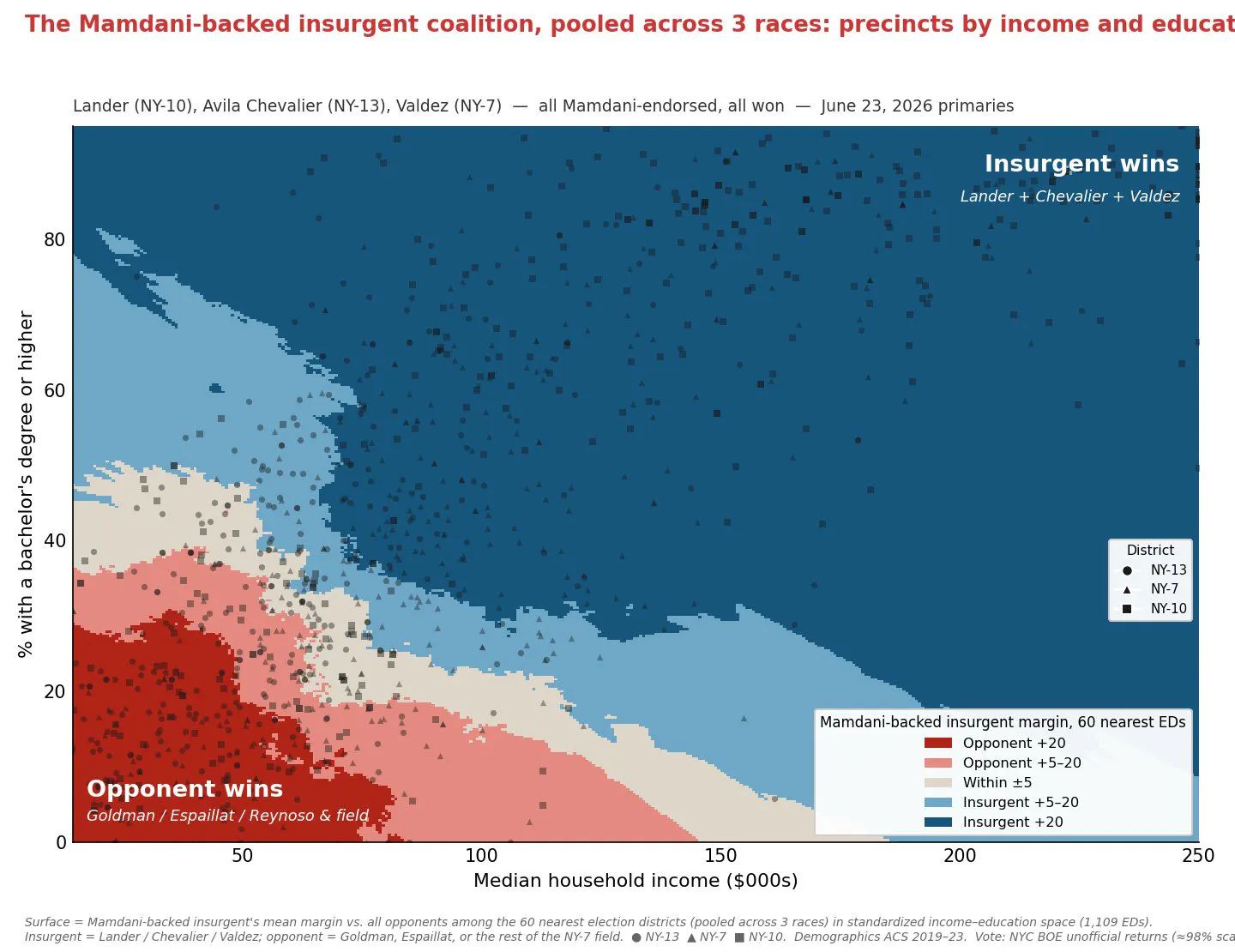
Credit: Patrick Ruffini
Another area where you did not see a comparable DSA effort was the actually-wealthy 12th district, where Upper West Side liberal Micah Lasher prevailed. According to figures compiled by Kyle Tharp, the results here were inversely proportional to the fame (as measured by social media followings) of each candidate:
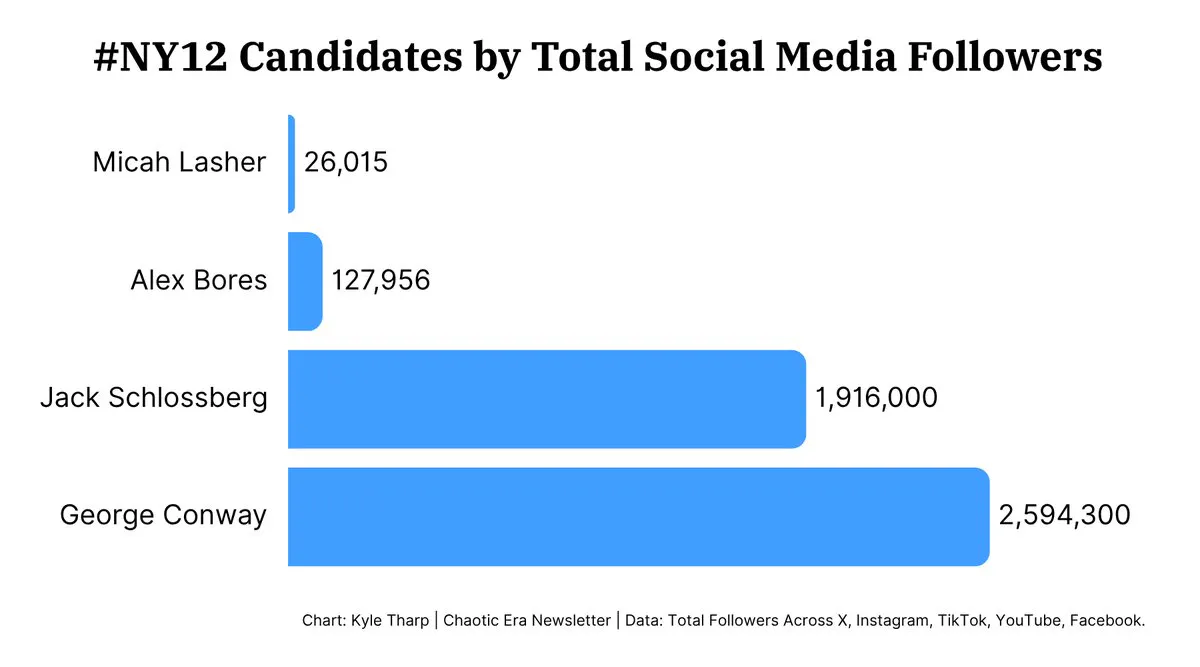
Credit: Patrick Ruffini
The sweet spot for socialism is downwardly mobile, highly educated young voters — the junior copy editor living in a studio apartment whose parents were corporate lawyers living in the suburbs. And largely missing from the party are the urban working class, who are dwindling in number.
Play this out, and it’s to see mainstream Democrats hanging on in cities anywhere, at least those that are magnets for college-educated young people. The actually rich voters, like those in the 12th, are limited in number, while the working class is increasingly priced out of their old neighborhoods and is moving to the suburbs. Who else is left? Basically, the DSA’s target voter.
Charles Franklin also breaks down DSA favorability: 20-48 nationally, but 40-20 among Democrats. But it’s not limited to big cities: all sorts of Democrats, including those who live in rural areas, view the DSA favorably.
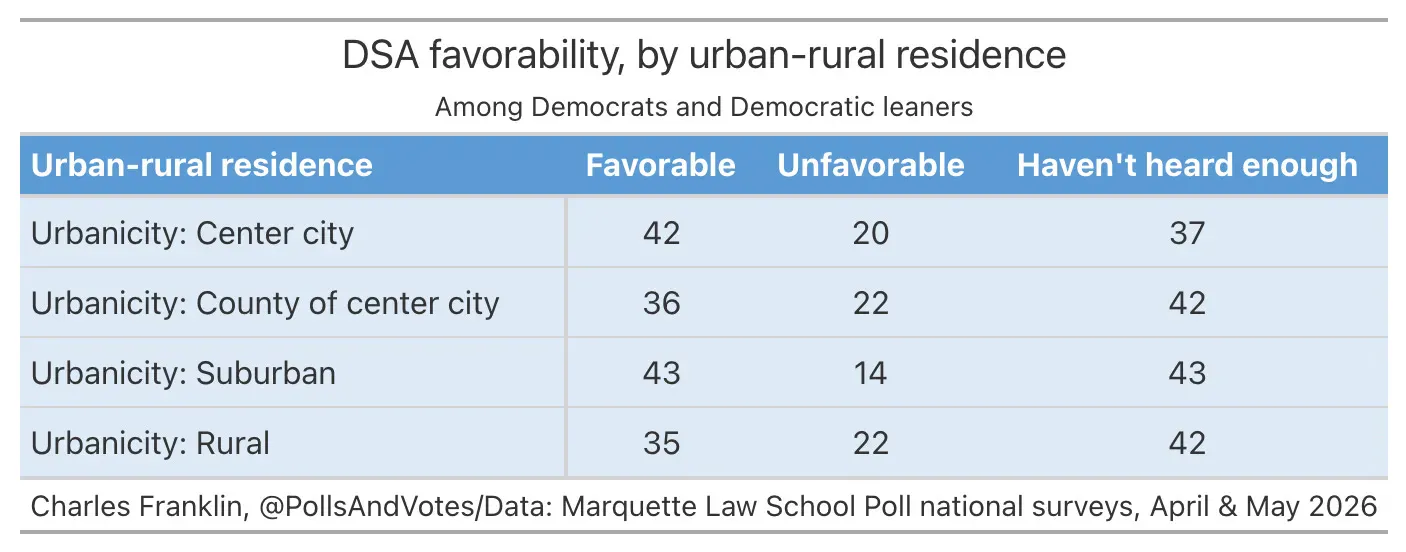
Credit: Patrick Ruffini
Could far-left politics go national in 2028? The Michigan Senate primary will be a big test of this, as I wrote on Wednesday. You also saw a progressive win in a Trump district, Maine’s 2nd, where it would have behooved Democrats to nominate a more mainstream alternative. Substantively, most Democratic primary voters appear to want socialism.
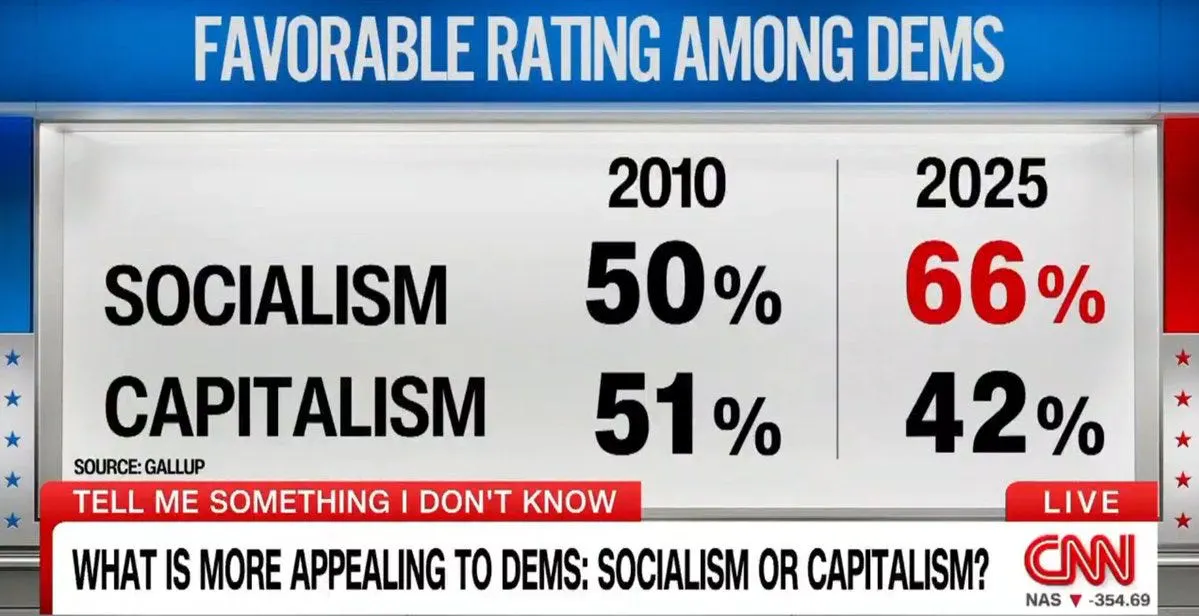
Credit: Patrick Ruffini
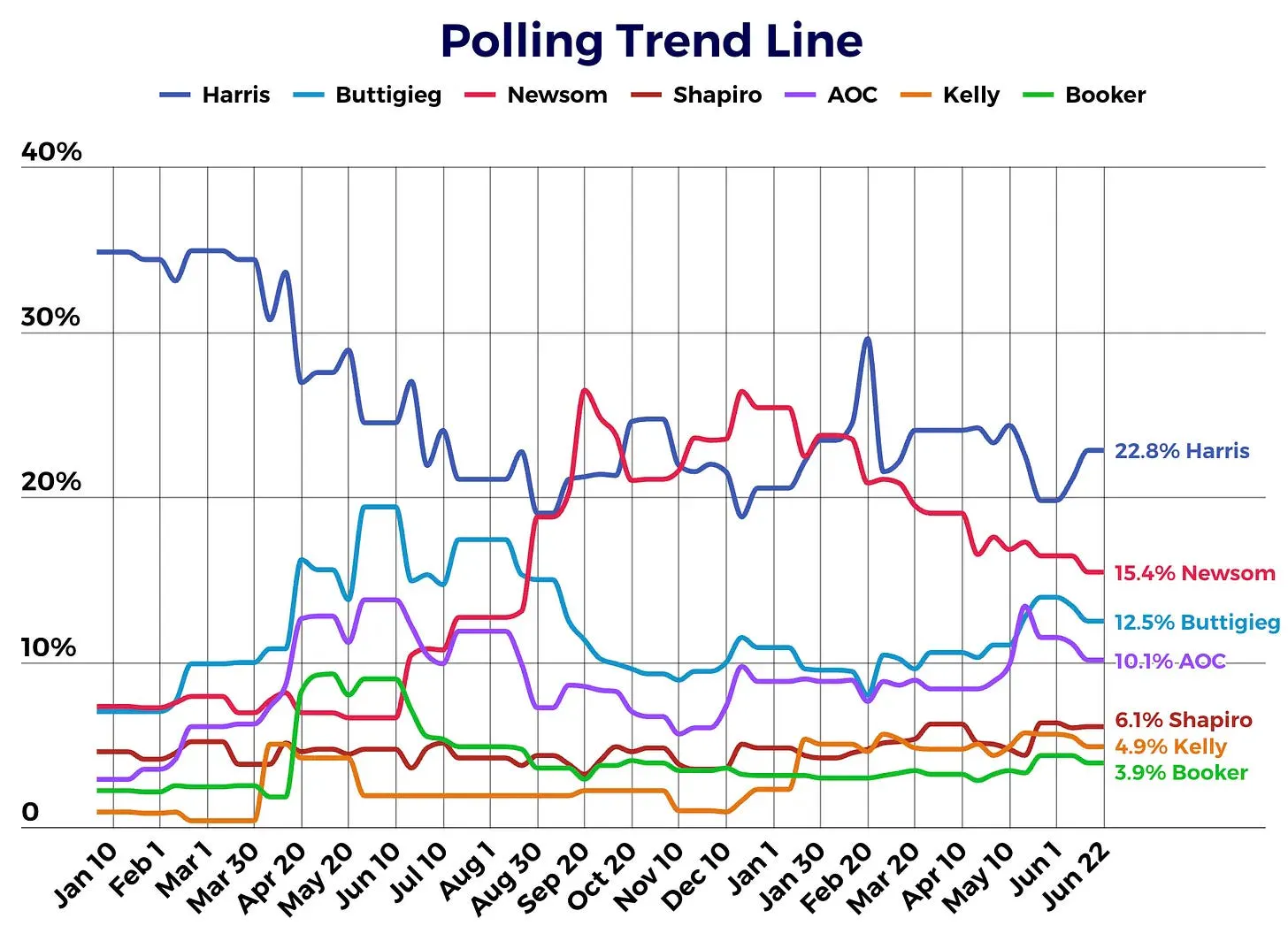
Meanwhile, normie liberals like Gavin Newsom appear to be walking a tighter line. Once surging in polls and prediction markets, he has since fallen back. His comeback strategy? Tethering himself to Joe Biden and an unpopular Democratic establishment. He’s also tried to negotiate with the unions to get a state billionaire tax off California’s ballot this fall. As it’s become apparent it’ll be a hard sell for this primary electorate, he’s come out for a national tax.
Credit: Patrick Ruffini
One Democrat who does seem to be making a name for himself is Jon Ossoff, whose viral rally clips have catapulted him to the top of the 2028 buzz. But something about it feels off-key, writes Kyle Tharp, a perfectly stage-managed 2012 production out of place in 2028:
To play devil’s advocate, however, the problem with this strategy is that the Perfectly-Optimized, Almost-Robotic Ossoff hasn’t proven he can turn the switch off. He almost never seems like he’s speaking off the cuff, and he rarely displays any casual human banter on camera. Like Martin noted, he “speaks in paragraphs,” and every clip seemingly lands because his team engineered it to land, which is exactly the issue. When a politician’s best moments all arrive pre-planned, voters and the reporters covering them will start to wonder what he sounds like when the advance team isn’t carefully picking the camera angle. Eventually, people will get bored.
Democrats seem to care about ~authenticity~ far more in 2026 than they did during the Obama years or even when Ossoff was first elected. The politicians often breaking through in the second Trump era do so, in part, by seeming unfiltered. Trump joked and rambled for hours on Rogan, Flagrant, and Bussin’ with the Boys and his supporters loved him more for it. Zohran Mamdani built a following on selfie-cam monologues and creator collabs, many of which look like he filmed them between subway stops. Gavin Newsom is hosting his own hour-long podcast every week, and AOC has long been the master of the art of informal Instagram live streams. Younger Democrats may now spend their time watching people like Hasan Piker reacting live for six hours straight, and older Democrats are watching candidates shoot the shit with Tim Miller on the Bulwark (When Ossoff recently appeared with Miller, he seemed like The Bulwark host was giving him a root canal).
That’s a perfect example of the “Joe Rogan CEO” test from a16z highlighted in Nathan Brand’s must-read media newsletter. Are you authentic and interesting enough to spend three hours shooting the breeze with Rogan? Kamala wasn’t — and probably knew it. Which 2028 Democrats will be?
***
Patrick Ruffini is a pollster at Echelon Insights, author of PARTY OF THE PEOPLE, and creator of The Intersection newsletter.
.png)
.png)