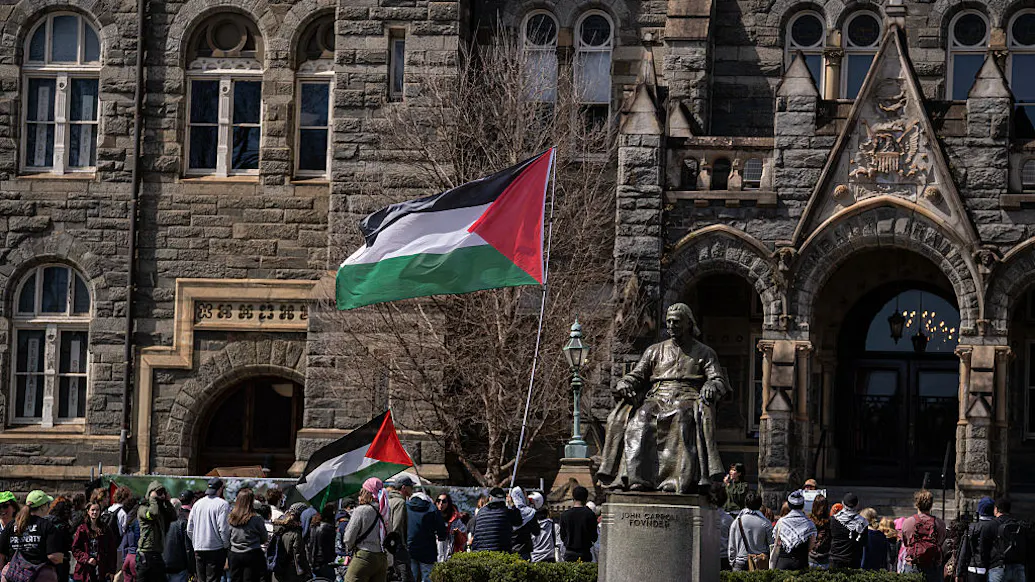
For years, Qatar’s billions flowed into some of America’s most prestigious universities. Now, a new report argues the Islamic monarchy gained more than a foothold in American higher education in return, turning elite academic institutions into vehicles for Islamist propaganda.
Qatar used “complex contractual designs” with Northwestern University and Georgetown University to gain influence and borrow the universities’ prestige to advance “Islamist movements hostile to the United States and its allies,” according to a new report by the Jewish Institute for National Security of America (JINSA).
The findings add to growing concerns about Qatari influence in American higher education. Despite having just over 350,000 citizens, Qatar has spent more than $8.8 billion between 2001 and 2021 on U.S. educational institutions. It is the largest foreign donor to U.S. universities, according to the Foundation for Defense of Democracies.
JINSA’s Hussein Aboubakr Mansour, drawing on the House Committee on Education and the Workforce’s 900 pages of contractual and institutional documentation on Qatari funding, said complex contractual designs approved by the university’s senior leadership allowed Qatar to acquire access to “intellectual property, governance deliberation, academic credentialing, and institutional reputation.” The funding structures enabled Qatar to acquire such partnerships to advance its national security interests, according to Mansour.
Mansour argues that Qatar’s Islamist agenda is reflected in its longstanding support for the Muslim Brotherhood and Hamas, including hosting their leaders, providing financial backing, and amplifying their messaging through the state-funded Al Jazeera network.
While Qatar is a key U.S. partner that hosts the Al-Udeid Air Base and often acts as a regional mediator, critics contend it has also cultivated relationships with Islamist movements. In 2024, Georgetown University’s Qatar was exposed for hosting speakers linked to Hamas and the Popular Front for the Liberation of Palestine (PFLP), both designated terrorist organizations by the United States.
While the contracts between Qatar and the American universities are not illegal, they bind “intellectual output of American academic institutions, including output generated with American taxpayer funding, to the development strategy of a foreign state,” Mansour said.
Mansour argues that Qatar masks its involvement through the Qatar Foundation for Education, Science, and Community Development, which presents itself as an educational nonprofit but functions as an extension of the Qatari state. The organization is headed by Sheikha Moza bint Nasser, the mother of the reigning Emir of Qatar, Sheikh Tamim bin Hamad Al Thani, and senior leadership is “drawn from the ruling family and its institutional extensions.”
The agreements establish joint advisory boards at both universities made up of university representatives and Qatar Foundation appointees. These boards review budgets, curriculum offerings, faculty and staff development, and reviews and comments on dean candidates.
While the agreements describe the boards as “advisory and non-binding,” Mansour argues that their lack of formal authority actually insulates Qatari influence from accountability.
“A body with decisional power could be held accountable for the decisions it makes, such as a blocked hire, a rejected curriculum, or a vetoed budget item,” Mansour said. “An advisory body that merely consults, reviews, and comments leaves no such record, but the effect is the same.”
University officials, he argues, understand who funds the campuses and that Qatar Foundation can terminate the partnerships, creating pressure to accommodate Qatari priorities.
The report also notes that the agreements establish admissions targets under which a majority of students at the Qatar campuses are expected to be Qatari citizens. Georgetown’s agreement sets a target of 60% Qatari nationals, while Northwestern’s sets a target of 70%.
Both Georgetown and Northwestern operate branch campuses in Doha, Qatar, where students can study abroad or earn full degrees. Mansour argues that Georgetown’s agreement requires most intellectual property created at the Doha campus to be jointly owned with Qatar Foundation and commercialized in ways that promote Qatar’s “knowledge-based economy.”
The report further argues that Qatar Foundation can acquire ownership interests or broad licensing rights even in certain research involving U.S. federal funding, raising questions about whether taxpayer-funded research could ultimately benefit a foreign state.
Mansour’s report highlights a 2024 agreement under which Qatar’s Ministry of Foreign Affairs provided Georgetown University’s Bridge Initiative with $630,000 to support research and conferences focused on Islamophobia.
According to Mansour, the funding allowed Qatar to shape conversations on a politically charged topic while cloaking those efforts in the credibility of a U.S. university.
“A state that does not permit its own citizens the civil liberties it funds an American university to advocate for in America is not engaged in human rights philanthropy,” Mansour said. “It is purchasing the institutional vocabulary and academic prestige of American civil rights and deploying them in service of a political category that aligns with its foreign policy objectives.”
Mansour argues that “Islamophobia” has increasingly been used not as a neutral academic concept but as a political tool to discourage criticism of Islamist movements and governments aligned with Qatar.
The report also points to a long-running partnership between Northwestern University’s Qatar campus and Al Jazeera Media Network, the state-funded media organization that has long been accused by critics of advancing Qatari foreign policy interests. According to Mansour, a 2013 memorandum of understanding between Northwestern and Al Jazeera established cooperation on research projects, journalism and media studies programs, scholarships and training for students, employment pathways for graduates into the Al Jazeera network, executive training for Al Jazeera leadership, and jointly organized conferences and workshops.
In 2020, the Justice Department concluded that AJ+, Al Jazeera’s U.S.-based affiliate, operates “at the direction and control” of the Qatari government and ordered it to register as a foreign agent under the Foreign Agents Registration Act, an order the network has not complied with. The department also cited Al Jazeera’s editorial guidelines as evidence that the outlet sought to influence public attitudes about the Middle East, including by discouraging the use of terms such as “terrorist” and “terrorism” in its reporting.
Critics argue the partnership is particularly troubling given Al Jazeera’s history of favorable coverage toward Islamist movements, including Hamas. The Foundation for Defense of Democracies has also pointed to documents recovered in Gaza that Israeli officials say showed coordination between Al Jazeera and Hamas on media messaging.
Along with Northwestern and Georgetown, Qatar has reportedly sought to influence colleges such as Harvard, Texas A&M, Cornell, Carnegie Mellon, and Virginia Commonwealth through billions in funding.
Blake Schaper contributed to this report.
.png)
.png)