An elite Pennsylvania liberal arts college agreed to sweeping changes after a lawsuit said the school allowed its campus to become a hotbed for radicalism, with open glorification of the terrorist group Hamas and antisemitic harassment by students.
Haverford College has settled with a group of Jewish students who sued the school in federal court in 2024. The students accused administrators of failing to protect them from discrimination and harassment because they were Jewish.
The lawsuit detailed a campus environment where Hamas-supporting rhetoric became increasingly intertwined with hostility toward Jewish students. Masked protesters disrupted events, activists favorably shared images of Hamas paragliders during the October 7 attack, and a professor called for support for the “Palestinian resistance” just days after the attack.
Under the agreement, Haverford will explicitly state that Jewish, Israeli, and Zionist students are welcome on campus and that discrimination and harassment targeting them violates college policy and can result in disciplinary action.
(The Deborah Project)
The settlement also requires Haverford to establish a new Civil Rights Director to handle antisemitism complaints, create an Antisemitism Committee, require annual antisemitism training for students and employees, and provide equal security for events sponsored by Jewish, Israeli, or Zionist groups. It will require masked individuals to identify themselves to campus officials when circumstances warrant it.
The students were represented by The Deborah Project, a nonprofit legal organization that represents Jewish students and faculty facing antisemitism in education.
According to the lawsuit, Jewish students faced hostility in classrooms, student forums, campus events, and even extracurricular activities, while administrators repeatedly failed to intervene or treated complaints as matters for students to resolve themselves. The campus environment became so hostile that administrators were warned that Jewish students felt physically threatened as Hamas-supporting rhetoric continued.
During an encampment in April 2024, one Jewish student wrote to the Haverford President Wendy Raymond that protesters were using bullhorns to chant from the Hamas Charter and accuse Israel of genocide.
“As a Jew I experience this conduct exactly as these people intend for me to experience it: as grossly demeaning, insulting and, most important, physically threatening. Glorying in Hamas’s conduct, and insisting that Israel do nothing to stop Hamas from doing it again, can’t be anything other than a threat to Jews,” the student wrote.
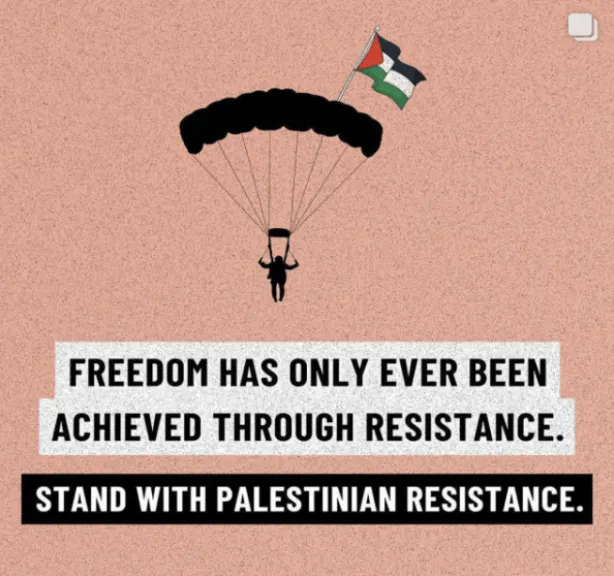
The lawsuit says one image circulated among Haverford students immediately after October 7 that featured a paraglider alongside the words “Stand with Palestinian resistance.” Hamas terrorists had used paragliders to infiltrate Israel for its massacre of Israeli civilians.
The complaint says the image was circulated as part of a series of posts that Jewish students viewed as celebrating or justifying the Hamas attack.
Haverford math professor Tarik Aougab also came under scrutiny for his social media activity following the attack.
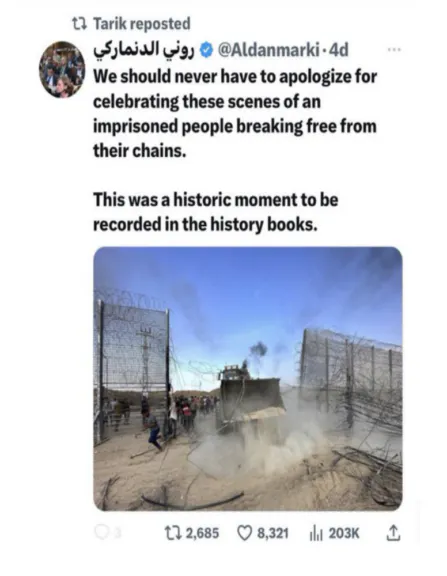
According to the lawsuit, Aougab publicly praised the October 7 atrocities on October 11, calling for “unequivocal and firm support for the Palestinian resistance” and reposting a message stating that defenders of Hamas’ attack “should never have to apologize for celebrating the scenes of an imprisoned people breaking free from their chains.”
(The Deborah Project)
Aougab later attacked Haverford students who supported Israel, calling them “racist genocidaires,” and announced that he would not provide recommendations for students seeking to study in Israel, according to the complaint.
When Jewish students asked Raymond about Aougab reposting a photograph of a bulldozer breaking through the barrier between Gaza and Israel at the beginning of the Hamas attack, the lawsuit says Raymond responded that the post “could be perceived in many ways.”
When pressed on how she perceived it, Raymond said she “heard people breaking free from their chains.” She also allegedly described some of the Gazans who crossed into Israel through the destroyed fence on October 7 as “peaceful.”
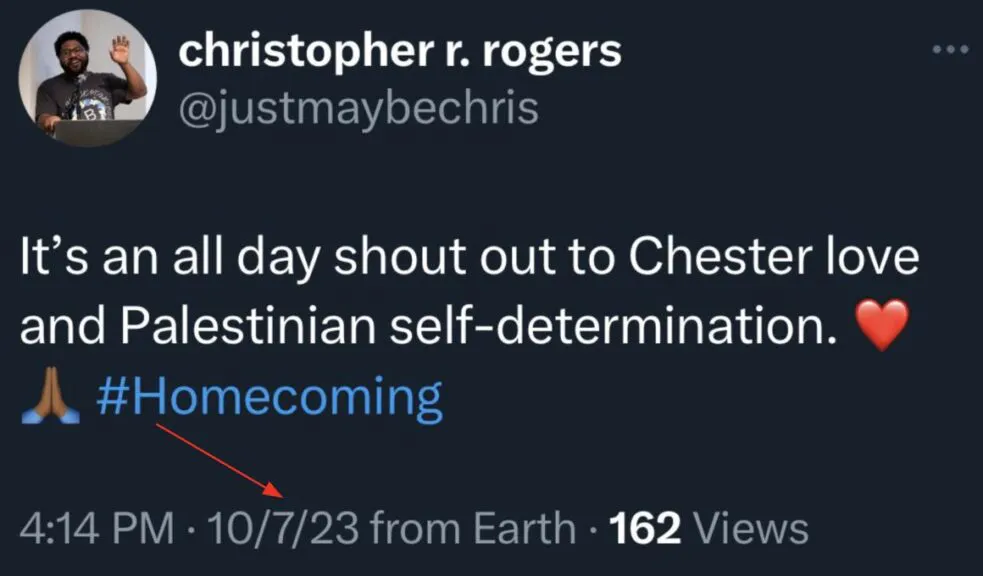
In spring 2024, Haverford hired Christopher R. Rogers as a visiting professor, despite him also publicly praising Hamas’ attack. Rogers reposted a tweet on October 7 featuring bulldozers breaking into Israel with the caption “beautiful sights to wake up to this morning.” He himself posted, “It’s an all day shout out to Chester love and Palestinian self-determination” during the attack.
(The Deborah Project)
Rogers is wearing a keffiyeh in his official photograph on the Haverford website.
The plaintiffs said that, to their knowledge, Haverford did not investigate or discipline professors over their social media posts supporting October 7. By contrast, they point out that Jewish-Israeli professor Richard Mendelsohn was investigated after criticizing a ceasefire petition and writing that its supporters appeared to ignore the “massacre, beheading, mutilation, and burning” of Israeli civilians by Hamas, before calling some of the petition’s supporters “Hamas apologists.” He posted that Haverford had a “Jewish problem,” that its student body was “led by Hamas apologists,” and that he would not send a Jewish student there.
The investigation found that Mendelsohn had not engaged in “discrimination or harassment,” but concluded that his conduct was “inconsistent with the College’s expectations of its faculty.”
The lawsuit also describes a September 30, 2024, antisemitism event featuring the Anti-Defamation League that was disrupted by masked protesters.
An alumna who witnessed the demonstration told Raymond that protesters gathered outside the event while shouting threatening slogans, carrying signs reading “No Zionists on campus,” and “shouting their support for the terrorist groups Hezbollah and Hamas.” Most of the demonstrators had their faces covered with masks, according to the alumna.
The protesters shouted “from Gaza to Lebanon Israel must be gone,” “Stand up fight back,” and “by whatever means necessary.” Inside the event, protesters banged on pots and shouted through a megaphone to disrupt the presentation.
The lawsuit says university president Raymond was physically present and witnessed the disruption but did not intervene or issue a statement after the event.
Raymond was later pressed about the incident during a May 7, 2025, congressional hearing. Rep. Randy Fine (R-FL) asked what would happen if a student walked across Haverford’s campus holding a sign reading “No Blacks on campus.”
Raymond said there would be “no room for discrimination,” prompting Fine to point out that students had held a “No Zionists on campus” sign at the September 30, 2024, protest where Raymond was present, without consequence.
“But there is room!” Fine told her. “Because at your campus, in front of you at a protest, students held up a sign saying ‘No Zionists on campus.’”
During Haverford’s spring 2024 anti-Israel encampment, which protesters declared a “Liberated Zone,” posters were present quoting Hamas to advocate for the destruction of the Jewish state, as well as chants of “long live the Intifadah,” according to the lawsuit.
The protesters occupied the center of campus for at least three days and blocked access to Founders’ Hall — a central building on campus. Students who did not express support for the protesters’ goals were allegedly shouted at and insulted.
Haverford also directed Jewish students to the student-run Honor Council to address complaints of antisemitism and harassment, despite allegations that some Honor Council members themselves allegedly participated in the attacks on Jewish students.
The lawsuit alleges that the Honor Code divided students into “marginalized” and “privileged” groups, resulting in different standards of treatment based on those labels. Anti-Israel students allegedly used that framework to portray Jews committed to Israel as inherently “privileged” and to bully or silence them.
In announcing the settlement, Raymond acknowledged that members of the Haverford community committed to Israel as the Jewish homeland had been “deeply hurt” by events following October 7.
“That constitutes a failure on our part,” Raymond said. “We commit ourselves to doing better going forward.”
The settlement has nevertheless drawn criticism from the Philadelphia chapter of the Council on American-Islamic Relations (CAIR), which argued that Haverford went too far by treating Zionism as a protected identity.
“Jewish students deserve protection from antisemitism, harassment, and discrimination. Palestinian students deserve those same protections,” said Dr. Ahmet Tekelioglu, executive director of CAIR-Philadelphia. “But no political ideology should be placed beyond criticism at an institution whose mission is supposed to center intellectual inquiry and the pursuit of truth.”
Tekelioglu argued that protecting Jewish students does not mean shielding Zionism from criticism.
“Protecting Jewish people is not the same as protecting Zionism from criticism,” he said. “A student’s Jewish identity is not a political ideology, and criticism of Zionism or advocacy for Palestinian rights should not be presumed to constitute hostility toward Jewish people.”
Texas and Florida moved to designate CAIR as a terrorist organization in 2025 under state law, but these designations are currently frozen or delayed due to active federal lawsuits.
.png)
.png)

